




Warren Buffett's Successor Has 61% of Berkshire's Portfolio in 5 Stocks. Here's My Top Pick for November.
Key Points
Berkshire Hathaway's portfolio of public stocks has a relatively high level of concentration.
Alphabet stock has been hit with a big pullback and looks like a worthwhile buy this month.
- Motley Fool Issues Rare "Total Conviction" Buy Alert ›
Warren Buffett was succeeded by Greg Abel as Berkshire Hathaway's (NYSE: BRKA)(NYSE: BRKB) CEO on Jan. 1, and to say that he has had big shoes to fill would be an understatement. Given that Warren Buffett is widely regarded as one of history's most successful investors, it's not surprising that he hasn't radically altered Berkshire's stock holdings in his relatively brief period as the company's leader -- but the investment conglomerate has made some notable trades.
Based on Berkshire's last public disclosure and current stock prices, just five stocks current account for roughly 61% of the company's total public stock holdings. The table breaks down Berkshire's five largest holdings by portfolio composition based on the investment conglomerate's most recent public filing and recent share prices for the stocks.
Missed AI’s "Act 1"? Act 2 Could Be 15x Bigger. Most investors think they missed the AI boat because they didn't buy Nvidia in 2005. But according to our analysts, we’re only at the end of "Act 1"—the R&D phase. "Act 2" is the global rollout. Continue »
| Company | Portfolio Percentage |
|---|---|
| Apple | 22.1% |
| American Express | 13.2% |
| Coca-Cola | 10.6% |
| Alphabet | 8.5% |
| Bank of America | 6.6% |
Data source: CNBC.
Of those stocks, I think Alphabet (NASDAQ: GOOGL)(NASDAQ: GOOG) stands out as the best stock to buy in November. Here's why.
Image source: The Motley Fool.
Alphabet stock has seen a big a sell-off
It's no secret that artificial intelligence (AI) stocks have been volatile lately. Percolating concerns about macroeconomic pressures and the economics of AI scaling and monetization were kicked into overdrive following big wins for the Democratic party in the recent U.S. midterm elections and expectations that the shift in congressional control and state executives could lead to more regulations on artificial intelligence.
Investors are worried that political wins for Democrats will curb the construction of data centers and put greater emphasis on establishing restrictions for frontier AI models. There's probably some truth to that, but I don't think it meaningfully derails Alphabet's long-term growth prospects.
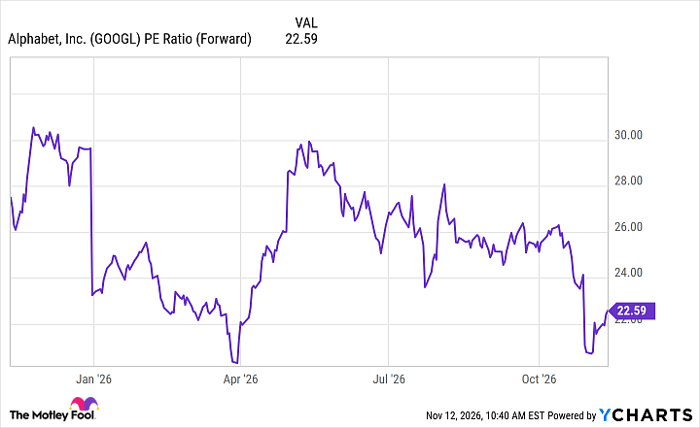
As of this writing, Alphabet stock trades down roughly 27% from its high. Meanwhile, the company is valued at roughly 22.5 times this year's expected earnings. While that's higher than the S&P 500 average of roughly 18, its valuation profile also has to be viewed in the context of its earnings momentum.
GOOGL PE Ratio (Forward) data by YCharts
Alphabet's revenue increased 25% year over year to $127.6 billion last quarter, and the business posted 30% year over year growth for its operating income and an operating income margin of 31.8%.
The third quarter saw the company's Google Cloud business grow its revenue 103% year over year to reach $30.7 billion. Some headwinds for the artificial intelligence market could lead to some growth deceleration, but I think there's a very good chance that the segment's revenue will continue expanding at a pace that's quite robust.
Additionally, the Google Services segment that houses the company's search and advertising businesses has continued to expand at a low-double digit clip -- with sales growing 11% year over year in the third quarter to reach $96.3 billion.
Alphabet has been Berkshire's biggest bet recently
Notably, Alphabet has also been the stock that Berkshire has been pushing most heavily into recently. That doesn't mean that it will wind up being the best performing out of the cohort, but it does carry at least some weight if you are looking to make investment moves that roughly mirror what the investment conglomerate is doing. The stock is now priced below the levels of its purchases in this year's first quarter and substantially below its purchase price in the second quarter.
Granted, there have been subsequent developments that introduced substantial volatility for the broader market and companies with heavy exposure to artificial intelligence trends. On the other hand, the stock looks attractively valued for long-term investors at current prices -- and investors can build a position that's meaningfully below the price that Berkshire made a big push into the stock in the second quarter.
Alphabet has very strong foundations in the tech industry and still has big room for growth over the long term. While the stock could continue to see volatility in conjunction with valuation trends in the AI space, I think it stands out as the best buy among Berkshire's top holdings so long as that possibility isn't disqualifying for you.
Should you buy stock in Alphabet right now?
Before you buy stock in Alphabet, consider this:
The Motley Fool Stock Advisor analyst team just identified what they believe are the 10 best stocks for investors to buy now… and Alphabet wasn’t one of them. The 10 stocks that made the cut could produce monster returns in the coming years.
Consider when Netflix made this list on December 17, 2004... if you invested $1,000 at the time of our recommendation, you’d have $335,171!* Or when Nvidia made this list on April 15, 2005... if you invested $1,000 at the time of our recommendation, you’d have $1,000,640!*
Now, it’s worth noting Stock Advisor’s total average return is 823% — a market-crushing outperformance compared to 208% for the S&P 500. Don't miss the latest top 10 list, available with Stock Advisor, and join an investing community built by individual investors for individual investors.
See the 10 stocks »
*Stock Advisor returns as of November 17, 2026.
Bank of America is an advertising partner of Motley Fool Money. American Express is an advertising partner of Motley Fool Money. Keith Noonan has no position in any of the stocks mentioned. The Motley Fool has positions in and recommends Alphabet, American Express, Apple, and Berkshire Hathaway. The Motley Fool has a disclosure policy.
Recommended Articles


