




Could Rivian's Model 3 Moment Be Coming? Tesla Stock Climbed 1,364% in 3 Years.
Key Points
After Tesla's Model 3 production breakthrough, the stock soared over 1,300% in three years.
The key wasn't only to produce more cars, it was to simultaneously produce each car with less inputs/labor.
Early signs for Rivian's R2 are positive, but it will have to earn its own production breakthrough.
- Motley Fool Issues Rare "Total Conviction" Buy Alert ›
Rivian Automotive (NASDAQ: RIVN) investors have plenty riding on the recently launched and highly anticipated R2, and selling more vehicles would certainly be welcome. But the bigger prize is what could happen when the company gets more efficient at building them.
Fortunately, we have precedent from a fellow electric vehicle (EV) maker. Tesla (NASDAQ: TSLA) offers a compelling example. Its Model 3 production breakthrough helped set the stage for a much more profitable business -- and shareholders enjoyed a roller-coaster stock price ride along the way.
Missed AI’s "Act 1"? Act 2 Could Be 15x Bigger. Most investors think they missed the AI boat because they didn't buy Nvidia in 2005. But according to our analysts, we’re only at the end of "Act 1"—the R&D phase. "Act 2" is the global rollout. Continue »
Could Rivian be approaching a similar turning point? There are encouraging signs, but the answer depends on more than customers wanting an R2. Let's dig in.
Rewind to Tesla's breakthrough
During the second quarter of 2018, Tesla's Model 3 gross margin turned slightly positive. Management credited lower labor hours, reduced ramp-up costs, better absorption of fixed costs, and lower material costs. Only one quarter later, Model 3 gross margin exceeded 20%, while labor hours per vehicle fell more than 30% sequentially. That happened even as Tesla shifted production toward more complex all-wheel-drive versions.
Tesla wasn't simply building more cars. It was using fewer labor hours to build each one. That doesn't necessarily mean its total labor hours declined, but it shows how a smoother production process can improve vehicle economics, requiring less labor time per vehicle.
Tesla's financial transformation quickly followed. Between the third quarter of 2018 and the third quarter of 2021, Tesla's company-wide operating margin increased from 6.1% to 14.6%. Between Sept. 28, 2018, and Sept. 30, 2021 -- the corresponding quarter-end trading dates -- its split-adjusted stock price climbed approximately 1,364%.
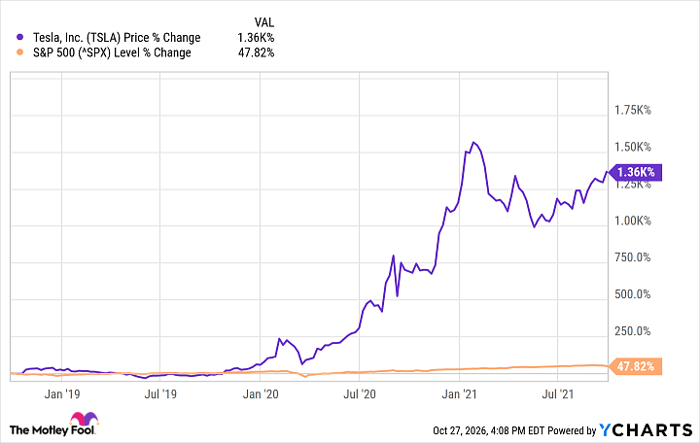
TSLA data by YCharts
Rivian shareholders would certainly take a helping of that, maybe even seconds. More importantly, Tesla's return reflected much more than one successful production ramp-up, and it certainly is not a forecast or prediction for Rivian. The useful lesson is how much the investment story can change when a promising vehicle becomes a profitable business.
Does Rivian have the demand?
Rivian will need ample demand to create its own Model 3 moment with its very own R2, and the early signals for R2 demand are encouraging. During its second-quarter earnings call, Rivian said reservation-to-order conversion for the roughly $58,000 R2 Launch Edition was meaningfully higher than management expected. It didn't disclose the conversion percentage, but that's a positive sign for the initial version before more affordable models of the R2 enter production.

Image source: Rivian.
Rivian subsequently delivered 19,248 vehicles across its lineup during the third quarter, increasing approximately 46% year over year and 58% sequentially. Production reached 19,751 vehicles, up approximately 57% from the second quarter. In other words, this R2 ramp-up is gathering momentum.
More importantly, management has identified the culprit behind less-than-perfect production. At September's Morgan Stanley conference, CEO RJ Scaringe said Rivian's factory was ahead of its supply base. Suppliers' ability to increase output was constraining the ramp-up, rather than the factory itself. He contrasted that with Tesla's initial Model 3 challenges inside its factory.
More than an R2 payoff
Investors might not have to wait for R3 or another future vehicle to benefit from Rivian's next manufacturing breakthrough. As R2 production accelerates, it could already improve the economics of the R1S, R1T, and commercial vans Rivian builds for Amazon.
How? Those vehicles share production shops with R2, and Rivian expects higher utilization to generate significant fixed-cost efficiencies. R2 wouldn't just bring another revenue stream -- it could help the factory earn its keep across multiple vehicles. That gives shareholders more riding on this ramp-up than R2 sales alone.
The good news for investors is that more benefits are on the way. Rivian started R2 production with one shift and planned to add a second by the end of the third quarter, with a third shift expected in 2027. That gives investors a timeline to watch.
What it all means
Investors should temper expectations of improvements during its upcoming third-quarter results, as launch costs and additional labor will still pressure automotive profitability. Rather, prepare to analyze fourth-quarter results for a clearer takeaway and track improvements throughout 2027. The next delivery record would be welcome, but improving automotive margins as production scales would be considerably more meaningful.
Tesla provides a powerful precedent. Rivian has to earn its own breakthrough -- and customers wanting R2 is only the beginning. Building it efficiently enough to improve the financial story is what could give shareholders something to truly celebrate over the next three years.
Should you buy stock in Rivian Automotive right now?
Before you buy stock in Rivian Automotive, consider this:
The Motley Fool Stock Advisor analyst team just identified what they believe are the 10 best stocks for investors to buy now… and Rivian Automotive wasn’t one of them. The 10 stocks that made the cut could produce monster returns in the coming years.
Consider when Netflix made this list on December 17, 2004... if you invested $1,000 at the time of our recommendation, you’d have $334,793!* Or when Nvidia made this list on April 15, 2005... if you invested $1,000 at the time of our recommendation, you’d have $1,257,420!*
Now, it’s worth noting Stock Advisor’s total average return is 874% — a market-crushing outperformance compared to 209% for the S&P 500. Don't miss the latest top 10 list, available with Stock Advisor, and join an investing community built by individual investors for individual investors.
See the 10 stocks »
*Stock Advisor returns as of October 31, 2026.
Daniel Miller has no position in any of the stocks mentioned. The Motley Fool has positions in and recommends Amazon and Tesla. The Motley Fool has a disclosure policy.
Recommended Articles


