




Lucid Is Buying Time. Here's What It Costs Shareholders
Key Points
Lucid is embarking on an "operational reset" to address the many problems plaguing its business.
Lucid's expanding share count isn't necessarily bad, but the funds must be used more wisely than they have in the past.
Lucid has struggled to turn its capital raises into consistent gross margin improvements.
- 10 stocks we like better than Lucid Group ›
For Lucid Group (NASDAQ: LCID) investors, another potential cash infusion could feel like watching the charge indicator finally move away from empty. There's a little breathing room, more capital to extend its funding runway, and another chance for a turnaround to gain traction. Of course, there's no such thing as a free lunch, and that cash infusion comes with strings attached.
In hypothetical classroom investing 101, we know this as shareholder dilution, and it can be a brutal speed bump for long-term wealth building. When automaker Lucid issues more shares, existing investors end up owning a smaller piece of the business -- and investors need the extra funding to accomplish more than simply keeping the lights on. Let's take a closer look at what this means, and what investors need to watch going forward.
Missed AI’s "Act 1"? Act 2 Could Be 15x Bigger. Most investors think they missed the AI boat because they didn't buy Nvidia in 2005. But according to our analysts, we’re only at the end of "Act 1"—the R&D phase. "Act 2" is the global rollout. Continue »

Image source: Lucid.
More shares, more problems?
Lucid's common shares outstanding increased from approximately 182.9 million at the end of 2022 to 394.1 million by June 2026, adjusted for its reverse stock split. That's an increase of roughly 115%. Looking at a comparable rival, Rivian's (NASDAQ: RIVN) share count increased approximately 47% over the same period, from 926 million to 1.362 billion.
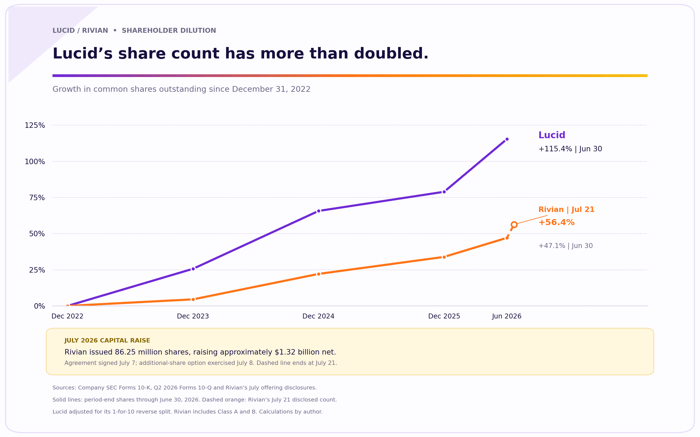
Data source: Lucid and Rivian SEC filings. Graphic source: Author using ChatGPT for editing.
Put another way, Lucid's share count more than doubled while Rivian's increased by less than half. Neither electric vehicle company has escaped dilution, but Lucid investors have surrendered considerably more of their proportional ownership. That doesn't mean their investments automatically lost the same amount of value. New funding also brings resources into the business, and the question is whether those resources create enough value to make the smaller ownership stake worthwhile.
Rivian's subsequent capital raise in July narrows the gap a bit, but hardly closes it. To be fair, Rivian has also relied on shareholders for additional funding, but its share count has grown much less than Lucid's over this stretch. This gives Rivian an advantage on dilution, although it doesn't settle which stock is the better investment.
What each company achieves with the money still matters, and if investors weren't expecting an eventual return on their investment, they would be donating to charity instead.
Buy progress, not time
Issuing shares isn't automatically a bad deal for existing investors. A smaller piece of a much larger business can still be worth considerably more. This is where the comparison gets a bit more uncomfortable for Lucid investors. Rivian has increased its shares less while making considerably more progress toward gross profitability. Its companywide gross margin turned positive in 2025, while Lucid's remained around -93%.
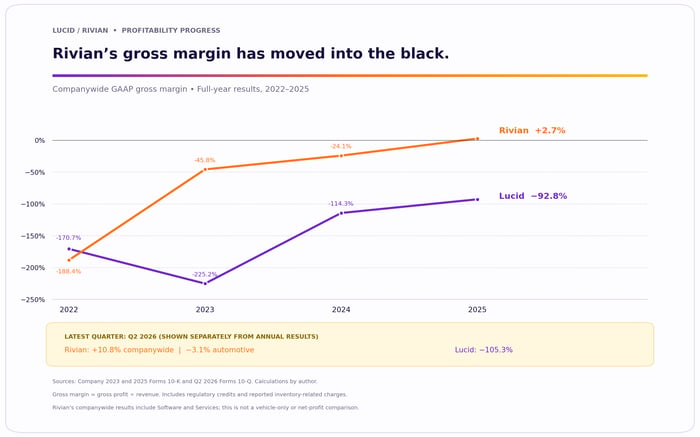
Data source: Lucid and Rivian SEC filings. Graphic source: Author using ChatGPT for editing.
Rivian's software business has been a huge boost to those results, and its automotive business still posted a gross loss in the latest reported quarter. But Rivian deserves credit for pursuing its software strategy. Lucid has also improved from its earlier lows, but it's fair to say shareholders need more than signs of improvement. Investors need to see consistent and tangible progress to justify repeatedly giving up another portion of the business; the trouble comes when repeated financing seems to only support ongoing losses without creating enough additional value.
Lucid used approximately $2.41 billion in operating cash during the first half of 2026. That makes reducing cash consumption critical -- more on this in a moment -- not just to extend its runway, but to reduce the need to keep returning for more money.
What it all means for long-term investors
For long-term investors, the big question is simple: Is each round of funding bringing Lucid closer to standing on its own? The answer is far closer to a yes for Rivian than for Lucid. Going forward, investors should keep a keen eye on cash burn, vehicle unit economics, and the share count alongside delivery growth.
Further, Lucid identified up to $1.4 billion in cash flow improvements, and executing and realizing those improvements will be highly important to its near-term financial health. Lucid is currently buying time, and existing investors need Lucid's extended operational runway to produce meaningful progress, rather than another trip to the financing well.
Should you buy stock in Lucid Group right now?
Before you buy stock in Lucid Group, consider this:
The Motley Fool Stock Advisor analyst team just identified what they believe are the 10 best stocks for investors to buy now… and Lucid Group wasn’t one of them. The 10 stocks that made the cut could produce monster returns in the coming years.
Consider when Netflix made this list on December 17, 2004... if you invested $1,000 at the time of our recommendation, you’d have $334,631!* Or when Nvidia made this list on April 15, 2005... if you invested $1,000 at the time of our recommendation, you’d have $1,312,844!*
Now, it’s worth noting Stock Advisor’s total average return is 893% — a market-crushing outperformance compared to 213% for the S&P 500. Don't miss the latest top 10 list, available with Stock Advisor, and join an investing community built by individual investors for individual investors.
See the 10 stocks »
*Stock Advisor returns as of October 31, 2026.
Daniel Miller has no position in any of the stocks mentioned. The Motley Fool has no position in any of the stocks mentioned. The Motley Fool has a disclosure policy.
Recommended Articles


