




Social Security's 2027 COLA Is One of the Highest in Decades, but There Are Still 2 Issues Retirees May Run Into
Key Points
The 3.6% COLA is the fifth-highest in the past 35 years -- putting more money into retirees' pockets.
However, the Social Security program has been operating at a deficit, paying out more than it takes in.
Despite the annual COLAs, Social Security benefits have continued to lose purchasing power.
- The $23,760 Social Security bonus most retirees completely overlook ›
Inflation has been high for most of the year as geopolitical events have driven up commodity prices, so it was no real surprise that the Social Security cost-of-living adjustment (COLA) -- which is intended to help retirees fight inflation -- was above average.
The 3.6% COLA for 2027 is the third-highest since 2012 and the fifth-highest in the past 35 years. This sizable bump is surely welcomed by retirees, but not everything is peachy keen. Retirees still face two key problems: The future of benefits and how far their current benefits stretch.
Missed AI’s "Act 1"? Act 2 Could Be 15x Bigger. Most investors think they missed the AI boat because they didn't buy Nvidia in 2005. But according to our analysts, we’re only at the end of "Act 1"—the R&D phase. "Act 2" is the global rollout. Continue »

Image source: Getty Images.
Social Security continues to operate at a deficit
Social Security is mostly funded by tax revenue, and for a while, the program collected more than it paid out in benefits. Unfortunately, that hasn't been the case since 2009, and the program has had to draw from the Old-Age and Survivors Insurance (OASI) Trust Fund.
The OASI Trust Fund isn't an unlimited pool of money, and according to the Social Security Administration (SSA), the program can only pay benefits at its current rate until the fourth quarter of 2032. After that, the trust fund will be depleted, and the program will be able to pay only 78% of benefits because it will have to rely solely on incoming tax revenue.
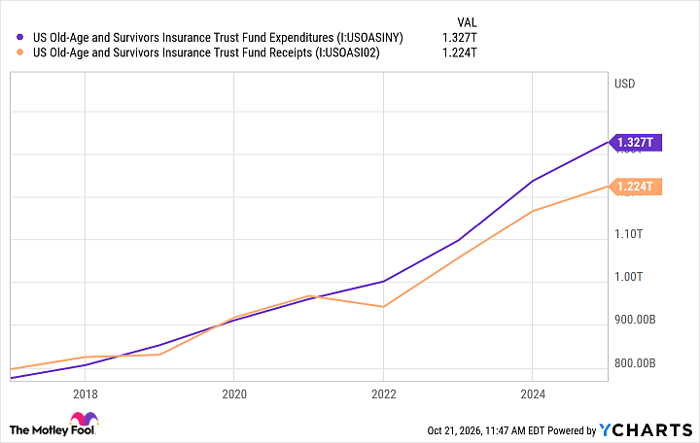
US Old-Age and Survivors Insurance Trust Fund Expenditures data by YCharts
A high 3.6% COLA will provide financial relief to retirees, but it could also speed up the financial strain on the trust fund. No indications suggest that money flowing into the system next year will be enough to offset the 3.6% increase in benefits the SSA will have to pay out.
The only short-term fix will have to come from Congress. Whether it's increasing wage taxes or raising the limit on how much income is subject to Social Security taxes (both of which will be unpopular), this will remain the elephant in the room.
Yesterday's dollar isn't today's dollar
Although Social Security recipients have consistently received annual benefit bumps (except in 2010, 2011, and 2016), these increases haven't fully offset the real inflation retirees experience in their daily lives. According to senior advocacy group The Senior Citizens League (TSCL), Social Security benefits lost 13.7% of their purchasing power from 2016 to 2026.
Tens of millions of retirees rely on Social Security for all of their retirement income. Losing purchasing power affects everyone, but it can especially impact household budgets for those fully reliant on Social Security.
There isn't an easy fix, since changes in the CPI-W inflation metric set the COLA. It has been recommended to change the calculation formula to the Consumer Price Index for Americans 62 years of age and older (CPI-E), and although that would have resulted in a larger COLA in most years, benefits would still have lost purchasing power.
Ideally, inflation cools next year, and the 3.6% COLA stretches further in retirees' budgets.
The $23,760 Social Security bonus most retirees completely overlook
If you're like most Americans, you're a few years (or more) behind on your retirement savings. But a handful of little-known "Social Security secrets" could help ensure a boost in your retirement income.
One easy trick could pay you as much as $23,760 more... each year! Once you learn how to maximize your Social Security benefits, we think you could retire confidently with the peace of mind we're all after. Join Stock Advisor to learn more about these strategies.
View the "Social Security secrets" »
The Motley Fool has a disclosure policy.
Recommended Articles


