




History Says Nvidia Rarely Trades This Cheaply. Here's What Happened the Last Time.
Key Points
The last time Nvidia stock traded this cheaply was at the end of 2018, and it went on a massive rally after that.
Nvidia still has a lot of room for growth despite becoming the world's largest company.
- 10 stocks we like better than Nvidia ›
Nvidia (NASDAQ: NVDA) has been one of the biggest beneficiaries of the artificial intelligence (AI) revolution that began four years ago, with shares of the semiconductor giant up by almost 1,700% over this period.
Nvidia stock's stunning surge has made it the world's largest company by market cap. The important thing to note is that Nvidia is still growing at a healthy pace. However, the stock has underperformed the broader market this year. The 19% jump in Nvidia stock in 2026 is lower than the 62% gains clocked by the PHLX Semiconductor Sector index.
Missed Nvidia in 2009? This Rare Signal Is Flashing Again. In 2009, a "Double Down" signal flashed for a little-known chipmaker called Nvidia. For the first time in years, that same "Total Conviction" signal is flashing for a company 1/100th the size of Nvidia. Continue »
Nvidia's tepid returns this year have made the stock extremely cheap. I will take a closer look at Nvidia's valuation in this article and look back to see what happened when it was this cheap last time.
Image source: The Motley Fool.
Nvidia is trading well below its five-year average valuation
Nvidia is trading at 23 times fiscal 2027 earnings, according to YCharts. That's lower than the company's five-year average forward earnings multiple of 33.4, according to Morningstar. Nvidia's forward earnings multiple, based on its projected earnings per share for fiscal 2028, is even lower at 13.6.
We will have to go back to 2018 to find a forward earnings multiple below 20 for Nvidia, according to Morningstar. The company exited calendar 2018 with a forward earnings multiple of 18.7. The metric has been significantly higher in the years that followed, driven by a solid surge in the company's stock price. As it turns out, this semiconductor stock has jumped by more than 6,500% since the beginning of 2019.
The stunning rally can be justified by Nvidia's outstanding growth trajectory over the past eight years, fueled by multiple catalysts, including the cryptocurrency boom, the incredible demand for gaming hardware during the pandemic, and the advent of AI toward the end of 2022. Importantly, Nvidia isn't done growing yet.
The company's revenue in the first half of fiscal 2027 increased by 96% year over year to $177.8 billion. The bottom-line growth has been stronger, with non-GAAP earnings per share increasing 130% year over year to $4.09. It is worth noting that Nvidia's earnings are growing faster than the broader market.
The S&P 500 index's earnings, for example, are anticipated to increase by 33% this year. Analysts expect a 16% increase in the index's earnings next year, while Nvidia's bottom line is projected to jump by 71%. So, Nvidia shouldn't be trading at a discount to the S&P 500 index's forward earnings multiple of 19. In fact, the company's attractive valuation and solid growth prospects indicate it could resume its bull run, as it did last time when it traded at less than 20 times forward earnings.
The stock is poised for a major breakout
Nvidia's 12-month median price target of $320 suggests a potential jump of 44% from current levels. What's more, almost all the 72 analysts covering Nvidia rate this tech stock as a buy. However, I won't be surprised to see Nvidia exceeding Wall Street's median price target over the long run, primarily due to its above-average earnings growth rate.
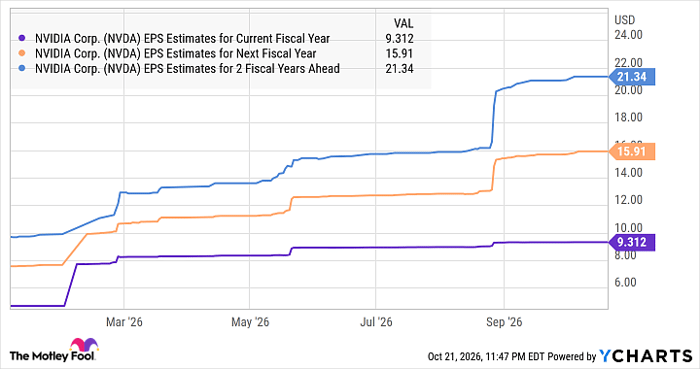
The following chart suggests that Nvidia's earnings per share will increase in the mid-30% range even in fiscal 2029, following the solid jumps projected for the current and the next fiscal year.
Data by YCharts
Let's say Nvidia trades at 30 times earnings at the end of fiscal 2029 (a slight discount to its five-year average forward earnings multiple of 33), and its earnings per share reach $21.34 (based on the consensus estimate seen in the chart above), the stock could soar to $640. That's almost 3x Nvidia's current stock price.
Now, there are several reasons why Nvidia can indeed sustain its impressive growth.
First, the company's dominance in the AI chip market, where it reportedly holds 80% share, will be the primary catalyst for its growth. McKinsey predicts that AI-driven growth in semiconductors will push the overall chip market's revenue to a whopping $2.3 trillion in 2030. That's well above the $1.6 trillion estimate offered by the consulting giant last year.
McKinsey notes that prices of cutting-edge chips are rising, with further upside expected. Nvidia is reportedly charging $7-$8.8 million for a server rack based on its latest Vera Rubin chips. That's well above the $2.8-$6.5 million range that prior-generation Blackwell server racks used to cost, depending on configuration.
Second, Nvidia has also entered the lucrative server processor market. It expects this space to contribute substantially to its top line. So, the company's focus on unlocking new growth opportunities should ensure that it indeed outperforms the broader market over the long run.
As such, investors looking to buy a potential multibagger trading at an attractive valuation can consider Nvidia, as it won't be surprising to see history repeat itself and the stock surge higher once again, just as it did the last time it was this cheap.
Should you buy stock in Nvidia right now?
Before you buy stock in Nvidia, consider this:
The Motley Fool Stock Advisor analyst team just identified what they believe are the 10 best stocks for investors to buy now… and Nvidia wasn’t one of them. The 10 stocks that made the cut could produce monster returns in the coming years.
Consider when Netflix made this list on December 17, 2004... if you invested $1,000 at the time of our recommendation, you’d have $361,596!* Or when Nvidia made this list on April 15, 2005... if you invested $1,000 at the time of our recommendation, you’d have $1,303,935!*
Now, it’s worth noting Stock Advisor’s total average return is 910% — a market-crushing outperformance compared to 211% for the S&P 500. Don't miss the latest top 10 list, available with Stock Advisor, and join an investing community built by individual investors for individual investors.
See the 10 stocks »
*Stock Advisor returns as of October 24, 2026.
Harsh Chauhan has no position in any of the stocks mentioned. The Motley Fool has positions in and recommends Nvidia. The Motley Fool has a disclosure policy.
Recommended Articles


