




President Donald Trump Just Threw Fed Chair Kevin Warsh Under the Bus, and Things Could Get Ugly for Wall Street
Key Points
Although the Dow Jones Industrial Average, S&P 500, and Nasdaq Composite have soared under President Trump, not all of his policies have been beneficial to the stock market.
In addition to admonishing the Federal Open Market Committee (FOMC) for not slashing interest rates, Trump is now taking a jab at Fed Chair Warsh.
Trumpflation has given the central bank little choice but to act -- and that’s potentially terrible news for Wall Street’s No. 1 catalyst.
- 10 stocks we like better than S&P 500 Index ›
Since the late 1890s, roughly three-quarters of all presidential terms have overseen stock market gains. But under President Donald Trump's two non-consecutive terms, the time-tested Dow Jones Industrial Average (DJINDICES:^DJI), benchmark S&P 500 (SNPINDEX:^GSPC), and tech-driven Nasdaq Composite (NASDAQINDEX:^IXIC) have generated average annual returns higher than under most other presidents over the last 130 years.
While investors have come to appreciate Trump's Tax Cuts and Jobs Act, which lowered the peak marginal corporate income tax rate from 35% to 21% and spurred record S&P 500 share buybacks, not everything the president has done has benefited Wall Street.
Missed Nvidia in 2009? This Rare Signal Is Flashing Again. In 2009, a "Double Down" signal flashed for a little-known chipmaker called Nvidia. For the first time in years, that same "Total Conviction" signal is flashing for a company 1/100th the size of Nvidia. Continue »
A couple of President Trump's policies are fueling inflation (rising prices), prompting Fed Chair Kevin Warsh and the Federal Open Market Committee (FOMC) to kick off just the fourth rate-hiking cycle of the 21st century.
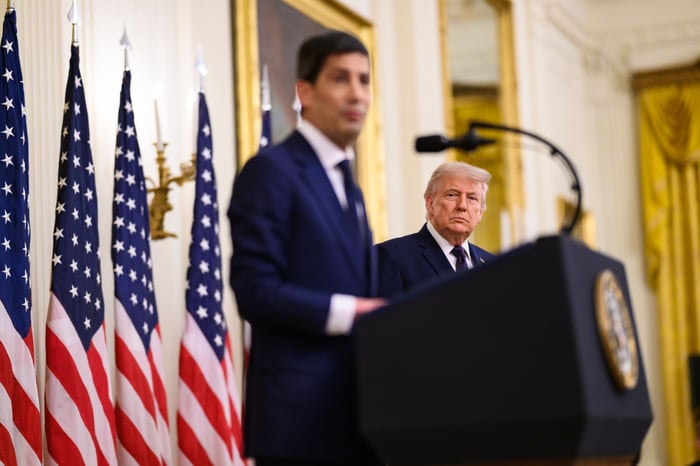
President Trump has been feuding with the Fed since his second term began. Image source: Official White House Photo by Daniel Torok.
For more than a year, Trump has been vocal about his displeasure with the central bank and its now-former head, Jerome Powell. However, he'd held back any criticism of his handpicked nominee, Kevin Warsh... until now.
President Trump throws the FOMC and his new Fed chair under the bus
Shortly after the start of Donald Trump's second term, he became a vocal critic of the central bank's monetary policy.
Under Powell, the FOMC lowered the federal funds target rate six times between September 2024 and December 2025, bringing it down to 3.50%-3.75%. But this wasn't nearly enough to appease President Trump, who's repeatedly called on the FOMC to slash interest rates to 1%.
There are likely several reasons for Trump's ongoing calls to lower interest rates:
- Lower borrowing costs would supercharge Wall Street's No. 1 catalyst, the artificial intelligence (AI) infrastructure build-out.
- Cheaper access to capital would also make it easier for businesses to hire workers, keeping the unemployment rate historically low.
- Most importantly, slashing interest rates would dramatically lower the cost to service the United States' more than $40 trillion in total debt.
President Trump called the Federal Reserve Board "very hostile" and "very political" after the central bank hiked interest rates by a quarter percentage point on Wednesday. Trump said he still has confidence in Kevin Warsh as Fed chair and is "relying on" him, even though "he doesn't have the votes." "No matter how good a job ... he's got a hostile board," Trump told reporters. "They're raising the rates to make Trump do as bad as they can possibly do."
— CBS News (@CBSNews) September 17, 2026
The president hasn't minced his words when talking about the other voting members of the FOMC. On Sept. 16 (the day the Fed raised the federal funds target rate by 25 basis points), he stood behind Kevin Warsh and blasted the FOMC in speaking to reporters:
I'm relying on Kevin, but he's got a very tough board. He's got a board that was put there by a lot of other people. And the interest rates are too high; they're not appropriate.... The board is very hostile. They're very political. They're doing the wrong thing.
But in a recent interview with Time, President Trump threw Kevin Warsh under the bus for the first time. Said Trump:
It's a problem because we have a very hostile Fed board. I don't blame Kevin Warsh. I probably would have voted against the board if I were him.
While Trump framed his response as supporting his Fed chair nominee, the full scope of his answer points to displeasure with Warsh's vote in favor of rate hikes on Sept. 16. Based on the president's interactions with former Fed Chair Powell, more jabs at Fed Chair Warsh are likely in the months to come -- and that's potentially terrible news for the stock market.

Image source: Getty Images.
Trumpflation is likely to accelerate the Fed's rate-hiking cycle in 2027
Although the president has been decisively critical of the FOMC's monetary policy, the central bank has good reason to take action against persistently elevated inflation.
While a modest level of inflation is expected when the U.S. economy is expanding, we've witnessed the prevailing inflation rate top the FOMC's long-term 2% target for the last 67 months, reaching a three-year high of 4.2% in May. The culprit behind this surge in consumer prices is two of President Trump's policies: tariffs and the Iran war.
Tariffs are a tool President Trump has leaned on during both of his terms. Ideally, tariffs protect U.S. jobs, encourage domestic production, and make U.S. goods more price-competitive with those imported from overseas. But based on a new report from a trio of New York Federal Reserve economists writing for Liberty Street Economics, Trump's tariffs are having a negative impact on consumer prices.
In "How Fast Do Tariffs Pass Through into Consumer Prices," the NY Fed economists estimate that Trump's tariffs added 2.9 percentage points to goods price inflation by February 2026. While tariffs directly contributed to higher prices, so did higher domestic manufacturing costs.
New from the New York Fed: "By February 2026, tariffs had contributed 2.9 pp to goods price inflation, and without them goods prices would have fallen slightly." About one quarter of every point in higher tariff rates shows up in consumer prices within one year. • A 10% across-the-board tariff yields a 2.6% rise in consumer goods prices after one year. • About two thirds of the increase comes from pricier imports, which get passed through quickly. • Another third comes from U.S. made goods, as producers face higher input costs and less import competition. This takes longer, about 6-12 months, to filter through.
— Nick Timiraos (@NickTimiraos) October 6, 2026
Additionally, the Iran war has created the largest energy supply disruption in modern history. The ongoing closure of the Strait of Hormuz has halted the flow of a fifth of the world's liquid petroleum, sending gas and diesel prices to the heavens.
Hypothetically, even if the Iran war ended today, it would take more than a month to bring production in the region back to near full capacity, and even longer to rebuild storage. The effects within the energy sector and beyond it would likely continue for several quarters after the war ends.
This evolution of Trumpflation, coupled with the inflationary effects of the AI infrastructure build-out, is what prompted Kevin Warsh and his FOMC colleagues to act in September. According to the CME Group's (NASDAQ:CME) FedWatch Tool, there's a 64% chance that Warsh and the FOMC will raise rates by at least 75 basis points come September 2027.
In other words, we may be setting up for another public feud between President Trump and a sitting Fed chair. Not only does Trump's public criticism of the central bank risk damaging its credibility, but further rate hikes, spurred primarily by Trumpflation, may upend Wall Street's leading catalyst.
The stock market is priced for perfection. If a rapid increase in lending costs slows the AI data center build-out, it wouldn't take much to push the Dow, S&P 500, and Nasdaq Composite off their respective pedestals.
If the past is any indication of what's to come, things could get ugly for Wall Street.
Should you buy stock in S&P 500 Index right now?
Before you buy stock in S&P 500 Index, consider this:
The Motley Fool Stock Advisor analyst team just identified what they believe are the 10 best stocks for investors to buy now… and S&P 500 Index wasn’t one of them. The 10 stocks that made the cut could produce monster returns in the coming years.
Consider when Netflix made this list on December 17, 2004... if you invested $1,000 at the time of our recommendation, you’d have $361,596!* Or when Nvidia made this list on April 15, 2005... if you invested $1,000 at the time of our recommendation, you’d have $1,303,935!*
Now, it’s worth noting Stock Advisor’s total average return is 910% — a market-crushing outperformance compared to 211% for the S&P 500. Don't miss the latest top 10 list, available with Stock Advisor, and join an investing community built by individual investors for individual investors.
See the 10 stocks »
*Stock Advisor returns as of October 24, 2026.
Sean Williams has no position in any of the stocks mentioned. The Motley Fool has positions in and recommends CME Group. The Motley Fool has a disclosure policy.
Recommended Articles


