




If a Stock Market Crash Is on the Way, Warren Buffett Says This Is the Best Thing Investors Can Do for Their Portfolio
Key Points
The stock market is selling off as investors digest rising bond yields and stubborn inflation.
Warren Buffett warns that picking stocks based on trendy industries is risky, putting artificial intelligence (AI) in the spotlight.
Investing in companies with competitive advantages and diversified business models will prove resilient in the long run.
- 10 stocks we like better than S&P 500 Index ›
The S&P 500 (SNPINDEX: ^GSPC) and Nasdaq Composite (NASDAQINDEX: ^IXIC) have recently been experiencing a bout of volatility after repeatedly notching record highs throughout 2026. With stocks coming under pressure, some investors are wondering whether a larger market correction is approaching.
Part of the concern stems from elevated bond yields and stubborn inflation. Meanwhile, artificial intelligence (AI) hyperscalers like Amazon, Microsoft, Alphabet, and Meta Platforms are among the companies supporting the broader economy as they accelerate spending on data centers.
Missed AI’s "Act 1"? Act 2 Could Be 15x Bigger. Most investors think they missed the AI boat because they didn't buy Nvidia in 2005. But according to our analysts, we’re only at the end of "Act 1"—the R&D phase. "Act 2" is the global rollout. Continue »
Whether this volatility is just a temporary pullback or the beginning of something worse is impossible to know. But legendary investor Warren Buffett spent decades explaining how to navigate markets dominated by exciting new technologies, sky-high valuations, and uncertainty.

Former Berkshire Hathaway CEO Warren Buffett. Image source: Getty Images.
Revolutionary technology does not equal a good investment
Buffett built Berkshire Hathaway into one of history's most successful investment firms simply because he had a relentless focus on businesses he understands. He generally avoided technology stocks, instead favoring industries such as insurance, banking, consumer products, utilities, and energy. These businesses usually have relatively predictable economics, which allowed Buffett to better assess their long-term earnings potential.
Buffett understood that an industry can revolutionize society without producing attractive returns overall. Consider the automobile and aviation industries as examples. Cars and airplanes have unquestionably transformed the global economy, but countless early manufacturers and airlines have gone bankrupt as competition intensified.
The theme here is that identifying which industries are game changers is much easier than choosing the specific companies that will capture profits in the long run. This distinction matters in today's AI environment.
While AI is shaping up to be one of the most transformative technologies in history, that doesn't mean every semiconductor company, software developer, or infrastructure provider is going to generate market-beating returns.
Is the AI revolution destined to end up like the dot-com bubble?
During the late 1990s, investors were pouring money into virtually anything that resembled the internet. Speculative technology stocks became multibaggers, even when the underlying companies had little revenue, no profits, or incomplete business models.
Reality inevitably caught up with expectations. After peaking in March 2000, the Nasdaq plummeted by 78% by October 2002. Suddenly, once-promising internet businesses left investors holding the bag.
Today, some investors are worried the AI boom could become a modern retelling of the dot-com bubble. Sure, AI leaders like Nvidia and the cloud hyperscalers already generate substantial profits and cash flow. The reason why is that their AI infrastructure is supported by numerous established businesses rather than simply promises around future growth. Still, the industry faces uncertainty because not every model developer is going to succeed in the long run.
This brings us to Buffett's most important investing principle. The single best thing an investor can do for their portfolio right now is load up on companies with durable competitive advantages rather than chasing the stocks attracting the most attention. Buffett describes these advantages as economic moats that come in the form of powerful brands, high switching costs, network effects, and economies of scale.
What is the best investment if the market crashes?
There's a more subtle lesson investors can learn from the dot-com crash: Time in the market is more valuable than trying to time the market. Suppose you invested in the S&P 500 near its peak during the dot-com era. If you managed to stay invested, you would have witnessed the index appreciate roughly 450%.
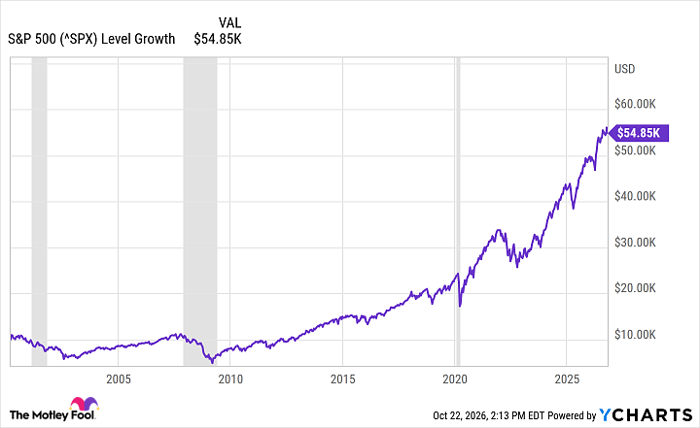
^SPX data by YCharts
A hypothetical $10,000 investment would have grown to nearly $55,000, even though it was made right before a major market collapse. What's even more inspiring is that over the last 25 years, the S&P 500 has endured three recessions -- pictured above as the grey-shaded columns -- and managed to come out higher after each one. This underscores the resiliency of the S&P 500 as one of the greatest wealth-creation vehicles.
This performance is why Buffett's emphasis on diversification is both valuable and relevant in today's market. Rather than panic-selling whenever stocks become volatile or valuation is frothy, investors should rebalance their portfolios if their positions expose them to unnecessary risk.
Ultimately, no one knows whether the recent sell-off will permeate into a full-blown crash. But Buffett's philosophy offers a practical response: The best opportunity is to own quality businesses, avoid paying unreasonable prices, and remain patient enough to let compounding do the heavy lifting.
Should you buy stock in S&P 500 Index right now?
Before you buy stock in S&P 500 Index, consider this:
The Motley Fool Stock Advisor analyst team just identified what they believe are the 10 best stocks for investors to buy now… and S&P 500 Index wasn’t one of them. The 10 stocks that made the cut could produce monster returns in the coming years.
Consider when Netflix made this list on December 17, 2004... if you invested $1,000 at the time of our recommendation, you’d have $350,756!* Or when Nvidia made this list on April 15, 2005... if you invested $1,000 at the time of our recommendation, you’d have $1,363,905!*
Now, it’s worth noting Stock Advisor’s total average return is 922% — a market-crushing outperformance compared to 213% for the S&P 500. Don't miss the latest top 10 list, available with Stock Advisor, and join an investing community built by individual investors for individual investors.
See the 10 stocks »
*Stock Advisor returns as of October 23, 2026.
Adam Spatacco has positions in Alphabet, Amazon, Microsoft, and Nvidia. The Motley Fool has positions in and recommends Alphabet, Amazon, Berkshire Hathaway, Meta Platforms, Microsoft, and Nvidia. The Motley Fool has a disclosure policy.
Recommended Articles


