



Will Alphabet Break Warren Buffett's Cardinal Rule of Investing?
Key Points
Warren Buffett has long said that the key to investing is finding stocks that can consistently earn high returns on capital.
But recently, Alphabet has seen its returns decline significantly as the company spends hundreds of billions on AI infrastructure.
- 10 stocks we like better than Alphabet ›
The most notable change in Berkshire Hathaway's (NYSE: BRKA)(NYSE: BRKB) massive, roughly $360 billion stock portfolio this year has been the conglomerate's large increase in Alphabet (NASDAQ: GOOGL)(NASDAQ: GOOG).
While Berkshire initiated the position last year under Warren Buffett's leadership, the company has significantly increased its stake in Alphabet under new CEO Greg Abel. Between the end of 2025 and the end of the second quarter of this year, the value of Berkshire's Alphabet position soared from about $5.6 billion to nearly $37.8 billion, making Alphabet one of Berkshire's largest positions.
Missed Nvidia in 2009? This Rare Signal Is Flashing Again. In 2009, a "Double Down" signal flashed for a little-known chipmaker called Nvidia. For the first time in years, that same "Total Conviction" signal is flashing for a company 1/100th the size of Nvidia. Continue »
Perhaps even more interesting is that as Berkshire was buying, Alphabet's returns have declined. Will Alphabet break Warren Buffett's cardinal rule of investing?
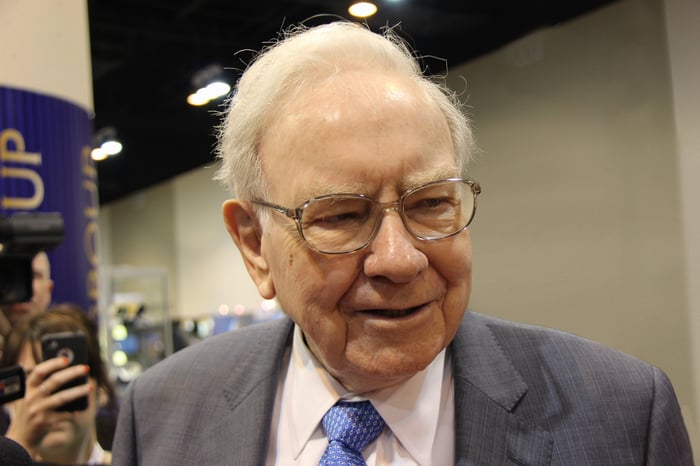
Image source: The Motley Fool.
Returns are declining as capex soars
In a surprising interview with CNBC in July, the 96-year-old Buffett, who remains executive chairman of Berkshire, revealed he had initiated the Alphabet position last year, meaning he and Abel likely decided together to significantly increase Berkshire's stake.
During this same interview, Buffett also told CNBC, "The trick in life is to find -- I mean investing -- is to find businesses that are going to earn high returns on capital for an extended period of time," Buffett said.
By returns on capital, Buffett is most likely referring to return on invested capital (ROIC), which essentially examines how efficiently companies use capital to generate profits. Capital, in this scenario, refers to both debt and equity.
The goal is for companies to generate ROICs that are above their weighted average cost of capital (WACC). Right now, Alphabet is experiencing declining ROICs, and that trend is expected to continue in future years, according to Wall Street analysts.
According to Visible Alpha, Alphabet generated a post-tax ROIC of over 58% in 2024, which is simply remarkable. In 2025, that number declined to roughly 42%. This year, analysts on average expect another decline to 38.3%.
While much more difficult to predict and likely to be revised, analysts also expect Alphabet's ROIC to decline in each year between 2027 and 2029, falling below 31% by 2029, which, generally speaking, is still quite strong.
The reason for the decline is that Alphabet, along with other hyperscalers, is significantly increasing its capital expenditures to build artificial intelligence infrastructure. Alphabet has guided for roughly $200 billion in capex this year, and that number is expected to "increase significantly in 2027," according to Alphabet CFO Anat Ashkenazi on the company's most recent earnings call.
Increased capex leads to lower ROIC, which is net operating profit after tax divided by invested capital. Capex increases the denominator, invested capital.
Buffett clearly knows this, so what is his plan?
Buffett is widely considered the greatest investor of all time, so he clearly understands what is happening.
While he probably doesn't love the near-term trends, he likely also realizes that Alphabet, as a hyperscaler, feels the significant capex investment is necessary to avoid missing out on the AI revolution. Investors should also understand that these companies are led by some of the brightest minds in the world. While they aren't always right, they don't make bets like this unless they have a strong conviction. The goal is for capex to flatten in the coming years and for revenue to accelerate over many years thereafter, leading to higher ROICs.
Now, whether this happens or not is hotly debated on Wall Street, and investors have seen this debate on full display this year in the stock prices of hyperscalers, which have bounced around. While Alphabet's ROIC has fallen significantly, a consistent ROIC above 30% remains quite attractive, though it also depends on how much the company's WACC increases, if at all.
So, while I wouldn't say Alphabet is breaking Buffett's cardinal rule for investing just yet, it raises the possibility. Buffett, Abel, and the Berkshire team likely believe this is only a small bump on the road. Remember, Berkshire likes to buy stocks it can ultimately hold forever.
There are other Alphabet-owned businesses that also make the stock a compelling buy. But it will be interesting to see if and when Alphabet can return its ROIC to levels seen in recent years, and how much slack Buffett and Abel are willing to afford the company.
Should you buy stock in Alphabet right now?
Before you buy stock in Alphabet, consider this:
The Motley Fool Stock Advisor analyst team just identified what they believe are the 10 best stocks for investors to buy now… and Alphabet wasn’t one of them. The 10 stocks that made the cut could produce monster returns in the coming years.
Consider when Netflix made this list on December 17, 2004... if you invested $1,000 at the time of our recommendation, you’d have $421,997!* Or when Nvidia made this list on April 15, 2005... if you invested $1,000 at the time of our recommendation, you’d have $1,413,876!*
Now, it’s worth noting Stock Advisor’s total average return is 978% — a market-crushing outperformance compared to 213% for the S&P 500. Don't miss the latest top 10 list, available with Stock Advisor, and join an investing community built by individual investors for individual investors.
See the 10 stocks »
*Stock Advisor returns as of September 6, 2026.
Bram Berkowitz has no position in any of the stocks mentioned. The Motley Fool has positions in and recommends Alphabet and Berkshire Hathaway. The Motley Fool has a disclosure policy.
Recommended Articles


