




51% of SoFi's New Products Last Quarter Went to Existing Members, Up From 35% a Year Ago
Key Points
SoFi Technologies topped last quarter's revenue and earnings estimates, but untouched earnings guidance rattled investors.
Even so, the company is showing strong promise on a growth front that's only just now being fully tapped.
The disappointing decision to leave its 2026 EBITDA guidance unchanged may set the stage for a pleasant earnings surprise sooner than later.
- 10 stocks we like better than SoFi Technologies ›
If you want proof that "very good" still isn't always good enough for investors, look no further than the market's response to SoFi Technologies' (NASDAQ: SOFI) second-quarter results. Revenue grew 40% year over year to $1.2 billion, pushing per-share earnings up from $0.08 a year ago to $0.12 this time around, both of which topped estimates of $1.12 billion and $0.11, respectively. Yet, largely because the online bank didn't raise its 2026 profit guidance despite raising its full-year revenue outlook, the stock tanked to the tune of 10% on Wednesday.
The thing is, SoFi reported a seemingly meaningless metric for Q2 that could actually be a pretty big deal for its bottom line in the foreseeable future...even if the company isn't saying as much.
Missed Nvidia in 2009? This Rare Signal Is Flashing Again. In 2009, a "Double Down" signal flashed for a little-known chipmaker called Nvidia. For the first time in years, that same "Total Conviction" signal is flashing for a company 1/100th the size of Nvidia. Continue »
Increasingly tapping more cost-effective prospects
It's not a complicated business. SoFi Technologies offers its customers everything a more traditional brick-and-mortar bank can, including checking, loans, savings, credit cards, investment services, and more. It's just all accessed online. And for much of its existence, most of the company's customers used only one of SoFi's products or services.
That's finally changing in a big way, though. Last quarter, 51% of the 2.22 million new products or services it sold were sold to existing customers. That's up from 43% just a quarter earlier and 35% in Q2 of last year. Said another way, while SoFi Technologies added 1.12 million new members last quarter to bring its customer headcount up to 15.81 million, it did just as well selling products to its existing users, who are much cheaper and easier to access and many of whom have now been around long enough to trust SoFi with more of their finances. End result? The average SoFi member now utilizes 1.54 products, up from an average of 1.46 just a year ago.
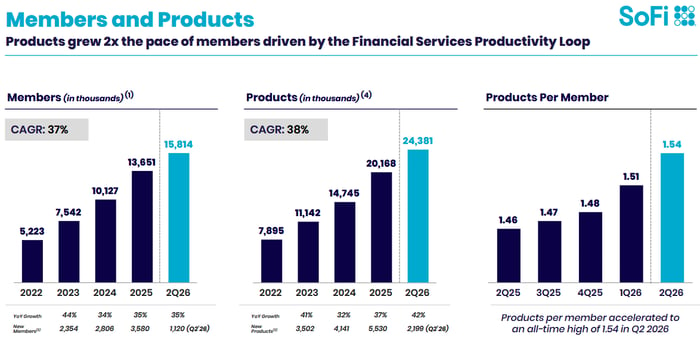
Image source: SoFi Technologies Q2-2026 investor report.
The new normal
At first blush, this doesn't seem to mean much. Although it's progress, it's progress that only extends existing trends.
This is a bigger deal than it seems on the surface, though. That figure of 51%, paired with the fact that SoFi's new customer growth is still accelerating rather than slowing down, says the company is at a tipping point many investors have been waiting for it to reach: being able to cost-effectively add revenue by leveraging -- for free -- its existing customers, most of whom almost certainly have assets held elsewhere. This dynamic ultimately raises each of these customers' lifetime value to SoFi.

Image source: Getty Images.
No, it doesn't look like this growing per-member lifetime value is going to make much positive impact in the immediate future. As was noted, while the online bank now expects to report 2026 revenue of between $4.75 billion and $4.85 billion, versus previous guidance of $4.655 billion, it's still calling for earnings before interest, taxes, depreciation, and amortization (EBITDA) of only $1.6 billion. That's what rattled shareholders.
Just don't lose sight of the bigger picture. SoFi Technologies has proven not only that online banking is marketable but also that it can be profitable. The stock's post-earnings dip, which dragged it back to less than half of its November peak, also leaves it more than 20% below analysts' consensus price target of around $20 per share. That's a hint worth taking.
Should you buy stock in SoFi Technologies right now?
Before you buy stock in SoFi Technologies, consider this:
The Motley Fool Stock Advisor analyst team just identified what they believe are the 10 best stocks for investors to buy now… and SoFi Technologies wasn’t one of them. The 10 stocks that made the cut could produce monster returns in the coming years.
Consider when Netflix made this list on December 17, 2004... if you invested $1,000 at the time of our recommendation, you’d have $394,601!* Or when Nvidia made this list on April 15, 2005... if you invested $1,000 at the time of our recommendation, you’d have $1,197,093!*
Now, it’s worth noting Stock Advisor’s total average return is 895% — a market-crushing outperformance compared to 206% for the S&P 500. Don't miss the latest top 10 list, available with Stock Advisor, and join an investing community built by individual investors for individual investors.
See the 10 stocks »
*Stock Advisor returns as of July 31, 2026.
James Brumley has no position in any of the stocks mentioned. The Motley Fool has no position in any of the stocks mentioned. The Motley Fool has a disclosure policy.
Recommended Articles


