




Fed Chair Kevin Warsh Plays the Hawk But May Have a Dove Up His Sleeve
Key Points
New Fed Chair Kevin Warsh has said on several occasions that the Fed will achieve price stability.
But the Federal Open Market Committee held rates steady at its July meeting.
Warsh also made several statements that led investors to question whether he is really as hawkish as he sounds.
- These 10 stocks could mint the next wave of millionaires ›
Since becoming the new chair of the Federal Reserve's Board of Governors and Federal Open Market Committee (FOMC), Kevin Warsh has given a lot of tough talk.
Warsh has said that prices are too high and that the Fed will achieve price stability and bring inflation back down to 2%. The market seemed to take him at his word and began penciling in multiple rate hikes for this year and next.
Where to invest $1,000 right now? Our analyst team just revealed what they believe are the 10 best stocks to buy right now, when you join Stock Advisor. See the stocks »
However, at the FOMC's recent July meeting, the committee held rates steady, and Warsh made some very interesting comments at the post-FOMC press conference. Warsh has done a good job of playing the hawk, but he may be holding a dove up his sleeve.
Warsh continues to talk a big game
The FOMC has been dealing with a difficult situation over the past year, in which the labor market has shown some cracks and inflation has remained elevated.
This has put the Fed's dual mandates of achieving stable prices and maximum employment at odds with one another, making the path forward murky. Further raising interest rates could rein in inflation, but hurt the labor market. On the other hand, leaving rates unchanged could increase the already high inflation.
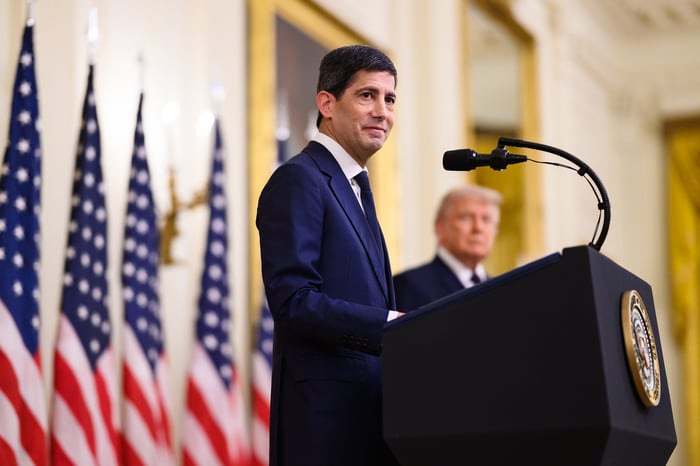
Fed Chair Kevin Warsh. Official White House photo by Daniel Torok.
The Iran war has not made the situation any easier. It's leading to higher oil and gas prices, which have worsened inflation. But the war is tricky because if it does end sooner rather than later, gas prices will likely subside over the next six to 12 months.
The 12-member FOMC has been divided over how to proceed with rates. At the July meeting, three members dissented, arguing that there should have been a rate hike.
Warsh began his post-FOMC press conference with some of the same tough talk he's issued in recent months. "Inflation remains elevated relative to the committee's 2 percent goal. The committee remains resolute. You've heard this before, but we will deliver price stability," he said.
Warsh also remained steadfast in saying that the Fed has no alternative inflation target, despite market speculation in recent years that the Fed may be willing to let inflation run over its long-held 2% target.
"Let me reiterate, there is no soft inflation target. There is no soft implicit target, not on this committee's watch. There's only a target, and it's 2 percent," he said.
Will Warsh push for the Fed to measure inflation differently?
Warsh has long expressed a desire to make the Fed less influential in the stock market by providing less forward guidance. But Warsh may have broken his own rule to some extent at his recent post-FOMC press conference.
For instance, Warsh has consistently said that the Fed's inflation target is 2%. What's less clear is how Warsh truly wants to measure inflation. He's already assigned a task force to look into this aspect of the Fed.
In Congressional testimony prior to his confirmation, Warsh also said he would prefer a "trimmed averages" method. Under this methodology, the most extreme price movements at both the bottom and top ends of a price basket are removed, and then a weighted average is taken.
The Federal Reserve Bank of Dallas produces a trimmed-mean Personal Consumption Expenditures (PCE) Index, and remember, the PCE is the Fed's preferred gauge for inflation. Between January and June of this year, core PCE, as currently measured, has ranged from 3% to 3.4% (year over year). The trimmed mean has ranged from 2.2% to 2.4%.
So, if Warsh could get the FOMC to view inflation this way, it would appear much more manageable than it does under the current framework, and Warsh hinted at this further in his press conference.
"We're going to deliver 2 percent inflation, and not a whisper more, but to achieve that, I'm looking at a broader set of inflation data than PCE. So without sort of fully revealing my cards, I'm trying to understand, like my colleagues, what's the underlying generalized change in prices that are happening in the economy," Warsh said.
Warsh further questioned whether the incredible spending spree in capital expenditures, largely to build out artificial intelligence infrastructure, points to "a broader inflationary dynamic, or do we just focus on them because they are under the bright streetlight?"
The market sees a dove
Comments like these have made the market view Warsh in a more dovish light. Before the FOMC meeting, the market placed over an 82% likelihood that the Fed would raise interest rates by either a quarter point or half a point by its September meeting, according to CME Group's FedWatch Tool.
As of July 30, the market still sees a 61% chance of the FOMC raising rates by a quarter point in September, but there is now no chance that rates will be up by half a point. Meanwhile, the likelihood that the Fed will keep rates steady has more than doubled, from just under 18% ahead of the FOMC meeting to nearly 39%.
Meanwhile, the yield on the 30-year U.S. Treasury Bond surged to over 5.2%, suggesting the bond market is worried that the Fed won't adequately respond to elevated inflation.
What will happen at the Fed's September meeting is anyone's guess. If more members of the FOMC become hawkish, Warsh may have no other choice but to go along with a rate hike. But it's clear that the market's view of Warsh has shifted from hawkish to more neutral, and maybe even dovish.
Where to invest $1,000 right now
When our analyst team has a stock tip, it can pay to listen. After all, Stock Advisor’s total average return is 895%* — a market-crushing outperformance compared to 206% for the S&P 500.
They just revealed what they believe are the 10 best stocks for investors to buy right now, available when you join Stock Advisor.
See the stocks »
*Stock Advisor returns as of July 31, 2026.
Bram Berkowitz has no position in any of the stocks mentioned. The Motley Fool has positions in and recommends CME Group. The Motley Fool has a disclosure policy.
Recommended Articles


