




Seagate Jumps as Much as 10% After-Hours as Results Top Estimates; Sees Orders Through 2029
TradingKey - After consecutive days of sell-offs in the AI infrastructure sector, the storage sector has finally welcomed positive news.
After the market close on July 28, Eastern Time, global hard drive leader Seagate Technology ( STX) announced its fourth-quarter fiscal 2026 financial results. Not only did both revenue and earnings for the quarter beat Wall Street expectations across the board, but its guidance for the next fiscal quarter was also significantly higher than market forecasts.
More importantly, company management sent a series of positive signals during the conference call: AI-related orders have not slowed down, customers have already begun planning procurement needs for 2029, and capacity for high-capacity enterprise hard drives (Nearline HDDs) has also been basically locked in ahead of schedule.
Against the backdrop of previous widespread market concerns over cooling AI capital expenditures and valuation pressure on the storage sector, this earnings report quickly reversed market sentiment.
Seagate's stock price fell 8.5% in regular trading before the earnings release, but rebounded by more than 10% at one point in after-hours trading.
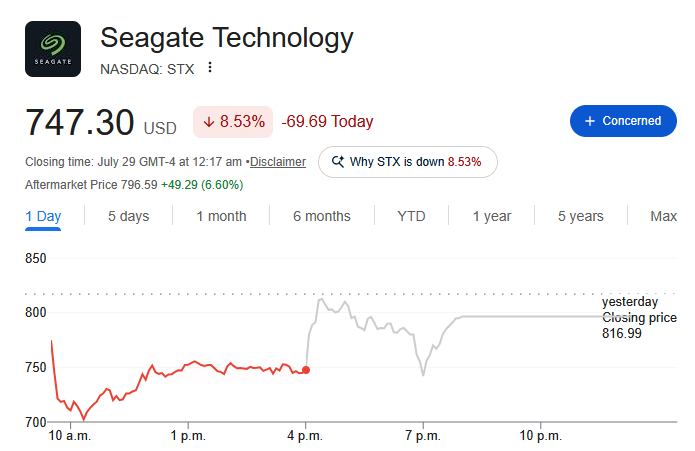
Source: Google Finance
Revenue, Margins and Guidance Beat Market Expectations Across the Board
According to its earnings report, Seagate achieved revenue of $3.65 billion in the fourth fiscal quarter, up approximately 49% year-on-year, beating market expectations of $3.49 billion; adjusted earnings per share (EPS) reached $5.71, a year-on-year surge of about 120%, exceeding the analyst consensus estimate by approximately 12%.
Compared to revenue growth, the market focused more on the continuous improvement of profitability. In the fourth fiscal quarter, the company's adjusted gross margin rose to 52.7%, up 14.8 percentage points from the same period last year; adjusted operating margin reached 44.6%, higher than the market expectation of 41.9%, reflecting that product mix upgrades and improved industry supply and demand are continuing to unlock profitability elasticity.
Meanwhile, the company's cash flow performance was equally robust. Cash flow from operating activities reached $1.3 billion in the fourth fiscal quarter, with free cash flow at $1.1 billion; free cash flow for the full fiscal year 2026 hit a new record of $3.1 billion. The company repaid $1.4 billion of debt throughout the year, further lowering its net debt level, which provides more ample room for subsequent capital returns and technology investments.
What truly drove the stock price rapidly higher in after-hours trading was the next-quarter earnings guidance provided by management.
Seagate expects revenue for the first fiscal quarter of fiscal year 2027 to be between $4.0 billion and $4.2 billion, with a midpoint of $4.1 billion, significantly higher than the market estimate of $3.79 billion; adjusted EPS is expected to be approximately $7.30, also far exceeding the analyst consensus of $5.85.
This means that the company not only delivered a better-than-expected quarterly scorecard but also signaled to the market that order demand continues to improve.
Over the past few years, the biggest winners in the AI value chain have been concentrated in GPUs, high-bandwidth memory (HBM), and high-speed networking equipment.
However, as the scale of AI models continues to expand, it is not just computing power that is growing rapidly, but also data itself. Model training, inference, log retention, multimodal data, model checkpoints, and long-term backups will constantly generate massive amounts of data, not all of which need to be deployed on the most expensive and fastest storage media.
For application scenarios that are more cost-sensitive and have larger capacity requirements, high-capacity mechanical hard drives still offer clear advantages.
Therefore, AI infrastructure buildout has gradually extended from computing power procurement to the data storage layer. GPUs handle computation, HBM handles high-speed caching, and enterprise hard drives bear the responsibility of long-term preservation and archiving. Together, these three form a complete data center architecture.
Seagate CEO Dave Mosley stated that AI is continuously driving the acceleration of data generation, and the increasing value of data will drive long-term demand for high-capacity storage.
Earnings Call Reveals More Positive Signals as Orders Seen Through 2029
Compared with the financial data, management's remarks during the earnings call further bolstered market confidence.
Dave Mosley stated that the company expects growth in fiscal 2027 to be faster than in fiscal 2026, and anticipates that full-year revenue and margins are poised to improve quarter-over-quarter.
Of greater interest, the company disclosed that its current nearline enterprise hard drive (Nearline HDD) capacity has been largely locked in through long-term supply agreements through 2028, and many customers have already begun planning procurement needs for 2029 and even beyond. Management has not observed any signs of customers shortening their investment cycles.
Meanwhile, the company stated that the new capacity freed up by continuous improvements in product yields can still be sold at prices above contract rates, reflecting that market supply and demand remains tight and customer appetite for high-capacity products remains robust.
Management expects that as HAMR (Heat-Assisted Magnetic Recording) technology continues to ramp up and the product mix further shifts toward high-capacity hard drives, there is still room for the company's gross margin to expand. Based on the latest guidance, the gross margin for the next quarter is poised to approach 57%.
Gross Margins Continue to Rise as High-Capacity Products Become Profitability Core
Seagate's significant gross margin expansion this quarter is no coincidence.
On one hand, AI data center procurement priorities are rapidly shifting toward high-capacity enterprise hard drives, with the share of high-unit-price products continuing to rise; on the other hand, following industry adjustments over the past two years, major manufacturers are more cautious about capacity expansion, which has significantly improved the supply-demand structure.
In addition, the company's continued advancement of HAMR (Heat-Assisted Magnetic Recording) technology upgrades has further enhanced its profitability.
Currently, the Mozaic platform employing HAMR technology has entered the volume delivery stage, with Mozaic 4 products ramping up rapidly and representing a rising share of enterprise nearline hard drive shipments; the next-generation Mozaic 5 is expected to begin qualification by the end of 2027.
Management expects that by the end of 2026, HAMR products will account for approximately 50% of nearline hard drive shipments. As single-drive capacity increases, Seagate will not only be better positioned to meet the rapidly growing data storage demands of the AI era but is also expected to further improve its gross margin by optimizing its product mix.
Management even stated that the incremental gross margin on the company's new revenue has exceeded 60%, demonstrating that operating leverage is being rapidly unleashed.
In addition, Seagate mentioned that KV Cache data generated by AI Agents in the future, as well as the massive video and sensor data brought by applications like physical AI and robotics, could all become new drivers of enterprise storage demand growth. However, the company believes these applications are still in their infancy and are only expected to gradually translate into larger demand increments over the next few years.
Recommended Articles


