




Nvidia is spending big to lock down the AI supply chain — what’s next?
Nvidia’s next growth phase may depend on more than how many AI chips it can design.
The company has agreed to provide US$1.5 billion in prepayments to Amkor Technology under a multi-year deal to expand advanced chip-packaging and testing capacity in the US. The move targets a critical bottleneck in the AI supply chain: turning increasingly complex processors into systems that can be deployed at scale.
It follows another useful demand signal for traders. Bristol Myers Squibb has agreed to become the first life-sciences customer for Nvidia’s next-generation Vera Rubin computing system, using it to support drug discovery and development.
These announcements arrive well before Nvidia reports Q2 results in August. They support the view that AI infrastructure spending remains broadening beyond the largest cloud companies. But they also raise the bar for the next earnings result: investors will want to see that spending on the next chip cycle can keep translating into revenue growth, margins and durable customer demand.
For Australian traders, Nvidia remains one of the most closely watched US shares. The opportunity is not simply to anticipate the August result, but to follow whether the evidence around supply, deployment and AI investment continues to support the market’s high expectations.
The next AI chip cycle is already taking shape
Nvidia’s latest results showed that demand for its current-generation systems remains exceptional. First-quarter revenue reached US$81.6 billion, up 85% from a year earlier, while data-centre revenue rose 92% to US$75.2 billion.
The market is now looking ahead to what comes after that rapid Blackwell ramp.
The packaging deal is important because advanced AI systems require more than a powerful graphics processor. They rely on sophisticated packaging, high-bandwidth memory, networking and large-scale system integration.
That can create a positive feedback loop for Nvidia if it helps the company deliver more systems to customers. It can also create a new risk: supply-chain capacity, execution and customer deployment schedules may become just as important as chip demand itself.
Why Nvidia is harder to trade than a simple AI-growth story
Nvidia remains central to the AI buildout, but the share price can react sharply when investors reassess the pace, profitability or sustainability of that spending.
Strong demand is already widely expected: Nvidia can report rapid revenue growth and still fall if guidance, margins or customer commentary does not exceed what investors have priced in.
The supply chain now matters more: Advanced packaging, memory availability and networking capacity can affect when systems are delivered and revenue is recognised.
A new architecture can create transition risk: The move from Blackwell to Vera Rubin gives Nvidia another potential growth driver, but traders will watch for any disruption to production, adoption or margins.
Customer spending is under closer scrutiny: Major cloud companies and AI developers continue to invest heavily, but the market is increasingly focused on whether that capital expenditure will produce attractive returns.
Nvidia can move with the entire AI trade: Changes in US bond yields, technology sentiment or broader concerns over AI valuations can affect Nvidia even without company-specific news.
The key question is whether the latest announcements show a company strengthening its lead, or a market pushing more capital into an AI buildout that is becoming harder to justify at current valuations.
Contracts for Difference (CFDs) allow traders to take a view on Nvidia’s price movements without owning the underlying shares. A long position may suit a view that AI demand and the next product cycle will support the stock, while a short position may suit a view that expectations remain too high.
“Trade Nvidia Stock with an ASIC-regulated broker. Fast AUD funding via PayID. ”
How Mitrade helps traders respond to Nvidia volatility
Mitrade provides CFDs on Nvidia and major US indices, allowing Australian traders to take a more focused view on the company or a broader view on technology sentiment.
Trade the company-specific story: Nvidia CFDs allow traders to respond directly to earnings, product announcements, supply-chain developments and major customer news without owning the underlying share.
Go long or short: A long position may suit a view that demand for Blackwell and Vera Rubin systems will support Nvidia. A short position may suit a view that valuation concerns or weaker guidance will pressure the stock.
Use the Nasdaq for broader exposure: The Nasdaq can be useful when the focus is wider AI and technology sentiment rather than Nvidia alone.
Prepare for major events: Pending orders, stop-losses and take-profit levels can help traders define risk before US earnings or a significant AI-sector announcement.
Use leverage carefully: Retail share CFDs can offer leverage of up to 5:1 under ASIC rules. This reduces the upfront margin required, but it also magnifies losses as well as gains.
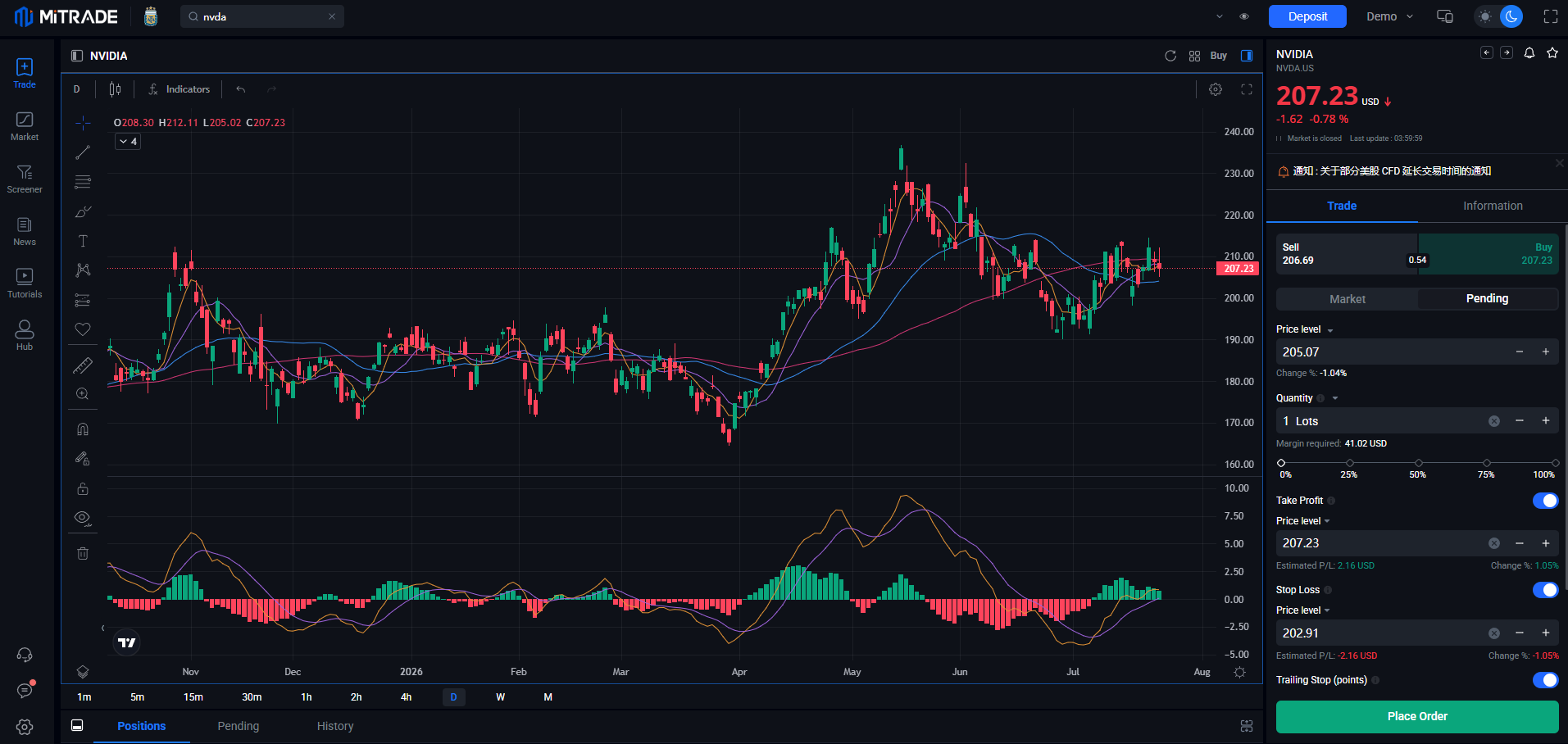
Nvidia does not need to wait for earnings to move sharply. A fresh demand signal, supply-chain issue or shift in AI-spending expectations could change the market’s view well before Q2 results drop.
“Trade Nvidia Stock with an ASIC-regulated broker. Fast AUD funding via PayID. ”
What could drive Nvidia’s next move?
The August earnings release is the next major event, but traders will be watching several signals before then.
Vera Rubin deployment: More customer announcements would support the case that Nvidia’s next platform is already attracting demand.
Advanced packaging capacity: Updates from Amkor, TSMC or other suppliers could show whether industry capacity is keeping pace with increasingly complex AI systems.
Hyperscaler capital spending: Investment plans from Alphabet, Microsoft, Amazon and Meta remain critical to the wider AI infrastructure trade.
Data-centre revenue and gross margins: Nvidia’s next report will need to show that rapid revenue growth is not coming at the expense of profitability.
China and export restrictions: Changes to US policy or Nvidia’s ability to serve China can affect revenue expectations and investor sentiment.
Technology-market conditions: Bond yields, broader AI valuation concerns and profit-taking across large-cap technology can amplify Nvidia’s reaction to company news.
The near-term case for Nvidia remains powerful, but the market will be looking for proof that demand is deepening across industries rather than simply being concentrated among a handful of large buyers.
Trade Nvidia CFDs with Mitrade
Nvidia shares can move quickly when earnings, customer demand or AI infrastructure spending reshapes expectations. Mitrade gives Australian traders practical tools for responding to those changes:
CFDs on Nvidia and major US indices
Long and short positions in rising or falling markets
Charts, pending orders, stop-losses and take-profit tools
AUD account funding, with margin and profit or loss displayed in Australian dollars
Mobile access for following US-market developments
ASIC regulation and a free $50,000 demo account to practise before trading with real capital
CFDs are complex instruments and carry a high risk of losing money rapidly due to leverage. Traders should ensure they understand how CFDs work and consider whether they can afford the high risk of losing their money.
Start trading Nvidia in three simple steps
Open an account: Register through the Mitrade homepage or use the fast sign-up process with an existing Google or Facebook account.
Fund in Australian dollars: Deposit initial margin using supported payment methods, including POLi or Visa/Mastercard.
Choose the exposure: Trade Nvidia directly or use the Nasdaq for a broader view on AI and US technology sentiment.
Nvidia’s next earnings result may be weeks away, but the evidence around its next AI chip cycle is already building. Open your Mitrade account today and use the demo account to practise before the next major catalyst.


1. Why does advanced chip packaging matter to Nvidia?
Advanced AI chips need to be packaged with other components, including high-bandwidth memory, so they can operate as part of a high-performance computing system. More available packaging capacity may help Nvidia deliver its products at scale, although it does not remove all production or demand risks.
2. Can traders benefit if Nvidia shares fall?
CFDs allow traders to take short as well as long positions. A short position may benefit if Nvidia’s share price falls, although losses can occur if the price rises instead.
3. Will Nvidia’s August earnings be the next major catalyst?
It is likely to be the most important scheduled event. Traders will focus on revenue guidance, data-centre demand, gross margins and any update on the timing and customer adoption of Vera Rubin systems.
Disclaimer: The content presented above, whether from a third party or not, is considered as general advice only. CFD trading involves significant risk of loss. Past performance does not guarantee future results. This article serves informational purposes only and does not constitute financial advice. Consider your risk tolerance before trading.


