




Japan, South Korea Stocks Rebound as SK Hynix Record Earnings Boost Shares; Nikkei 225 Returns to 63,000, Kospi Rises Nearly 3%, Kioxia Gains Over 7%
TradingKey - In the early Asian trading session on July 29, after sharp consecutive corrections the previous day, Japanese and South Korean stock markets rebounded. SK Hynix rose over 3% after releasing its financial results, Samsung Electronics climbed over 4%, and Kioxia surged over 7%.
South Korea's KOSPI Index opened 1.1% higher, with its gains subsequently expanding to 2.76%, temporarily trading at 6,190.04 points. Japan's Nikkei 225 Index opened up 0.59% and moved further higher intraday, briefly reclaiming the 63,000-point mark, and was last up 1.07% at 63,034.55 points.
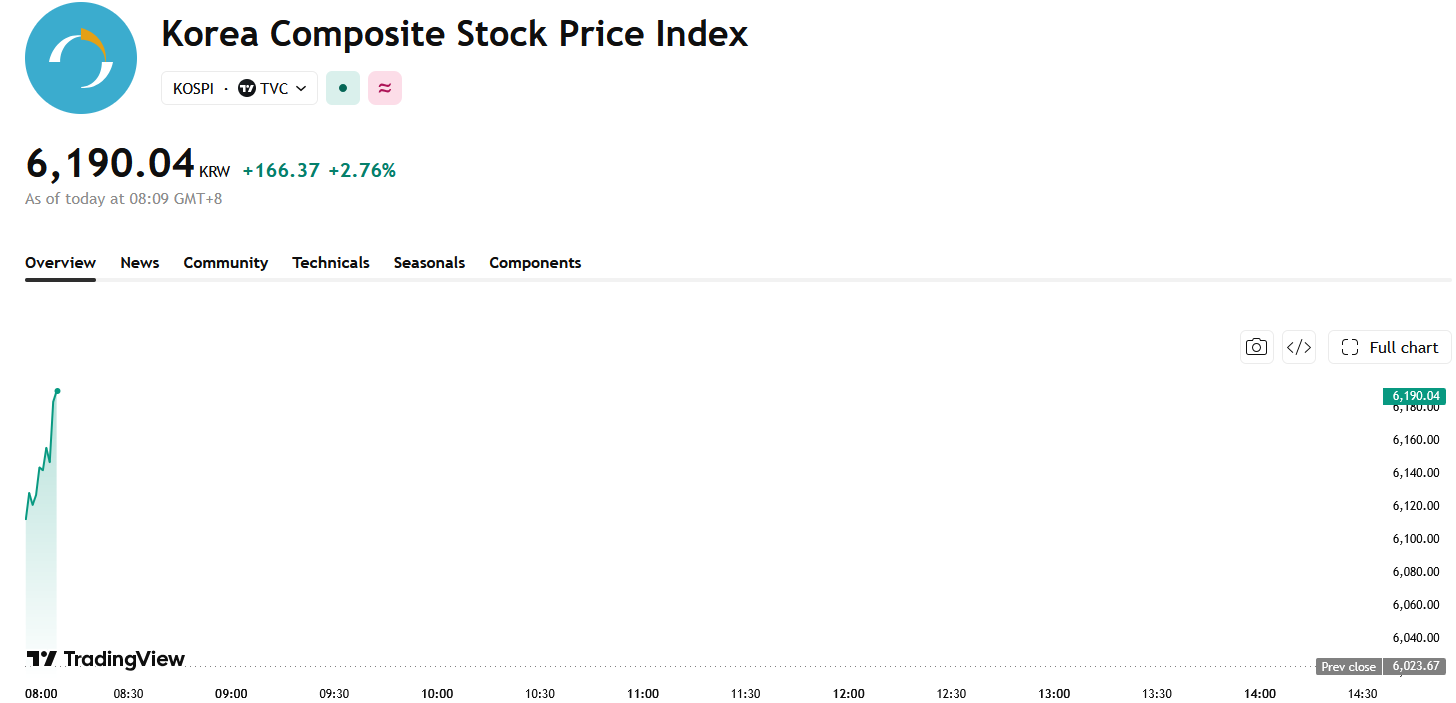
Source: TradingView
SK Hynix rose 3.74% to 1,608,000 won (approximately $1,105); Samsung Electronics climbed 4.55% to 230,000 won (approximately $159), with the two heavyweight stocks driving an overall recovery in the South Korean semiconductor sector.
In the Japanese market, Kioxia surged 7.30% to 47,800 yen (approximately $292), becoming one of the leading gainers among the Nikkei 225 components; SoftBank Group was flat, ticking up 0.1% to 5,100 yen (approximately $31).
SK Hynix's newly released quarterly results took center stage. The company released its second-quarter earnings report after the US market close on July 28, with operating profit surging 557% year-over-year to 60.5 trillion won, and revenue growing 257% year-over-year to 79.3 trillion won, with both metrics reaching record highs.
However, as both operating profit and revenue missed previous market expectations of approximately 64.2 trillion won and 83.9 trillion won, the stock price fell over 9% in after-hours trading following the earnings release. As investors digested the results, SK Hynix's post-market decline gradually narrowed, eventually turning to a gain of over 2%.
The company also stated that capital expenditures for 2026 are expected to be at the upper end of the guidance range of 40 trillion to 50 trillion won, indicating that it will continue to increase investments in AI-related businesses such as High Bandwidth Memory (HBM).
Overnight, the US tech sector remained under pressure, with the Nasdaq 100 Index falling about 1% and the Philadelphia Semiconductor Index slumping 4.5%, declining for a second consecutive session.
The memory chip sector's decline was particularly pronounced, with the DRAM memory ETF plunging 8.89%, and Micron ( MU) falling over 12% intraday, while SanDisk ( SNDK) fell more than 14%.
Recommended Articles


