




Could Investing $50,000 Into S&P 500 Index Funds Be Enough to Get Your Portfolio to $1 Million by Retirement?
Key Points
The S&P 500 has achieved higher-than-typical returns in recent years.
Tracking the index today may yield lower future returns, but the overall gains can still be significant.
A $50,000 investment can turn into $1 million, but how quickly it does will depend heavily on the growth rate.
- 10 stocks we like better than S&P 500 Index ›
The old adage that you need money to make money is true, as the benefits of compounding are greater when an investment balance is large. Consider that the S&P 500 (SNPINDEX: ^GSPC) has averaged an annual return of 10% for decades. That means an investment might, on average, double after just over seven years. But if someone were to invest $1,000, the gain would be much more modest than if they invested $10,000 or $50,000.
That's why there's a strong incentive to invest a large lump sum for those who can afford to do so. Below, I'll look at whether a $50,000 investment in S&P 500 index funds today could grow to $1 million or more by retirement.
Where to invest $1,000 right now? Our analyst team just revealed what they believe are the 10 best stocks to buy right now, when you join Stock Advisor. See the stocks »

Image source: Getty Images.
The S&P 500 has generated strong returns, but they may be a bit more modest in the future
Estimating how large an investment in the S&P 500 might grow to be in the long run is no easy task, since it depends on assumptions about its future growth rate. What complicates matters is that the S&P 500 index has been performing well above average in recent years, and thus, it may be overdue for a slowdown. That means investing today could result in below-average returns in the future.
While the index has averaged returns of around 10% for decades, there have been periods when it's been far below that. Investing in an index fund that tracks the S&P 500 today might still be a good move, but investors may need to brace for lighter annual returns of around 9% or perhaps even 8%.
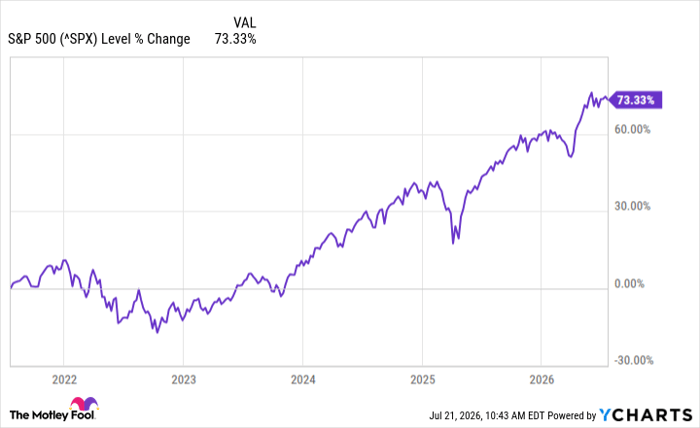
^SPX data by YCharts
Here's how large a $50,000 investment might grow to be over the long run
Rather than picking a specific growth rate, I've created a table below showing what a $50,000 investment would grow to at varying rates over a very long time frame. It also demonstrates just how significant even a 1% change in the annual return can be for an investment in the long run.
| Year | 8% Return | 9% Return | 10% Return |
|---|---|---|---|
| 5 | $73,466 | $76,931 | $80,526 |
| 10 | $107,946 | $118,368 | $129,687 |
| 15 | $158,608 | $182,124 | $208,862 |
| 20 | $233,048 | $280,221 | $336,375 |
| 25 | $342,424 | $431,154 | $541,735 |
| 30 | $503,133 | $663,384 | $872,470 |
| 35 | $739,267 | $1,020,698 | $1,405,122 |
| 40 | $1,086,226 | $1,570,471 | $2,262,963 |
Table and calculations by author.
A $50,000 investment in an index fund tracking the S&P 500 can indeed grow to $1 million, but whether it gets there by retirement will depend on what the average annual return will end up being and how many years a person still has until retirement.
However, even for investors who may be worried about a slowdown ahead, it can still make a lot of sense to invest in a top index fund, as it remains a relatively low-risk way to invest in the stock market.
Should you buy stock in S&P 500 Index right now?
Before you buy stock in S&P 500 Index, consider this:
The Motley Fool Stock Advisor analyst team just identified what they believe are the 10 best stocks for investors to buy now… and S&P 500 Index wasn’t one of them. The 10 stocks that made the cut could produce monster returns in the coming years.
Consider when Netflix made this list on December 17, 2004... if you invested $1,000 at the time of our recommendation, you’d have $377,990!* Or when Nvidia made this list on April 15, 2005... if you invested $1,000 at the time of our recommendation, you’d have $1,269,518!*
Now, it’s worth noting Stock Advisor’s total average return is 896% — a market-crushing outperformance compared to 206% for the S&P 500. Don't miss the latest top 10 list, available with Stock Advisor, and join an investing community built by individual investors for individual investors.
See the 10 stocks »
*Stock Advisor returns as of July 25, 2026.
David Jagielski, CPA has no position in any of the stocks mentioned. The Motley Fool has no position in any of the stocks mentioned. The Motley Fool has a disclosure policy.
Recommended Articles


