




Palantir (PLTR) Falls 6% - NHS Scrutiny, Open-Source Rival, Earnings Aug 3
TradingKey - Palantir Technologies (NASDAQ: PLTR) is at $125.03 as of Wednesday, July 22, falling 6% from Monday’s intraday high of $133.00 following two distinct catalysts. First, the UK Office for Statistics Regulation (OSR) addressed public concerns regarding the communication of performance data by NHS England on its Federated Data Platform (FDP), raising compliance questions on a high profile international healthcare contract. Secondly, a developer launched the free open-source tool World Monitor on GitHub.
While not a commercial substitute, World Monitor provides similar global intelligence monitoring functions to Palantir's commercial offering. Second Quarter 2026 results are due Aug. 3. Analysts' average price target is $186.32. The relative strength index is near 34, nearing an oversold territory. The primary support levels are $122.92, and then $119.10.
Two Catalysts Behind Today's 6% Drop
The UK Office for Statistics Regulation issued an official statement today regarding public concerns on the way NHS England is communicating performance data on the Federated Data Platform (FDP), the company's largest healthcare contract. The FDP is a cornerstone of NHS England's digital infrastructure, bringing together patient data, clinical records, workflow data and operational data from across NHS hospital trusts. The OSR did not call for the termination of the contract, but the compliance question over a high profile deal that Palantir has relied on to demonstrate its healthcare AI capabilities is concerning.
The FDP contract, valued at hundreds of millions of pounds, forms a substantial component of Palantir's healthcare business in the UK and internationally. A finding by the UK regulator which required NHS England to make alterations to the way it presented data from the FDP could mean changes to the FDP's architecture itself.
The second catalyst was a lower-profile event that nonetheless hits on one of the regular fears of Palantir bulls. A developer launched the free open-source alternative, World Monitor, on GitHub. World Monitor does not compete at the enterprise scale, it is a GitHub project not a live production service.
But the launch of a free alternative did prompt immediate discussion because the reason Palantir can command high prices is the perception that only Palantir's level of data consolidation, security architecture and AI-driven analytics could ever be offered for such a fee. Even open source projects that do not offer the same functionality can chip away at that perception. With a price-to-earnings of 139 to 149 times current earnings, any event that chips the moat can move a stock with a higher valuation.
What the Business Looks Like Today Ahead of Aug. 3
With $5.22 billion in trailing twelve-month revenues, and $2.28 billion in net income, Palantir runs profit margins of 43.7%. It holds a war chest of $8.03 billion in cash, and relatively little debt in its capital structure. Over the past three years the stock has returned approximately 7x for shareholders. Year-over-year, first-quarter 2026 revenues increased 39%, US commercial revenues surged 71% and government revenues gained 45%.
Palantir has expanded its platform dramatically in recent months; AI Platform (AIP) has gone beyond military and intelligence agencies to now include healthcare and commercial businesses alike. Its Small Business Administration (SBA) anti-fraud contract announced earlier this week, identifies and pursues fraud in the government-backed Small Business relief programmes, which was enacted as an emergency measure during the pandemic. Such high-value, government-mandated initiatives are not typically easy to replicate by competitors.
The valuation, however, is one of the central questions for Palantir stock today, with it trading at an average 139 to 149 times trailing earnings, against an industry average of 28 times and peer group average 36 times. According to valuation firm Simply Wall St, the stock is between 10% and 23% undervalued on a DCF cash flow basis, suggesting that the market is pricing in real growth but not necessarily exponential growth.
The forward P/E is approximately 90 times based on the consensus expectations that earnings will approximately double over the next 12 to 18 months, which this year's first quarter growth rate tracks to. Aug 3 first quarter earnings will be the first public disclosure this year where the consensus expectation of growth in US commercial businesses, government and the AIP rate can be judged. Motley Fool predicts PLTR stock will go parabolic after August 3 if results match the expectation.
PLTR Technical Set-Up - $130 Pivot Rejected, 34 RSI, Support Levels
Palantir is at $124.77 on the 4-hour chart and was rejected from the $130.03 pivot where 50EMA ($130.21) and 200 EMA ($132.22) are clustered. Today, the stock was in a $123.45 to $133 range. The relative strength index is currently near 34 and approaching oversold levels without a reversal confirmation.
Key support is at $122.92, followed by the secondary support level of $119.10. If the stock closes below $119.10, the support levels are $112.25, and $106.60. A reversion above $130.03 targets $137.38 and $144.44, provided the stock closes above the descending trendline.
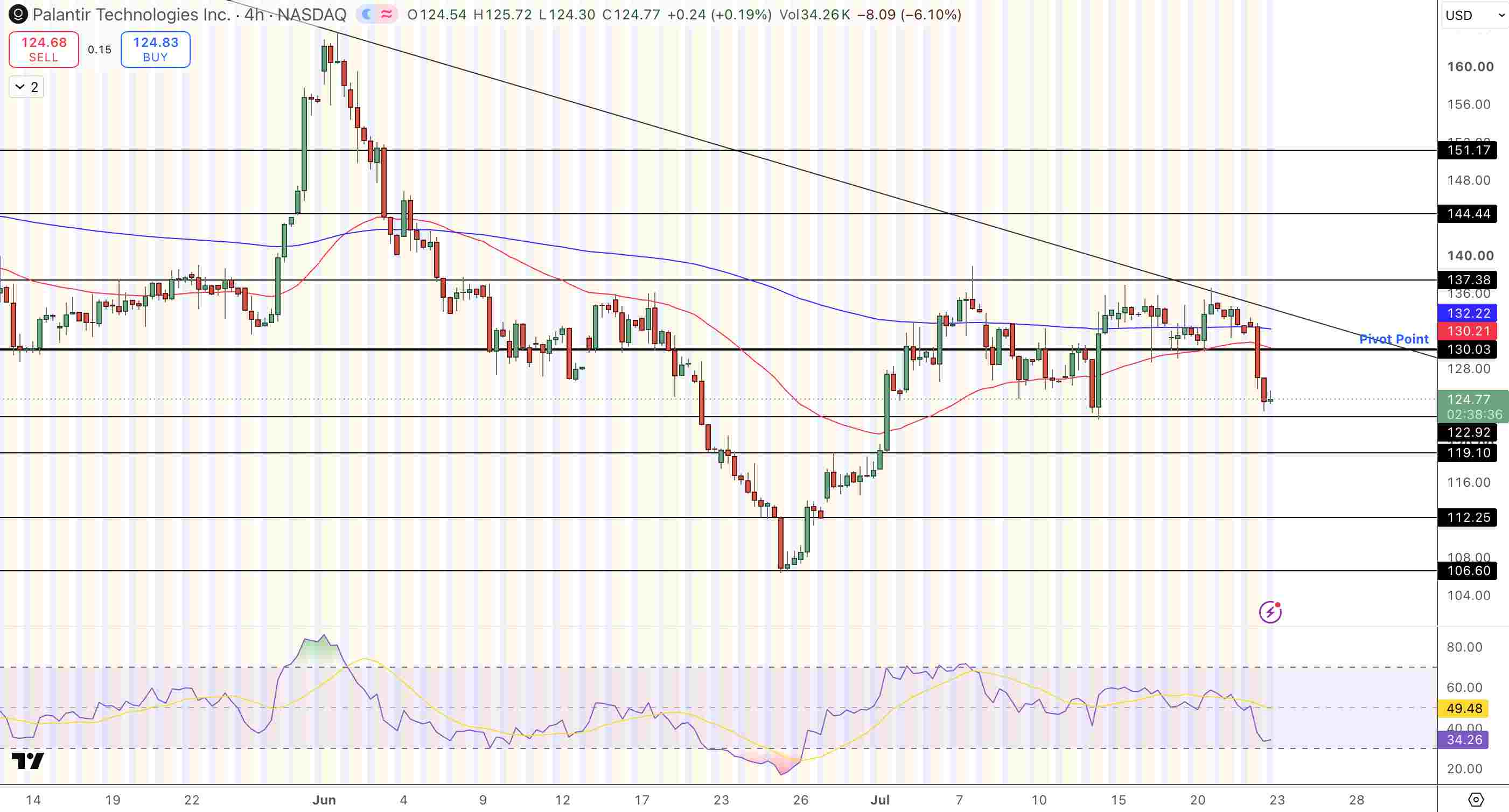
Palantir Price Chart - Source: Tradingview
Today's range: $123.45 to $133.00 | Current: $125.03 (-6%) | YTD: -21%
- NHS: The UK's Office of Statistics Regulation investigated how NHS England communicates performance results from Federated Data Platform (FDP) contract.
- Open Source: World Monitor is a free, open source alternative to Palantir's intelligence tracking, launched on GitHub.
- Q2 Earnings: Aug 3 2026. Consensus: Expect continued strong growth in commercial US businesses, government contracts.
- Analyst Targets: Consensus $186.32. Highest: $255. Lowest: $70.
- Valuations: P/E ratio: 139 to 149 times trailing earnings. Price to Sales: 65x.
- Support: $122.92 then $119.10. Lower supports: $112.25, then $106.60. To gain traction, stock must close above $130.03.
Why Did Palantir Fall 6% on July 22?
Two separate stories put downward pressure on Palantir stock today. First, the UK’s Office for Statistics Regulation released a statement responding to criticism from the public about how NHS England reports performance metrics on the Federated Data Platform, Palantir’s largest healthcare partnership in the UK. The statement raised the possibility of compliance issues for the contract, one that Palantir has frequently used to show its ability to deploy healthcare AI.
Separately, someone launched World Monitor on GitHub, a free open-source version of Palantir’s global intelligence tracking products. While not enterprise-ready, World Monitor’s release triggered some questions on the viability of Palantir charging the prices it does, a point more pertinent at a 139x price/earnings multiple than it would be with a more conventional valuation.
What Is the NHS Federated Data Platform and Why Does It Matter for Palantir?
The NHS Federated Data Platform is Palantir’s largest healthcare contract. The program, worth hundreds of millions of pounds, pulls together patient data, clinician workflows, and administrative information for every hospital trust in NHS England.
The UK’s Office for Statistics Regulation put out a statement Wednesday responding to criticism from the public about how NHS England was communicating performance metrics on the FDP. It didn’t cancel the contract, but it introduced the possibility of compliance issues that could require the FDP to change how it reports on its success. Such changes may have cost implications and delay Palantir’s efforts to replicate the FDP model with other national healthcare systems.
What Should Investors Watch at Palantir's August 3 Earnings?
Palantir will release fiscal 2026 second-quarter financial results on August 3. The key factors to watch are US commercial revenue growth. The unit grew at 71% on a year-on-year basis in the first quarter and has room to maintain or accelerate those growth rates in Q2. The second factor is government growth from a combined US Department of Defense and intelligence community business as well as other international government contracts.
Finally, any information available on AI Platform adoption rates, showing how many customers have moved from the pilot stage to actual production deployment. Any update on the status of the NHS Federated Data Platform relationship from the OSR statement should be watched carefully. According to Robinhood options data, traders expect a volatile move after August 3’s results, indicating they aren’t certain about whether Q2 will confirm the direction Q1 took in growth.
Bottom Line
Palantir shares traded 6% lower on Tuesday, closing at $125 in part because of the UK’s Office for Statistics Regulation release regarding the NHS and because the World Monitor open source project was posted on GitHub on Tuesday. Neither represents an existential threat, but both reinforce investors’ concerns about the company trading at 139 times earnings.
On the fundamental side, Palantir has generated US$5.22 billion in sales over the last 12 months, with 44% profit margins and an $8 billion cash balance. The stock is up 7x over the last three years. RSI near 34 approaches oversold.
Palantir’s support level is at $122.92. A drop below that price puts immediate support at $119.10. A close above $130.03 should take the stock toward $137.38. August’s Q2 results could either confirm the path US commercial and US government customers are on or call that narrative into question.
Recommended Articles


