




Google’s Strong Q2 Results Fail to Prevent Stock Pressure, Free Cash Flow Turns Negative for First Time, AI Spending Sparks Concern
TradingKey - Google's parent company Alphabet ( GOOGL) ( GOOG) delivered a quarterly scorecard showing both growth and pressure.
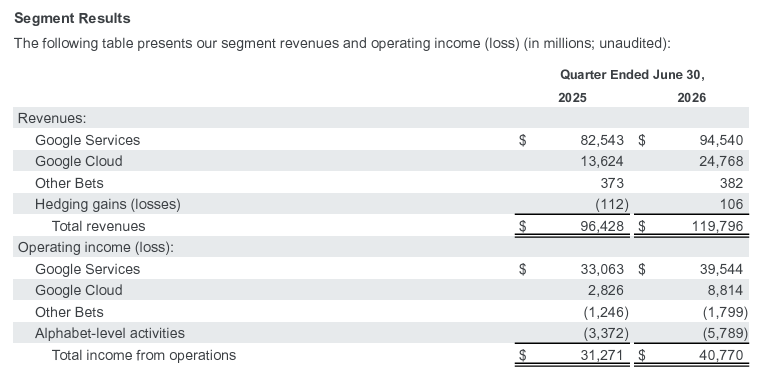
The earnings report showed that for the second quarter ended June 30, the company's revenue reached $119.8 billion, up 24% year-over-year, marking the 12th consecutive quarter of double-digit growth; operating profit rose to $40.77 billion, and the operating margin increased to 34%, reflecting a still-robust overall operating performance.
The real standout was Google Cloud. Driven by the continuous release of generative AI demand, cloud business revenue surged 82% year-over-year to $24.8 billion, which not only far exceeded market expectations but also set a record for the fastest growth in recent years.
Source: Google
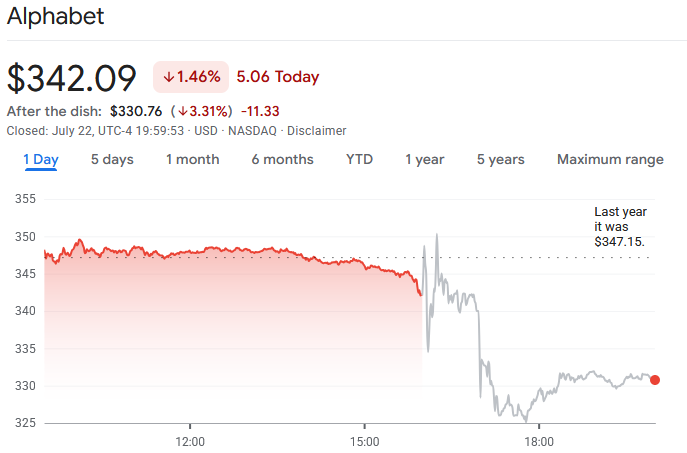
However, after the release of this report, market focus quickly shifted from the stellar revenue to another more controversial metric—Google's first negative quarterly free cash flow since its IPO, while management once again raised its full-year capital expenditure targets.
Growth driven by AI investments has begun to materialize, but to compete for the next phase of competitive advantage, the company is paying increasingly high capital costs, which also became the primary reason for the pressure on the stock price after the earnings release.
Source: Google Finance
Cloud Business Continues to Surge, AI Starts to Deliver Commercial Value
This quarter, Google Cloud remains Google's fastest-growing core engine.
Driven by enterprise AI infrastructure buildout, Google Cloud Platform (GCP), and the continuous growth in demand for generative AI solutions, cloud revenue reached $24.768 billion, up 82% year-over-year, significantly outperforming prior market expectations.
Meanwhile, the profitability of the cloud business improved in tandem, with operating profit rising to $8.814 billion, more than tripling from the same period last year, and operating margins further expanding, indicating that the AI business has not only driven revenue expansion but has also begun to contribute higher-quality earnings.
Another metric highly watched by the market also hit a new high.
As of the end of the quarter, Google Cloud's contracted but unrecognized revenue reached $514 billion, surpassing the $500 billion mark for the first time and continuing to expand from the previous quarter. The company expects that more than half of this will be recognized as revenue over the next two years, meaning that the cloud business still maintains strong growth certainty over the coming quarters.
Although Google Cloud still lags behind Microsoft Azure and Amazon AWS, its importance in the AI infrastructure market is continuously rising thanks to the rapid growth in demand for AI model training, inference, and enterprise deployment, making it a new growth pillar for Alphabet.
AI Investment Continues to Escalate, Free Cash Flow Falls Into Negative for the First Time
If the cloud business demonstrates the fruits of AI commercialization, cash flow reflects the price Google is paying for this competition.
In the second quarter, the company's capital expenditures reached $44.9 billion, nearly doubling from the same period last year, with the vast majority used for servers, data centers, and network infrastructure. As infrastructure investment increased rapidly, free cash flow for the quarter fell to negative $5.86 billion, marking the first time Alphabet has recorded a negative quarterly free cash flow since going public.
For a long time, free cash flow has been Google's most competitive financial advantage and a key metric for investors to gauge the quality of the company's earnings. Consequently, this change quickly became the focus of market discussion.
More importantly, the company has not slowed its pace of investment.
During the earnings call, Chief Financial Officer Anat Ashkenazi announced that the capital expenditure target for full-year 2026 would be further raised to $195 billion to $205 billion, up from the previous forecast range of $180 billion to $190 billion. This is already the second time this year that Google has raised its capital expenditure guidance, meaning the company is continuing to accelerate its AI infrastructure buildout.
Ashkenazi stated that market demand still significantly outstrips existing supply, and the company will continue to rely on a combination of operating cash flow, debt financing, and previously completed equity financing to support AI investments, expecting free cash flow to remain under pressure in the short term.
In fact, to secure the funds needed for AI expansion, Google not only recently issued more than $20 billion in bonds but also completed its first large-scale equity financing in more than two decades since going public, raising nearly $70 billion in cumulative funding while retaining a quota for subsequent share issuances. This also means that the internet company, once renowned for its abundant cash flow, is gradually transitioning to a more capital-intensive development model.
Market concerns have also intensified as a result. Some analysts believe that when capital expenditures consistently exceed cash generation capability, investors will focus more on whether AI projects can realize profits as soon as possible, rather than simply pursuing revenue growth.
Gemini Enters Critical Phase, Google Accelerates Next Round of AI Competition
Since the beginning of this year, the delayed launch of Gemini 3.5 Pro has raised market doubts about the pace of Google's AI research and development. Especially as competitors such as Anthropic and OpenAI continue to roll out new models, whether Google still maintains a leading edge has become a major focus for investors.
In response, CEO Sundar Pichai stated that the company has shifted its R&D focus to the next-generation flagship model Gemini 4, and is currently allocating more computing power for training, with plans to further accelerate the pace of model updates.
Meanwhile, the Gemini ecosystem continues to expand rapidly. Currently, nearly 90% of Fortune 100 companies have deployed Gemini Enterprise; the Gemini model processes approximately 22 billion API tokens per minute; and Gemini App's monthly active users have reached 950 million, leaving it just one step away from joining the ranks of Google's billion-user products.
Whether High Investment Can Yield High Returns Becomes Market’s New Test
Overall, this earnings report highlights Google's most distinctive current feature. On one hand, AI has begun to contribute real revenue, with Google Cloud growing rapidly and enterprise orders continuing to accumulate, proving that the company's investments over the past few years are gradually paying off. On the other hand, to maintain this leading edge, the company must continue to invest more capital, pushing capital expenditures to consecutive record highs, while free cash flow dipped into negative territory for the first time.
For the market, the real question is no longer whether Google is willing to invest in AI, but whether these growing capital expenditures can continue to translate into higher revenue, stronger profitability, and more stable cash flow in the future.
In the coming quarters, whether Google Cloud can maintain its rapid growth, the pace of Gemini's commercialization, and when AI infrastructure investments will begin to generate cash returns will all determine whether Google's massive AI bet will ultimately win market approval.
Recommended Articles


