




Why Upstart Stock Lost 19% in the First Half of 2026
Key Points
Upstart continued to deliver strong top-line growth in 2026.
Concerns about declining take rates and margins pushed the stock lower.
Dave Girouard surprised investors by stepping down as CEO.
- 10 stocks we like better than Upstart ›
Upstart's (NASDAQ: UPST) business has come a long way in recent years. The fintech stock was one of the biggest losers in the post-pandemic bear market as its profits evaporated in 2022, but since then, it has regrouped, returned to generally accepted accounting principles (GAAP) profitability, and delivered strong growth.
However, that hasn't been enough to please investors, at least so far this year, and concerns about its business model and the departure of CEO Dave Girouard have hung over the company, despite its continuing to deliver solid results.
Where to invest $1,000 right now? Our analyst team just revealed what they believe are the 10 best stocks to buy right now, when you join Stock Advisor. See the stocks »
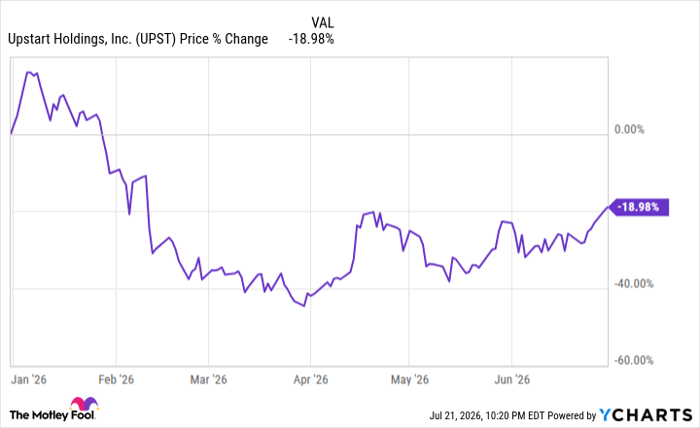
As a result, the stock fell 19% in the first six months of 2026, according to data from S&P Global Market Intelligence. As you can see from the chart below, shares fell sharply through the first quarter before recouping some of those losses in Q2.
UPST data by YCharts
What happened with Upstart this year
Upstart actually jumped out of the gate, scoring a buy rating from Truist early in the year, crediting its advantage over traditional credit scoring and its AI foundation. However, by the end of January, the stock was in the red.
Upstart tumbled in February as it gave investors two bitter pills to swallow. First, it said that co-founder Dave Girouard was stepping down as CEO, to be replaced by co-founder and then-CTO Paul Gu, and it reported fourth-quarter earnings, delivering solid results but offering underwhelming guidance.
Overall growth in the quarter was impressive, with loans originated up 86% to 455,788 and revenue up 35% to $296.1 million as the company targets smaller loans and lower-risk borrowers, which offer less of a premium and have led to lower take rates. That figure beat estimates at $288.6 million.
On the bottom line, adjusted earnings before interest, taxes, depreciation, and amortization (EBITDA) rose from $38.8 million to $63.7 million, and it reported a GAAP profit per share of $0.17.
However, the company guided 2026 adjusted EBITDA margin to fall slightly from 22% to 21%, and investors also seemed worried about declining take rates, suggesting its lending partners aren't paying as much as they previously were. The stock fell 15% on Feb. 11 on the news and continued to decline from there.
The stock began to come back in April, popping 13% on April 15 in response to comments from Morgan Stanley that downplayed the risks in the private credit market, which have weighed on Upstart.
Shares pulled back again following the first-quarter earnings report in May, as it delivered solid growth but similar concerns persisted, including its declining take rate. More importantly, its adjusted EBITDA margin fell from 20% to 13%, driven by higher sales and marketing expenses, and its net loss widened from $2.4 million to $6.6 million.

Image source: Getty Images.
What's next for Upstart
The company maintained its guidance for the year in the Q1 report, and CEO Paul Gu bought 50,000 shares of the stock the following week in May, which is typically a bullish signal.
Management also offered guidance through 2028, calling for a compound annual growth rate of around 35% during 2025-2028 and an adjusted EBITDA margin of 28%. If it can execute on that, the stock should move higher, but this is still a risky stock, especially considering that interest rates are now expected to move higher by the end of the year.
Should you buy stock in Upstart right now?
Before you buy stock in Upstart, consider this:
The Motley Fool Stock Advisor analyst team just identified what they believe are the 10 best stocks for investors to buy now… and Upstart wasn’t one of them. The 10 stocks that made the cut could produce monster returns in the coming years.
Consider when Netflix made this list on December 17, 2004... if you invested $1,000 at the time of our recommendation, you’d have $364,562!* Or when Nvidia made this list on April 15, 2005... if you invested $1,000 at the time of our recommendation, you’d have $1,247,668!*
Now, it’s worth noting Stock Advisor’s total average return is 894% — a market-crushing outperformance compared to 207% for the S&P 500. Don't miss the latest top 10 list, available with Stock Advisor, and join an investing community built by individual investors for individual investors.
See the 10 stocks »
*Stock Advisor returns as of July 22, 2026.
Jeremy Bowman has positions in Upstart. The Motley Fool has positions in and recommends Truist Financial and Upstart. The Motley Fool has a disclosure policy.
Recommended Articles


