




SpaceX (SPCX) Fell Despite Investment-Grade Ratings — Why the $20B Bond Deal Matters
TradingKey - SpaceX (NASDAQ: SPCX) is trading at $178.91, probing the ascending black trendline support on the 2H time frame following a correction from its $225.64 record high. The stock is now oscillating between a recent $172 low and $190 resistance. RSI reading is at 44.24, in neutral zone with no strong divergences and long wicks of recent candles showing buyers defending the trendline convergence zone near 0.618 Fibonacci level.
One event from the past week is probably more important than charts: Moody’s, Fitch, and S&P Global each rated SpaceX creditworthy with a stable outlook on June 18, the same day the stock fell close to 4%. It will likely be the most useful exercise for investors to determine why the strongest financial rating that a corporate lender can get didn't lift the stock price. This is vital as the stock market awaits SpaceX to raise more money through an expected $20 billion bond sale, likely taking place this week.
Investment-Grade Ratings on a Down Day — Equity vs Bond Market Logic
Moody’s issued Baa1, Fitch gave SpaceX a BBB+, and S&P Global rated the company BBB, all with a stable outlook. This was the day that every major credit rating agency assigned SpaceX investment-grade status. At market close, SpaceX stock was down nearly 4%. This is as clear a case of the equity market and the bond market valuing the same piece of information in two very different ways as I’ve witnessed.
The first reason is obvious. Investment-grade status means access to much more capital: pension funds, insurers, and anyone that buys only investment-grade bonds can purchase SpaceX debt, not the limited pool of institutional investors that is buying it now. And lower yield means lower cost of borrowing, which is very relevant when you’ve got $29 billion long-term debts, as SpaceX does.
The second reason, however, is more specific to equity market. It was announced on June 18 that the credit ratings of SpaceX’s bonds, a $20 billion bridge loan which needs to be paid back in September 2027, is investment-grade. This is not a flexible deadline. It doesn’t matter where the stock trades in between now and then; SpaceX must raise $20 billion through a debt offering or find another lender, because this money has to be replaced before September 2027 one way or another.
The reason SpaceX stock declined rather than rallied in reaction to the ratings is that the equity market is not focused on credit ratings. Rather than focus on credit ratings, it’s important to focus on what was disclosed and why that disclosure could matter to SpaceX: S&P’s report predicted that SpaceX would post negative free cash flows through 2029. Moody’s flagged governance concerns, given the heavy reliance on a person, due to its high voting power by a single person. Fitch pointed out a capital-intensive situation with its AI arm. The equity market was selling on the liability confirmation. The bond market was buying on a path to financing the liability.
What the Agencies Actually Said About Starlink and AI — 12 Million Subscribers and $75 Billion in Compute Deals
The rating agencies' bullish thesis centers almost exclusively on Starlink, the segment all three agencies named as the core engine of SpaceX's cash flows, and therefore the focal point of its investment grade rating. Starlink had attracted 12 million users by early June, 2026, a number the source article citing a figure of 5.5 million significantly understated.
Moody's predicted robust revenue and earnings growth through 2028, mainly due to Starlink, including a milestone expected to be reached by the AI division. It also pointed to recent third party compute contracts signed with both Google and Anthropic, totaling $75 billion, as proof of the potential of the AI business.
Fitch highlighted SpaceX's dominant position in the commercial launch sector, accounting for more than 80% of the orbital mass delivered since 2023. Fitch viewed this as a testament to the soundness of the connectivity operation.
The caveats were just as significant: Moody's specifically warned of the governance risks associated with the restricted ownership and voting powers of SpaceX, noting the dependency on a single individual. S&P's forecast that SpaceX would continue to run in the red until 2029, even though Starlink is profitable, accounted for the capital costs of the Starship development and the AI business expansion.
Those risks aren't new, which partly explains the wide variance in valuation estimates that range from Morningstar's $62 to Arete Research's $401. The new development here is that three independent credit rating agencies have now provided a detailed analysis of those risks in their public credit assessment, offering an explicit evaluation of risk that no equity research note has since the IPO.
SPCX Technical Setup — Ascending Trendline at $178.91, Resistance $187–$196, Target $196.60
At its lower high ($2H) time frame, SPCX is bouncing up against the 0.618 Fib and ascending black trend ($178.71), the lower wick confirming buyers defending this level. RSI at 44.24 is neutral with some upside left and no major divergence, and the volume has thinned out a bit on the last couple of bars, a sign of healthy exhaustion rather than major selling pressure.
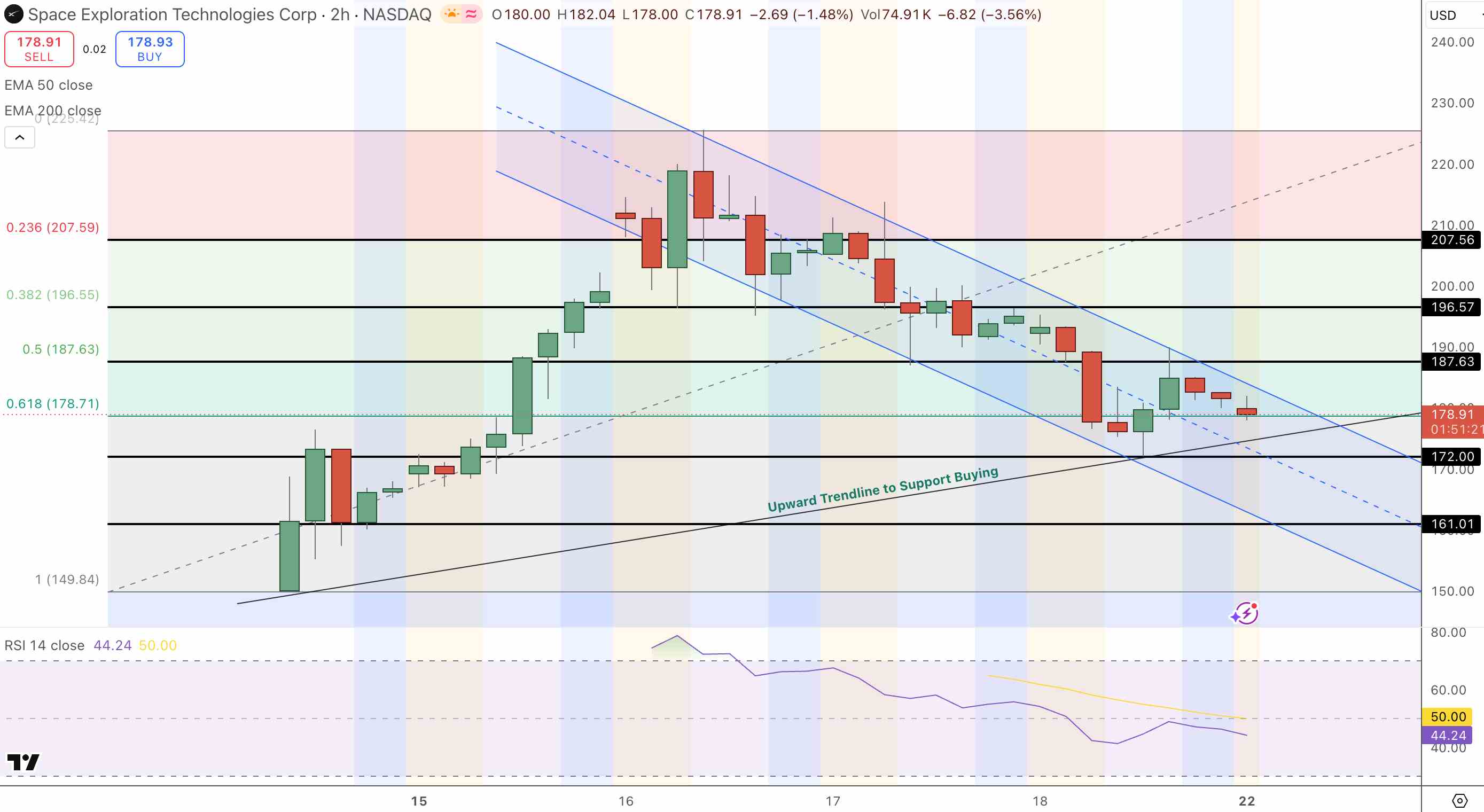
SpaceX (SPCX) Price Chart - Source: Tradingview
Resistance above the stock is in the $187.63 to $196.57 level, where both Fibonacci and EMA zones reside. Holding on to the current trend suggests a bounce higher to somewhere between $196 and $207. A break below $172 would bring $161.01 back into play. We'd buy a retest above $187.60 with a target of $196.60 on the trendline and a stop loss just below $172.00.
- Entry: Longs above 187.60 - Above Fib and EMA
- Target: 196.60 - Trendline retrace
- Support: 178.71 - 0.618 Fib and Ascent trend
- Stop loss: Below 172.00 - below ascending trendline, 161.01
- Bond issue: ~20 billion, this week, as a near term trade
- Next earnings: August 6, 2026, per TradingView
Why Did SpaceX Stock Fall on the Same Day It Got Investment-Grade Credit Ratings?
On June 18, Moody’s (Baa1), Fitch (BBB+), and S&P (BBB) all gave SpaceX an investment-grade rating, yet the stock closed down almost 4% that same day. The rating confirmed SpaceX’s outstanding $29 billion of debt, which includes a $20 billion bridge loan due in September 2027, a loan that must be refinanced no matter where SpaceX’s stock is trading.
The three agencies also revealed that S&P is anticipating negative free cash flow through 2029 while Moody’s pointed out its concerns about governance and single-individual concentration. In other words, for bond investors, the investment-grade rating means cheaper refinancing. But for equity investors, it just confirmed SpaceX has lots of liabilities and risk.
What Is the $20 Billion Bond Deal and Why Does It Matter?
Next, SpaceX could start a $20 billion bond deal later this week to refinance that bridge loan that has to be refinanced in September 2027. That is why it is important. In September 2027, SpaceX must complete refinancing regardless of market conditions or its own stock price. No matter where the stock is trading, there is no getting away from that bridge loan deadline.
This explains why getting an investment-grade rating from all three agencies is such a big deal for SpaceX. The bond market will have to purchase the bonds because it is an investment-grade rated issue, meaning pension funds and insurers can purchase them. It’s a very large pool of demand and enables SpaceX to price the bonds at lower yields than a junk-rated issuer could achieve.
What Did the Credit Rating Agencies Say About Starlink’s Growth?
All three agencies agree that SpaceX’s Starlink unit is going to be its cash flow engine and the linchpin to its investment-grade rating. Starlink has 12 million subscribers as of early June 2026. Moody’s cited third-party compute agreements with Anthropic and Google totalling $75 billion as evidence of the AI division’s potential and projected strong revenue and earnings growth through 2028 driven primarily by Starlink.
Fitch said SpaceX has launched 80%+ of the global mass into space from 2023. S&P nonetheless projected negative free cash flow through 2029 due to ongoing Starship and AI capital requirements.
Bottom Line
SpaceX got an investment-grade credit rating from Moody’s (Baa1), Fitch (BBB+), and S&P (BBB) on June 18. On that same day, the SPCX stock fell nearly 4%, the clearest signal yet that equity and debt investors are pricing SpaceX differently. The credit rating just confirmed the $20 billion bridge loan due in September 2027. The credit rating also confirmed S&P is forecasting negative free cash flow through 2029. But the debt market liked the refinancing option and equity investors sold on the confirmed risk.
That $20 billion bond deal is expected this week. Starlink has 12 million subscribers with $75 billion in third-party compute partnerships. Technicals: The 2H is testing the ascending trendline at $178.91 with a neutral RSI and confirmed buyer support on the lower wicks. An entry above $187.60 targets $196.60 with a stop below $172.00.
Recommended Articles


