




The Financial Markets Are Flashing an Alarm Right Now, and New Fed Chairman Kevin Warsh Could Make Things Worse
Key Points
Stock indexes trade close to their all-time highs, and valuations remain high.
Yields on Treasury bonds have climbed higher so far this year as well.
Investors have to find a balance between safe bonds and risky stocks right now.
- 10 stocks we like better than NASDAQ Composite Index ›
The stock market is in the midst of a historic bull run. Even a war in Iran and spiking inflation have failed to significantly slow down the S&P 500 and Nasdaq Composite. Both have shown remarkable resilience and continue to trade within a few percentage points of their all-time highs recorded last month.
Meanwhile, Kevin Warsh took the helm of the Federal Reserve with a clear agenda, as outlined in his Senate hearing earlier this year. While the central bank left interest rates unchanged at its meeting this week, a push to reduce the Fed's balance sheet could set off significant alarm bells in financial markets. Here's what's going on and how future Federal Reserve decisions could impact the markets.
Where to invest $1,000 right now? Our analyst team just revealed what they believe are the 10 best stocks to buy right now, when you join Stock Advisor. See the stocks »

Official White House Photo by Daniel Torok.
A key ratio just flashed a big warning sign
Many investors are well aware they need to be mindful of valuations when investing. Invest in a company at too high a price, and it doesn't matter how spectacularly management performs; it'll be hard to produce very strong stock returns over the long run. Right now, however, many S&P 500 stocks trade at high valuations. The index's aggregate P/E ratio is around 22 times expectations.
Stocks aren't the only investment option on the block. Investors must also weigh equity investments against potential returns from other investments. For example, investors can buy 10-year Treasury bonds and receive a practically guaranteed return. (If the U.S. government defaults on its debt, the world has some serious problems.) That's why the yield on Treasury notes is often referred to as the "risk-free rate."
Comparing the earnings yield on stocks (the inverse of the P/E ratio) to the yield on 10-year Treasuries yields a metric called the equity risk premium. Right now, with the S&P 500 trading around 22 times earnings and 10-year yields at 4.45%, the equity risk premium is close to zero.
The equity risk premium briefly touched zero a couple of years ago, but the last time it fell into negative territory for an extended period was in the run-up to the dot-com bubble bursting. That should be a major warning signal for investors, and Warsh could be the catalyst to push the risk premium into negative territory.
How Warsh could influence the markets
One of Warsh's biggest criticisms of previous central bank decisions is that the Fed became too active in the bond market. Through quantitative easing, the Federal Reserve drove up the amount of Treasuries and mortgage-backed securities on its balance sheet to $9 trillion at one point. While that now sits at $6.7 trillion, Warsh still thinks that's way out of line.
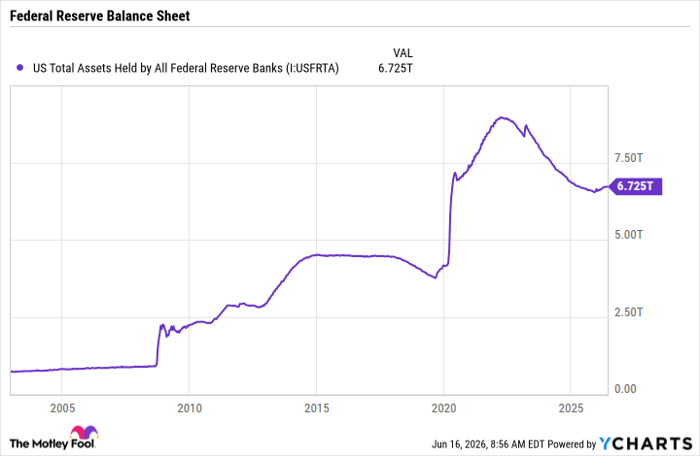
US Total Assets Held by All Federal Reserve Banks data by YCharts
Under Warsh, the Fed could sell some of its assets or let some bonds mature without buying more. The net effect of a large market participant selling bonds is that prices will fall. And when prices fall, yields go up.
Quantitative easing and tightening have a larger impact on long-term bond yields than short-term rates. Short-term rates are more closely tied to the Fed funds rate, the rate set by the Fed for overnight borrowing between banks. So, if Warsh can implement that part of his monetary policy agenda, investors could see the risk-free rate rise from here.
The consequence for equity investors is that without a change in stock prices or earnings expectations, the equity risk premium could drift into negative territory.
An alarm bell, but not a sign to abandon stocks
A negative equity risk premium doesn't necessarily mean stocks will underperform bonds going forward. That's because the yield on a bond purchase doesn't change. You buy the bond and collect the same amount with every interest payment. On the other hand, investors typically buy stocks with the expectation that the underlying business will generate more earnings per share from one year to the next.
Investors are very optimistic about the prospects for further earnings growth right now. Analysts are projecting aggregate S&P 500 earnings growth of 23.2% for 2026 and 16.2% for 2027. That's well above the historic average of around 7%.
Even in the run-up to the dot-com bubble, the equity risk premium remained negative for years before the market peaked. Indeed, it wasn't until well after signs of deteriorating earnings power emerged that the market began reevaluating equity pricing relative to the risk-free rate.
That is to say, paying a premium price for a premium company can be worthwhile if management executes on the business's potential. Right now, investors need to be cautious about high valuations, especially relative to Treasury yields, but that shouldn't stop them from buying high-quality stocks at a fair price.
Should you buy stock in NASDAQ Composite Index right now?
Before you buy stock in NASDAQ Composite Index, consider this:
The Motley Fool Stock Advisor analyst team just identified what they believe are the 10 best stocks for investors to buy now… and NASDAQ Composite Index wasn’t one of them. The 10 stocks that made the cut could produce monster returns in the coming years.
Consider when Netflix made this list on December 17, 2004... if you invested $1,000 at the time of our recommendation, you’d have $424,531!* Or when Nvidia made this list on April 15, 2005... if you invested $1,000 at the time of our recommendation, you’d have $1,273,016!*
Now, it’s worth noting Stock Advisor’s total average return is 940% — a market-crushing outperformance compared to 209% for the S&P 500. Don't miss the latest top 10 list, available with Stock Advisor, and join an investing community built by individual investors for individual investors.
See the 10 stocks »
*Stock Advisor returns as of June 18, 2026.
Adam Levy has no position in any of the stocks mentioned. The Motley Fool has no position in any of the stocks mentioned. The Motley Fool has a disclosure policy.
Recommended Articles


