




Chip Stocks Are Tumbling. Is It Time to Sell Cerebras, Broadcom, and Nvidia?
Key Points
After a blockbuster IPO, Cerebras' share price has fallen along with other chip stocks.
Broadcom is still benefiting from the artificial intelligence (AI) boom, and its shares carry less of a premium after their recent sell-off.
Nvidia's still the undisputed leader in AI processors, so dropping it from your portfolio wouldn't be a good long-term strategy.
- 10 stocks we like better than Nvidia ›
The past month or so has not been kind to many chip stocks. Investors have grown increasingly worried that some have become overvalued and may not be worth holding. That's sent the share prices of Nvidia (NASDAQ: NVDA), Broadcom (NASDAQ: AVGO), and Cerebras (NASDAQ: CBRS) lower over the past several weeks.
But does this volatility among semiconductor stocks really mean you should get out of these three companies?
Will AI create the world's first trillionaire? Our team just released a report on the one little-known company, called an "Indispensable Monopoly" providing the critical technology Nvidia and Intel both need. Continue »
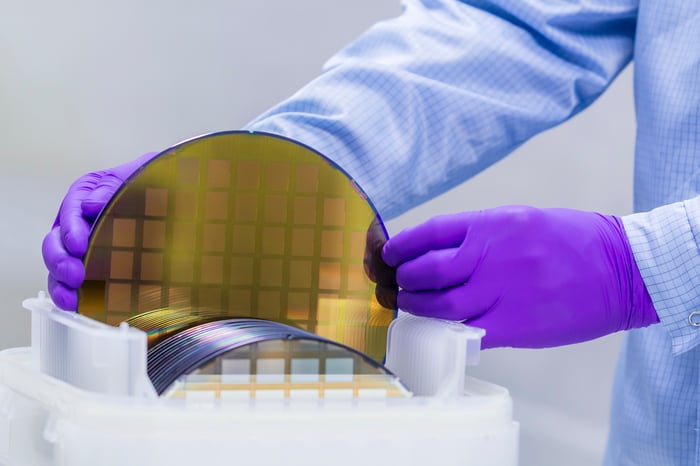
Image source: Getty Images.
A strong IPO isn't saving Cerebras right now
Cerebras just went public a few weeks ago, with an IPO price of $185 and an opening trading price of $350. However, after an initial share price surge, Cerebras' stock has shed about 18% since May 15 (the day after its IPO).
The company designs and manufactures massive wafer-scale chips -- each one about the size of a dinner plate -- that put the equivalent processing power of a cluster of GPUs into one large integrated chip. This new approach to semiconductors has put the company in competition with Nvidia, which (like most other chip companies) turns each silicon wafer it uses into hundreds of smaller processors, rather than one large one.
Cerebras says that its large-wafer technology is more efficient for artificial intelligence (AI) inference, making it a better fit for the next phase of the technology.
Shareholders who are thinking about selling right now may want to reconsider. While the company has its risks -- it's not profitable on a generally accepted accounting principles (GAAP) basis, and its shares are very expensive -- its unique approach to AI processing has quickly gained popularity among AI companies.
Consider that OpenAI says it will spend $20 billion on Cerebras' processors over the next few years, and Amazon is already integrating them into its AWS AI cloud services. Cerebras shares come with a premium price tag right now -- it trades at a price-to-sales (P/S) ratio of 97 compared to the tech sector's average of about 8 -- but having a small position in this novel AI company could pay off if more companies shift to its large wafer tech.
Investor expectations for Broadcom were too high
Broadcom stock has been on a strong run -- it's still up 55% over the past 12 months. But some investors changed their tune about the company after it reported its fiscal second-quarter results at the beginning of June.
Non-GAAP earnings per share of $2.44 beat Wall Street estimates, and AI semiconductor revenue surged by 143% to $10.8 billion. Broadcom's management also reiterated its previous estimate of $100 billion in AI chip sales for the year.
But investors were hoping that management would raise its AI chip guidance. And they didn't like that the company's total sales of $22.2 billion came in slightly below the analysts' consensus estimate of $22.27 billion.
But the sell-off that followed was likely an overreaction. Broadcom's application-specific integrated circuits (ASICs) still play a unique role in AI processing, allowing its customers to design processors to handle precisely the workloads that come from their AI models. Alphabet, Anthropic, OpenAI, and Meta Platforms are some of Broadcom's key customers.
Its semiconductor gross margins are high -- around 70% in the second quarter, which helped drive Broadcom's net income up 88% to $9.3 billion.
What's more, now that the stock has tumbled over the past month, it's carrying less of a premium. Broadcom's stock now trades at a price-to-earnings ratio of about 65, down from around 88 several weeks ago.
With its strong margins, long list of AI clients, and unique AI processors, owning Broadcom still looks like a good long-term bet.
Nvidia is facing increasing competition, but don't count it out just yet
Of course, Nvidia remains a leading semiconductor company, but it, too, is facing some investor skepticism right now.
Large tech companies have committed to investing hundreds of billions of dollars into AI infrastructure annually, and the pace at which they're laying out those funds has been increasing, but some onlookers have grown increasingly concerned that this spending spree could end soon. They're also aware that Advanced Micro Devices, Broadcom, and Cerebras offer AI chip alternatives to Nvidia.
They're not wrong to assume that this torrid spending won't last forever, and some investors have begun selling their shares of Nvidia to lock in their gains.
There's nothing wrong with that strategy, but it could be a mistake to assume Nvidia won't be able to hold on to its dominant position in the AI accelerator space. The company currently has a market share of 88% in data center GPU sales.
Nvidia is also looking toward the future of AI, in which it believes everything from PCs to cars and robots will have some level of autonomy built into them. If that turns out to be the case, then AI processing certainly still has more room to expand, and Nvidia's current lead will only be to its benefit.
And, with a price-to-earnings ratio of just 30 right now, Nvidia's stock is relatively inexpensive compared to many of its peers.
Should you buy stock in Nvidia right now?
Before you buy stock in Nvidia, consider this:
The Motley Fool Stock Advisor analyst team just identified what they believe are the 10 best stocks for investors to buy now… and Nvidia wasn’t one of them. The 10 stocks that made the cut could produce monster returns in the coming years.
Consider when Netflix made this list on December 17, 2004... if you invested $1,000 at the time of our recommendation, you’d have $438,283!* Or when Nvidia made this list on April 15, 2005... if you invested $1,000 at the time of our recommendation, you’d have $1,257,427!*
Now, it’s worth noting Stock Advisor’s total average return is 938% — a market-crushing outperformance compared to 206% for the S&P 500. Don't miss the latest top 10 list, available with Stock Advisor, and join an investing community built by individual investors for individual investors.
See the 10 stocks »
*Stock Advisor returns as of June 12, 2026.
Chris Neiger has no position in any of the stocks mentioned. The Motley Fool has positions in and recommends Advanced Micro Devices, Alphabet, Amazon, Broadcom, Meta Platforms, and Nvidia. The Motley Fool has a disclosure policy.
Recommended Articles


