




Elon Musk Wants to Create a "Space-Faring Civilization." Here's What That Means for the SpaceX IPO.
Key Points
SpaceX intends to go public this week.
Investors should put Musk's claims into perspective.
- These 10 stocks could mint the next wave of millionaires ›
With the SpaceX initial public offering (IPO) just days away, the company's IPO prospectus has become required reading for investors around the world.
In this 380-page document, several incredibly bold claims are made. One of the boldest is at the start of the document, where SpaceX CEO Elon Musk outlines his vision for the company:
Will AI create the world's first trillionaire? Our team just released a report on the one little-known company, called an "Indispensable Monopoly" providing the critical technology Nvidia and Intel both need. Continue »
You want to wake up in the morning and think the future is going to be great -- and that's what being a space-faring civilization is all about. It's about believing in the future and thinking that the future will be better than the past. And I can't think of anything more exciting than going out there and being among the stars.
Within a few sentences, the SpaceX prospectus doubles down on Musk's "space-faring civilization" dreams. "Our mission is to build the systems and technologies necessary to make life multiplanetary," the prospectus reads. "To do this, we have formed the most ambitious, vertically integrated innovation engine on (and off) Earth with unmatched capabilities to rapidly manufacture and launch space-based communications that connect the world, to harness the Sun to power a truth-seeking artificial intelligence that advances scientific discovery, and ultimately to build a base on the Moon and cities on other planets."
How much value should you attribute to SpaceX's "multiplanetary" rhetoric? If you're thinking of investing, you should keep two things in mind.
1. Elon Musk is a master marketer
A quick review of Musk's history with Tesla shows how much investors should buy into his bold claims. In 2013, for example, Musk declared that Tesla drivers "should be able to do 90 percent of miles driven [autonomously] within three years." In 2015, he doubled down: "I am confident that in less than a year you will be able to go from highway on ramp to highway [exits] without touching any controls."
Today, Tesla vehicles still don't have full autonomy, although advances in artificial intelligence (AI) are pushing the technology closer to full self-driving than ever before. As one might expect, Musk is still forecasting a bullish future for Tesla's autonomous capacities: "We expect to have fully autonomous vehicles in probably somewhere between a quarter and half of the United States by the end of the year, pending regulatory approval," he predicted earlier this year.
Musk's predictions for his company have proven consistently wrong for more than a decade. But here's the thing: Tesla still achieved enormous success. In fact, Musk's bold predictions likely helped the company massively improve its brand awareness and access to capital, despite their inaccuracy.
This is what you should understand about Musk and SpaceX. He will consistently put out overly ambitious predictions. But failing to meet these forecasts doesn't necessarily make the company a poor investment.
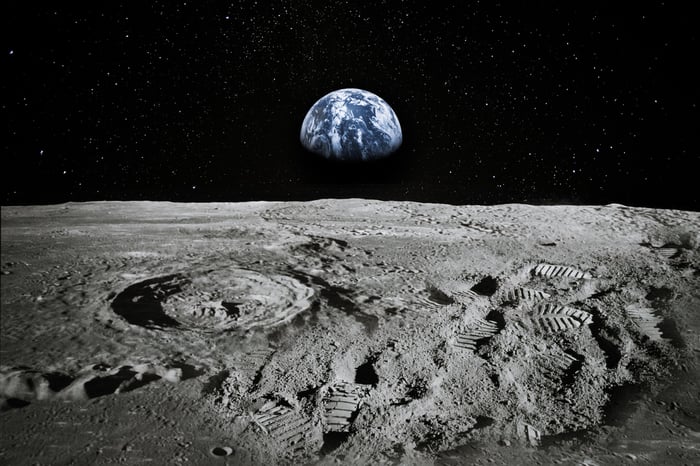
Image source: Getty Images.
2. SpaceX's value doesn't hinge on a multiplanetary civilization
Despite the saber-rattling, SpaceX's long-term value doesn't necessarily hinge on the company realizing its vision of a space-faring civilization. The IPO prospectus even admits to this. Of the company's $28.5 trillion projected total addressable market, just $370 billion in growth potential is related to rockets. Around $1.6 trillion in value is related to the company's Starlink internet service. A whopping $26.5 trillion in value, meanwhile, is connected to AI, and $22.7 trillion of that is limited to enterprise applications. Much of that bucket is aimed at improving workforce productivity or accelerating workflows, not enabling multiplanetary ventures.
To be clear, SpaceX is uniquely positioned to make a space-faring civilization a reality. And believe we will see much of its capital expenditure plan positioned to achieve this lofty goal, even if there's little direct traction over the short term. But IPO investors shouldn't be buying SpaceX stock for that reason. Instead, you'll need to have a bullish view on the company's more mundane efforts, specifically its AI ambitions.
Where to invest $1,000 right now
When our analyst team has a stock tip, it can pay to listen. After all, Stock Advisor’s total average return is 942%* — a market-crushing outperformance compared to 206% for the S&P 500.
They just revealed what they believe are the 10 best stocks for investors to buy right now, available when you join Stock Advisor.
See the stocks »
*Stock Advisor returns as of June 11, 2026.
Ryan Vanzo has no position in any of the stocks mentioned. The Motley Fool has positions in and recommends Tesla. The Motley Fool has a disclosure policy.
Recommended Articles


