




These 2 High-Yield Dividend Stocks Are on Track to Become Dividend Kings Next Year. Here's the Better Buy in May.
Key Points
McDonald’s checks all the boxes when it comes to dividend reliability.
Clorox has a higher yield and a lower valuation than McDonald’s.
The latter has a lot of work to do if it wants to remain a Dividend King.
- 10 stocks we like better than McDonald's ›
As of April 15, there are just 57 stocks that have raised their dividends annually for at least 50 consecutive years, giving them the title of Dividend Kings. But the list could soon grow with the addition of two notable high-yield stocks.
McDonald's (NYSE: MCD) raised its dividend for the 49th consecutive year last October, and Clorox (NYSE: CLX) boosted its payout for the 48th straight year last July. Here's why both stocks could be great buys this May, but for completely different reasons.
Will AI create the world's first trillionaire? Our team just released a report on the one little-known company, called an "Indispensable Monopoly" providing the critical technology Nvidia and Intel both need. Continue »

Image source: Getty Images.
McDonald's can pull multiple levers to reward patient shareholders
McDonald's has a simple capital allocation philosophy. It starts with growing the business. After that comes the dividend. And the remaining free cash flow (FCF) goes toward repurchasing stock. This strategy has paid off remarkably well for long-term McDonald's investors.
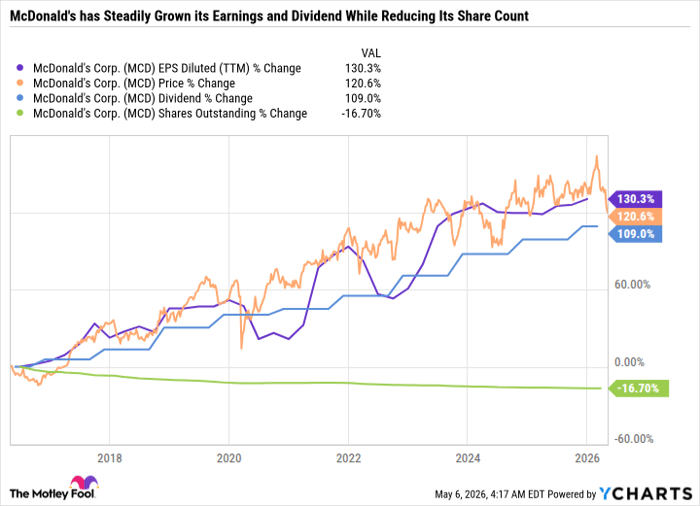
MCD EPS Diluted (TTM) data by YCharts; TTM = trailing 12 months. EPS = earnings per share.
As you can see in the chart, McDonald's earnings, share price, and dividend have more than doubled over the last decade, while its share count has been reduced considerably. Despite its strong long-term returns, the company has been in a rut lately. The stock is down 6.7% year to date and up just 21.3% over the last five years, compared to a 74.2% gain in the S&P 500.
The fast-food chain has been steadily growing sales and maintaining high margins. Over 95% of its locations are owned by franchisees; McDonald's core business is actually collecting rent and fees from its franchisees rather than selling hamburgers and fries from its corporate-owned stores.
Therefore, a better metric for assessing how McDonald's locations are performing, whether franchises or corporate-owned, is systemwide sales, which grew 7% last year to $139 billion. Loyalty-member sales increased 20%.
The franchise model makes it a relatively capital-light business, enabling it to convert a significant portion of sales into earnings. In 2025, McDonald's (corporate) generated $26.89 billion in revenue, $12.39 billion in operating income, and $8.56 billion in net income. Or put another way, the company converted around 32 cents of every dollar in revenue into after-tax profit for $11.95 in diluted earnings per share, which easily covers its $7.17 dividend per share in 2025.
Add it all up, and McDonald's is an ultra-high-quality blue chip dividend stock that should be able to continue increasing its payout for decades to come.
A high-yield turnaround candidate for value investors
Clorox has been a mess in recent years. The stock surged to an all-time high during the pandemic, but management badly overestimated demand trends, which bloated costs and crushed margins.
Then came a costly cyberattack in August 2023, followed by consumer-spending pressures due to the higher cost of living and weak wage growth, now amplified by rising oil prices. The broader household and personal products industry is in a downturn, and Clorox is facing intense competition.
On its third-quarter fiscal 2026 earnings call, management expressed long-term confidence that its brands will continue to win over consumers seeking value and quality. Its $2.25 billion acquisition of Gojo Industries, the maker of Purell hand sanitizer, adds another brand to its lineup of elite cleaning and hygiene products anchored around Clorox and Pine-Sol.
Throw in Glad trash bags and food containers, Hidden Valley salad dressing, Burt's Bees skin care, Brita water filters, Kingsford charcoal, Fresh Step cat litter, and more, and Clorox definitely has what it takes to turn around. But the market won't be convinced until the company stops overpromising and underdelivering.
Despite its poor results and guidance, the company is confident in its brand portfolio and long-term outlook thanks to efficiency improvements and cost cuts. But its dividend is absorbing most of its earnings and FCF. On the third-quarter fiscal 2026 earnings call on May 1, Clorox expressed confidence in its ability to take market share. But it remains to be seen if that pursuit of market share growth will translate to higher earnings and free cash flow. If not, Clorox could need to forgo its potential Dividend King status.
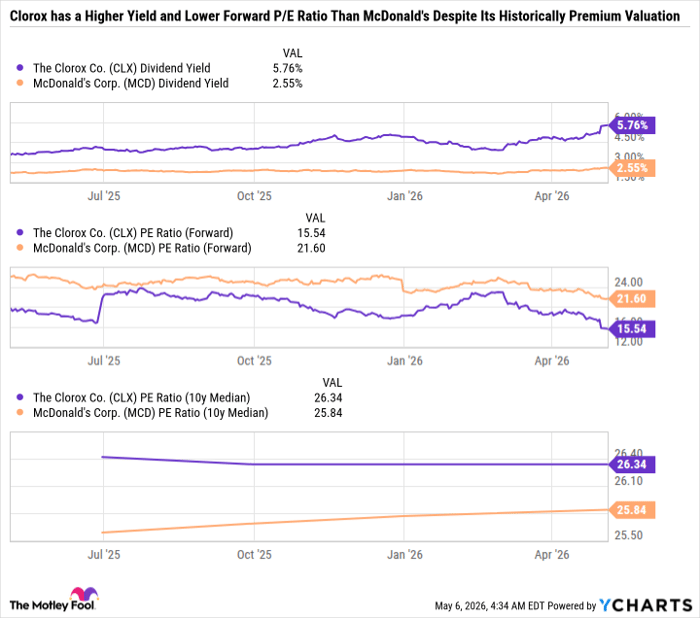
CLX Dividend Yield data by YCharts; PE = price to earnings.
The dividend yield has skyrocketed to 5.8% because the stock price is near an 11-year low, but Clorox has continued to raise its dividend. Meanwhile, its forward price-to-earnings ratio has fallen to just 15.5. Historically, the company has commanded a premium valuation -- even higher than McDonald's -- thanks to its portfolio of leading brands.
Two high-yield stocks to buy now
McDonald's is the better buy for risk-averse investors looking for reliable passive income, especially those wanting to supplement income in retirement. The fast-food chain has global diversification, low risk, and high margins, driven by its franchise model and recession resilience. Given how affordable its dividend is relative to earnings, I could see it remaining a Dividend King for decades to come.
Clorox could become a Dividend King but lose the title if its fundamentals don't improve. However, I think long-term investors can win either way. Even if it were to cut its dividend in half, it would still yield more than McDonald's. And that lower expense would give management more dry powder to fuel its turnaround. Alternatively, the company's investments in efficiency improvements, organic growth, and new brands could translate into higher FCF -- allowing Clorox to continue raising its dividend without relying on asset sales, cash, or debt.
Balanced investors may prefer a 50/50 split between both stocks, which would still provide a sizable yield of 4.2% and combine McDonald's reliability with Clorox's higher upside potential if its turnaround goes well.
Should you buy stock in McDonald's right now?
Before you buy stock in McDonald's, consider this:
The Motley Fool Stock Advisor analyst team just identified what they believe are the 10 best stocks for investors to buy now… and McDonald's wasn’t one of them. The 10 stocks that made the cut could produce monster returns in the coming years.
Consider when Netflix made this list on December 17, 2004... if you invested $1,000 at the time of our recommendation, you’d have $471,827!* Or when Nvidia made this list on April 15, 2005... if you invested $1,000 at the time of our recommendation, you’d have $1,319,291!*
Now, it’s worth noting Stock Advisor’s total average return is 986% — a market-crushing outperformance compared to 207% for the S&P 500. Don't miss the latest top 10 list, available with Stock Advisor, and join an investing community built by individual investors for individual investors.
See the 10 stocks »
*Stock Advisor returns as of May 11, 2026.
Daniel Foelber has no position in any of the stocks mentioned. The Motley Fool recommends the following options: long January 2028 $320 calls on McDonald's and short January 2028 $340 calls on McDonald's. The Motley Fool has a disclosure policy.
Recommended Articles


