




The World Is Burning Through Oil With No Resupply in Sight. Is SHEL Stock a Buy Before the Squeeze Gets Worse?
Key Points
The geopolitical conflict in the Middle East, which has closed the Strait of Hormuz, has left the world short of oil.
There's no solution until after the conflict is over, and even then, the supply/demand imbalance will take months to level out.
- 10 stocks we like better than Shell Plc ›
Shell (NYSE: SHEL) CEO Wael Sawan is one of many energy industry executives sounding the alarm on the oil supply/demand imbalance that has been building since the geopolitical conflict in the Middle East erupted. Right now, Sawan says the world is short 1 billion barrels of oil, a number Halliburton (NYSE: HAL) CEO Jeffrey Miller backs.
The CEOs of Chevron (NYSE: CVX) and ExxonMobil (NYSE: XOM) both agree that it will take months to solve the growing imbalance once the conflict ends. Until then, the supply shortfall will only get worse. Should you buy Shell or one of its rivals? The answer depends on your investment horizon.
Will AI create the world's first trillionaire? Our team just released a report on the one little-known company, called an "Indispensable Monopoly" providing the critical technology Nvidia and Intel both need. Continue »

Image source: Getty Images.
High oil prices are a problem, but they aren't unusual
While the current conflict is headline news, the energy sector has a long history of volatility. Today's high oil prices aren't really unusual. If history is a guide, when the conflict ends and the supply/demand imbalance is finally corrected, oil prices will retreat. Stocks of oil companies tend to rise and fall along with oil prices.
Buying Shell, Chevron, and Exxon will let you participate in the upside. But they are integrated energy giants with portfolios spanning the entire energy value chain. That tends to mute their participation in oil rallies (and routs). If you are trying to ride oil prices higher, a pure-play upstream stock will probably give you more bang for the buck, such as Devon Energy (NYSE: DVN) or Diamondback Energy (NASDAQ: FANG). Both are U.S.-focused, so the conflict in the Middle East isn't slowing down their production. There's just one problem. Upstream producers are also likely to feel the brunt of an oil price drop, as investors exit the oil trade.
The proof is in the dividends for Chevron and Exxon
If you are looking to establish a long-term position in the energy sector right now, your best bet is an integrated energy giant like Shell, Chevron, or Exxon. They have all proven they can survive through the entire energy cycle in relative stride. However, Chevron and Exxon have a leg up on Shell, noting that Shell cut its dividend in 2020. Chevron and Exxon have each increased their dividend for decades.
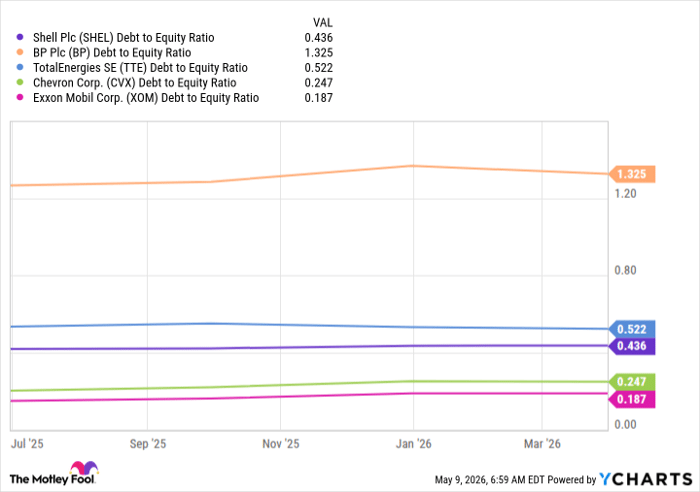
SHEL Debt to Equity Ratio data by YCharts
Moreover, they have the strongest balance sheets in their peer group. That allows Chevron and Exxon to add debt during energy downturns so they can continue to support their businesses and dividend until energy prices recover. When oil prices are weak, you can focus on collecting reliable dividends instead of worrying about what are likely to be falling stock prices. Right now, Chevron's 3.9% yield is the highest of this trio, with Exxon at 2.8% and Shell at 3.4%.
Shell is OK, but Chevron is more attractive
All in, Chevron is probably the best option among the integrated majors right now for those who take a long-term view in the energy sector. And when oil markets do eventually recover, and oil prices fall, you might even consider adding to your position in this historically reliable dividend stock.
Should you buy stock in Shell Plc right now?
Before you buy stock in Shell Plc, consider this:
The Motley Fool Stock Advisor analyst team just identified what they believe are the 10 best stocks for investors to buy now… and Shell Plc wasn’t one of them. The 10 stocks that made the cut could produce monster returns in the coming years.
Consider when Netflix made this list on December 17, 2004... if you invested $1,000 at the time of our recommendation, you’d have $471,827!* Or when Nvidia made this list on April 15, 2005... if you invested $1,000 at the time of our recommendation, you’d have $1,319,291!*
Now, it’s worth noting Stock Advisor’s total average return is 986% — a market-crushing outperformance compared to 207% for the S&P 500. Don't miss the latest top 10 list, available with Stock Advisor, and join an investing community built by individual investors for individual investors.
See the 10 stocks »
*Stock Advisor returns as of May 10, 2026.
Reuben Gregg Brewer has no position in any of the stocks mentioned. The Motley Fool has positions in and recommends Chevron. The Motley Fool has a disclosure policy.
Recommended Articles


