




Warren Buffett's Best Advice for Buying Stocks During Market Uncertainty
Key Points
Buffett's approach to investing during market uncertainty focuses on having the right mindset.
Berkshire's long-held position in Coca-Cola is a textbook example of how Buffett put his philosophy into action.
Buffett's is simple, yet difficult to do because it requires putting emotions aside.
- 10 stocks we like better than Coca-Cola ›
You might have heard someone say that the Chinese word for "crisis" means "danger" plus "opportunity." While that would be intriguing if true, it reflects a misunderstanding of Mandarin. However, the connection between danger and opportunity aligns well with Warren Buffett's investing philosophy.
Dangers seem to be almost everywhere you look in the current market environment. The ongoing war with Iran continues to affect oil prices. President Trump's tariffs add to concerns about resurging inflation. Some experts warn that the widespread adoption of artificial intelligence (AI) could wreak havoc on the job market. The Federal Reserve appears to be caught between a rock and a hard place on what to do with interest rates.
Will AI create the world's first trillionaire? Our team just released a report on the one little-known company, called an "Indispensable Monopoly" providing the critical technology Nvidia and Intel both need. Continue »
But Buffett has always viewed these kinds of dynamics opportunistically. Here's his best advice for buying stocks during periods of market uncertainty.
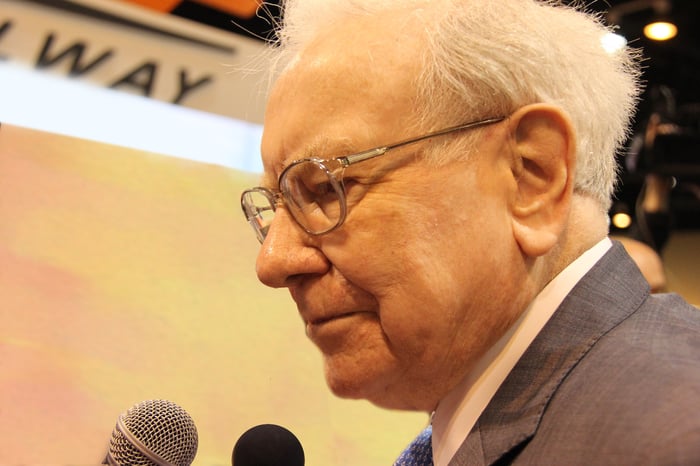
Image source: The Motley Fool.
Two essential nuggets of Buffett's wisdom
Perhaps the most quoted adage that Buffett ever stated is: "We simply attempt to be fearful when others are greedy and to be greedy only when others are fearful." Those words first appeared in Buffett's 1986 letter to Berkshire Hathaway (NYSE: BRKA) (NYSE: BRKB) shareholders, which was released in early 1987.
What's interesting to me is that the stock market was performing quite well at the time. The S&P 500 (SNPINDEX: ^GSPC) rose nearly 15% in 1986, while the Dow Jones Industrial Average (DJINDICES: ^DJI) soared more than 22%. Both indexes were up another 20% by the end of the first quarter of 1987. However, Buffett's message was eerily prescient. The S&P 500 and Dow plunged in October 1987 in what became known as "Black Monday" -- one of the most infamous stock market crashes in history.
Another often-cited statement from Buffett is, "The stock market is a device for transferring money from the impatient to the patient." His point was that investors who focus on the long term are likely to profit, typically at the expense of the investors who trade in and out of stocks based on short-term worries or euphoria.
Both examples of Buffett's wisdom go hand in hand. They focus on having the correct investing mindset. When market uncertainty leads to fear-based selling, it creates opportunities for investors who can look past temporary storms. Those same investors also know that it's unwise to sell the stocks of well-run companies with solid prospects just because they have fallen.
Applying Buffett's philosophy
Buffett's approach to investing differentiates between share price and underlying value. If you can reasonably estimate the value of a company's business, market uncertainty won't be concerning to you. It could even be beneficial.
Which stock in Berkshire Hathaway's portfolio is the best example of how Buffett has put his investing philosophy in action? My vote goes to The Coca-Cola Company (NYSE: KO).
Buffett initiated a position in Coca-Cola in 1988. Importantly, his purchase followed the "Black Monday" crash, when panic selling presented an opportunity. The legendary investor was greedy when others were fearful.
Coca-Cola is now the longest-held position in Berkshire's portfolio. It's also the third-largest holding for the conglomerate, valued at around $31.5 billion. Buffett highlighted Coca-Cola in his 2023 letter to Berkshire shareholders, stating, "When you find a truly wonderful business, stick with it. Patience pays, and one wonderful business can offset the many mediocre decisions that are inevitable."
With Coke, the stock market truly transferred money from impatient investors who didn't have long-term mindsets to the always-patient Buffett. But how did Buffett know to buy Coca-Cola when he did and know that it was a stock worth holding?
First, he understood the company's business. If a stock isn't in Buffett's circle of competence, he knows that he can't estimate its likely earnings growth -- a critical component in evaluating its intrinsic value.
Second, Buffett recognized that Coca-Cola had a strong moat. Its brand is known globally. Millions of consumers drink Cokes every day (including Buffett himself, by the way). Coca-Cola had pricing power and customer loyalty in 1988. It still does today.
Simple, yet difficult
Buffett's advice on buying stocks during market uncertainty is simple. However, it's also difficult because it requires discipline to put emotions aside.
Investors who bought high-quality stocks in 1988, during the 2008 financial crisis, or early in the 2020 COVID-19 pandemic market meltdown were able to use uncertainty to their advantage. But most of them probably had to go against the instinct to follow the crowd.
Notably, Buffett isn't buying many stocks in the current market environment. The major indexes are near record highs. If uncertainty leads to fear and fear leads to a huge sell-off, though, look for Buffett and new Berkshire CEO Greg Abel to take action. Other investors should be prepared to do the same.
Should you buy stock in Coca-Cola right now?
Before you buy stock in Coca-Cola, consider this:
The Motley Fool Stock Advisor analyst team just identified what they believe are the 10 best stocks for investors to buy now… and Coca-Cola wasn’t one of them. The 10 stocks that made the cut could produce monster returns in the coming years.
Consider when Netflix made this list on December 17, 2004... if you invested $1,000 at the time of our recommendation, you’d have $496,473!* Or when Nvidia made this list on April 15, 2005... if you invested $1,000 at the time of our recommendation, you’d have $1,216,605!*
Now, it’s worth noting Stock Advisor’s total average return is 968% — a market-crushing outperformance compared to 202% for the S&P 500. Don't miss the latest top 10 list, available with Stock Advisor, and join an investing community built by individual investors for individual investors.
See the 10 stocks »
*Stock Advisor returns as of May 3, 2026.
Keith Speights has positions in Berkshire Hathaway. The Motley Fool has positions in and recommends Berkshire Hathaway. The Motley Fool has a disclosure policy.
Recommended Articles


