




Australian Dollar steadies at a 10-month low after split RBA minutes
- AUD/USD hits its lowest since January and is flat after five straight falls.
- The RBA gave no hint of another hike, with its rate already above the Fed's.
- Australian wages are due Wednesday and October jobs figures on Thursday.
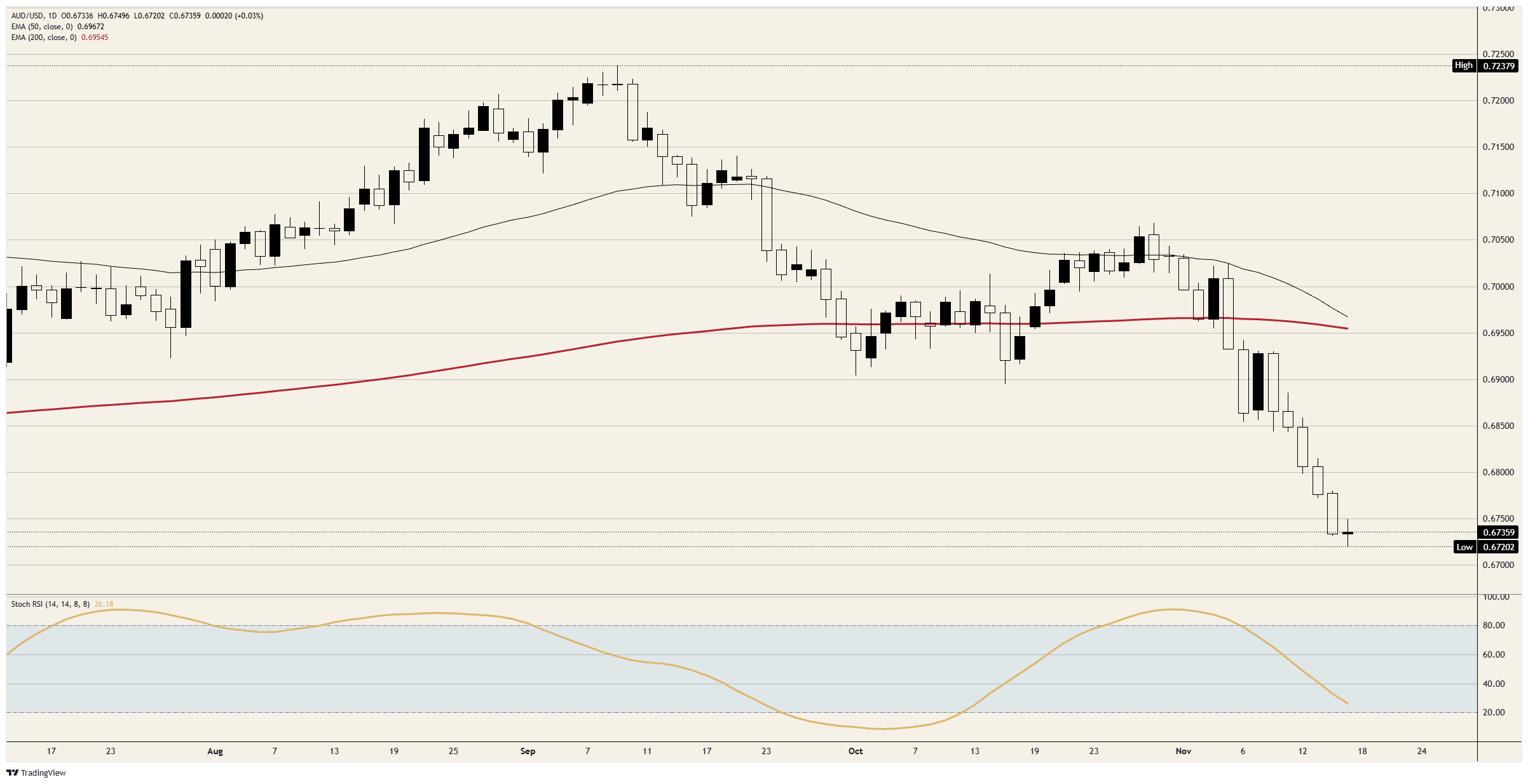
Five straight falls in the Australian Dollar have stopped at its lowest level since January, without much of a rebound to show for it. AUD/USD fell to just above 0.6700, its lowest in 10 months, and is now trading just under 0.6750, about in line with Monday's close. The Pound recovered more from the same five-session run.
The Reserve Bank of Australia (RBA) published the minutes of its November 3 meeting, where three of nine board members voted against the hike to 4.85%. The minutes made no mention of further tightening, and traders have dropped their bets on a December RBA hike. Australia's cash rate is at an 18-year high, and 0.85 percentage points above the top of the Fed's, and the Aussie is at a 10-month low.
The Dollar Index reversed from a 19-month high after US industrial production fell 0.4%, and that reversal is what stopped the Aussie's fall. A December Fed hike is fully priced, and an RBA hold on December 8 would narrow Australia's rate lead to 0.60 percentage points.
On the calendar
Australia's third-quarter Wage Price Index is due at 00:30 GMT on Wednesday, forecast up 1% on the quarter after 0.8%. October jobs figures follow at 00:30 GMT on Thursday, with employment forecast up 25.2K after a 39.3K fall and unemployment unchanged at 4.7%. Both feed the RBA's December 8 decision, where a split board has to choose again.
The Fed's October minutes arrive on Wednesday at 19:00 GMT, and the People's Bank of China (PBoC) announces its rate decision at 01:15 GMT on Friday, forecast unchanged at 3%. The first is bears on the Fed's side of the rate gap and the second is demand from Australia's biggest customer.
On the charts
AUD/USD has fallen from just under 0.6950 on November 10, and Tuesday's range is the narrowest of the run. Nothing on the chart, which starts in July, is lower than Tuesday's low, and the September peak was just under 0.7250. The 50-day Exponential Moving Average (EMA) has fallen almost onto the 200-day, with both just above 0.6950.
AUD/USD daily chart
Australian Dollar FAQs
One of the most significant factors for the Australian Dollar (AUD) is the level of interest rates set by the Reserve Bank of Australia (RBA). Because Australia is a resource-rich country another key driver is the price of its biggest export, Iron Ore. The health of the Chinese economy, its largest trading partner, is a factor, as well as inflation in Australia, its growth rate and Trade Balance. Market sentiment – whether investors are taking on more risky assets (risk-on) or seeking safe-havens (risk-off) – is also a factor, with risk-on positive for AUD.
The Reserve Bank of Australia (RBA) influences the Australian Dollar (AUD) by setting the level of interest rates that Australian banks can lend to each other. This influences the level of interest rates in the economy as a whole. The main goal of the RBA is to maintain a stable inflation rate of 2-3% by adjusting interest rates up or down. Relatively high interest rates compared to other major central banks support the AUD, and the opposite for relatively low. The RBA can also use quantitative easing and tightening to influence credit conditions, with the former AUD-negative and the latter AUD-positive.
China is Australia’s largest trading partner so the health of the Chinese economy is a major influence on the value of the Australian Dollar (AUD). When the Chinese economy is doing well it purchases more raw materials, goods and services from Australia, lifting demand for the AUD, and pushing up its value. The opposite is the case when the Chinese economy is not growing as fast as expected. Positive or negative surprises in Chinese growth data, therefore, often have a direct impact on the Australian Dollar and its pairs.
Iron Ore is Australia’s largest export, accounting for $118 billion a year according to data from 2021, with China as its primary destination. The price of Iron Ore, therefore, can be a driver of the Australian Dollar. Generally, if the price of Iron Ore rises, AUD also goes up, as aggregate demand for the currency increases. The opposite is the case if the price of Iron Ore falls. Higher Iron Ore prices also tend to result in a greater likelihood of a positive Trade Balance for Australia, which is also positive of the AUD.
The Trade Balance, which is the difference between what a country earns from its exports versus what it pays for its imports, is another factor that can influence the value of the Australian Dollar. If Australia produces highly sought after exports, then its currency will gain in value purely from the surplus demand created from foreign buyers seeking to purchase its exports versus what it spends to purchase imports. Therefore, a positive net Trade Balance strengthens the AUD, with the opposite effect if the Trade Balance is negative.
Recommended Articles


