




AUD/USD Price Forecast: More downside likely towards 0.6660
- AUD/USD hits fresh 10-month low near 0.6730 as the Australian Dollar underperforms.
- The RBA minutes show that members hesitate to advocate more rate hikes amid economic worries.
- The US Dollar Index retreats from its 19-month high of 103.70.
The Australian Dollar (AUD) trades close to its fresh 10-month low at around 0.6730 against the US Dollar (USD) during the European trading session on Tuesday. The Aussie pair is under pressure as the Australian Dollar underperforms, following the release of the Reserve Bank of Australia (RBA) minutes of the October policy meeting.
Australian Dollar Price Today
The table below shows the percentage change of Australian Dollar (AUD) against listed major currencies today. Australian Dollar was the weakest against the Swiss Franc.
| USD | EUR | GBP | JPY | CAD | AUD | NZD | CHF | |
|---|---|---|---|---|---|---|---|---|
| USD | -0.12% | -0.11% | -0.18% | 0.00% | 0.02% | 0.00% | -0.17% | |
| EUR | 0.12% | 0.00% | -0.05% | 0.13% | 0.13% | 0.15% | -0.05% | |
| GBP | 0.11% | 0.00% | -0.04% | 0.12% | 0.13% | 0.15% | -0.05% | |
| JPY | 0.18% | 0.05% | 0.04% | 0.17% | 0.18% | 0.19% | -0.01% | |
| CAD | -0.01% | -0.13% | -0.12% | -0.17% | 0.00% | 0.02% | -0.17% | |
| AUD | -0.02% | -0.13% | -0.13% | -0.18% | -0.01% | 0.02% | -0.18% | |
| NZD | -0.01% | -0.15% | -0.15% | -0.19% | -0.02% | -0.02% | -0.19% | |
| CHF | 0.17% | 0.05% | 0.05% | 0.00% | 0.17% | 0.18% | 0.19% |
The heat map shows percentage changes of major currencies against each other. The base currency is picked from the left column, while the quote currency is picked from the top row. For example, if you pick the Australian Dollar from the left column and move along the horizontal line to the US Dollar, the percentage change displayed in the box will represent AUD (base)/USD (quote).
The RBA minutes showed that members see financial conditions as “restrictive”, and “warns of sharper economic slowdown”. However, members still “see risks to latest inflation forecast as skewed to upside”.
Market experts were confident before the RBA minutes release that the Australian central bank’s monetary tightening cycle has come to an end.
Analysts at OCBC Group Research highlight the mixed signals in the latest RBA decision, noting that while the statement stressed that “inflation remains elevated and recent data indicate that it is broadly based” to justify the hike, it also acknowledged that “the increases in the cash rate target since the beginning of the year have tightened financial conditions. The economy is slowing, housing prices have fallen significantly and the unemployment rate has risen”. They point out that the RBA has further softened its stance by removing the earlier guidance “including increasing the cash rate target further if needed”. Against this backdrop, OCBC concludes: “We expect no more hike in this cycle, and the next policy move is likely to be a cut.”
Meanwhile, the US Dollar retreats from its day’s high ahead of United States (US) Retail Sales data for October, which will be published at 13:30 GMT. As of writing, the US Dollar Index (DXY), which gauges the Greenback’s value against six major currencies, is down 0.1% to near 103.48 after failing to extends gains above 103.70.
AUD/USD Technical Analysis
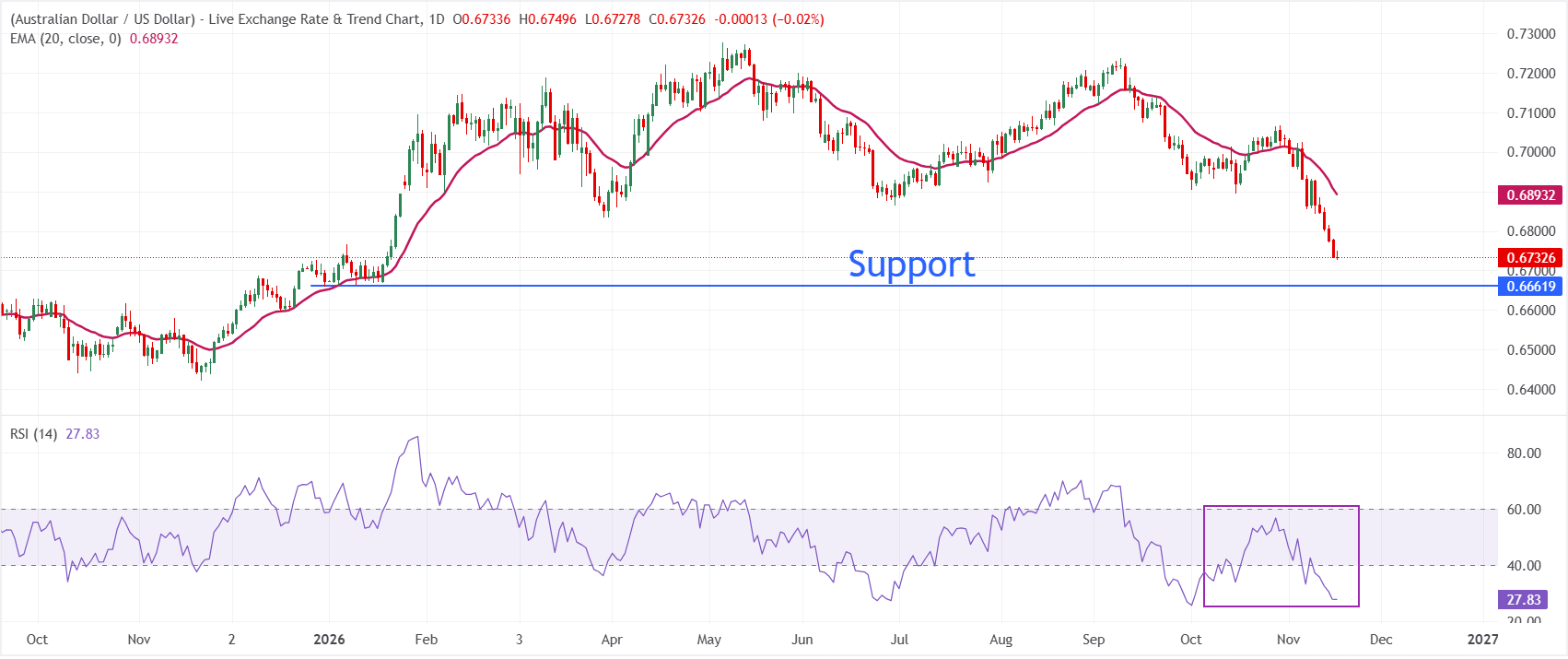
In the daily chart, AUD/USD trades at 0.6733, extending its slide below the 20-day exponential moving average (EMA) at 0.6893 and keeping the near-term bias bearish. The pair remains decisively capped by this EMA-based barrier, while the Relative Strength Index (RSI) at 27.85 sits in oversold territory, hinting that downside momentum is stretched even as sellers retain control beneath the main trend indicator.
On the topside, immediate resistance is located at the 20-day EMA around 0.6893, and a daily close above this level would be needed to ease selling pressure and allow a more sustained recovery. Until that hurdle is reclaimed, price action is vulnerable to further downside probes, with traders likely to fade rebounds while AUD/USD holds under the EMA resistance zone.
(The technical analysis of this story was written with the help of an AI tool. Know more.)
Economic Indicator
RBA Meeting Minutes
The minutes of the Reserve Bank of Australia meetings are published two weeks after the interest rate decision. The minutes give a full account of the policy discussion, including differences of view. They also record the votes of the individual members of the Committee. Generally speaking, if the RBA is hawkish about the inflationary outlook for the economy, then the markets see a higher possibility of a rate increase, and that is positive for the AUD.
Read more.Last release: Tue Nov 17, 2026 00:30
Frequency: Weekly
Actual: -
Consensus: -
Previous: -
Source: Reserve Bank of Australia
The Reserve Bank of Australia (RBA) publishes the minutes of its monetary policy meeting two weeks after the interest rate decision is announced. It provides a detailed record of the discussions held between the RBA’s board members on monetary policy and economic conditions that influenced their decision on adjusting interest rates and/or bond buys, significantly impacting the AUD. The minutes also reveal considerations on international economic developments and the exchange rate value.
Recommended Articles


