




Gold Price Forecast: XAU/USD Reclaims $4,000 as Democrats Win Congress — Is $4,200 Next?

Gold prices surged more than 2% on Wednesday, 4 November 2026, breaking back above the psychological US$4,000 level as Democrats secured control of both chambers of the US Congress in the midterm elections.
Spot gold climbed to approximately US$4,016 per ounce during Asian trading, recovering from an intraday low near US$3,920. The rebound represented a gain of nearly US$100, supported by a weaker US dollar, falling Treasury yields and renewed demand for defensive assets.
The US election outcome has prompted investors to reassess the outlook for fiscal policy, government spending and future Federal Reserve interest rate decisions.
However, despite gold's impressive recovery, the broader technical outlook remains uncertain.
The key question for gold traders is whether XAU/USD can extend its rebound towards US$4,100–4,150 or whether the recovery will prove temporary within a broader downtrend.
Why Is the Gold Price Rising Today? Democrats Win Control of Congress
Gold's latest rally followed a decisive shift in the US political landscape.
The Democratic Party secured control of both the House of Representatives and the Senate in the 2026 midterm elections, ending Republican control of Congress.
The outcome creates a divided government in Washington, with President Donald Trump remaining in the White House while Democrats gain greater influence over legislation, government spending and congressional oversight.
For financial markets, the result raises questions about the direction of US fiscal policy and its implications for inflation, Treasury yields and the US dollar.
1. A Divided Congress Could Limit Fiscal Expansion
Democratic control of Congress could make it more difficult for the Trump administration to introduce additional tax cuts or major spending initiatives without bipartisan support.
If investors expect slower fiscal expansion, concerns about future government borrowing and inflationary pressure may ease.
This could help limit upward pressure on longer-term US Treasury yields.
Lower yields generally improve the relative attractiveness of non-yielding assets such as gold.
However, a divided Congress does not guarantee lower government spending or reduced fiscal deficits.
Budget negotiations, legislative gridlock and existing spending commitments could continue to create uncertainty.
2. Falling Treasury Yields Support Gold
One of the most important developments following the election was the decline in US Treasury yields.
The benchmark 10-year Treasury yield moved below the 5% level, while shorter-term yields also fell as investors reassessed the outlook for monetary policy and economic growth.
Gold typically benefits when nominal and real yields decline because the opportunity cost of holding a non-interest-bearing asset decreases.
The latest rally reflects this relationship.
Pepperstone's head of research, Chris Weston, highlighted the combination of a weaker US dollar and sharply lower nominal and real Treasury yields as important sources of support for gold.
The decline in yields has helped XAU/USD recover from its recent weakness, although the sustainability of the move will depend on whether the bond market rally continues.
3. A Weaker US Dollar Boosts Gold Demand
The US Dollar Index fell towards 101.2–101.5 as investors responded to the election outcome.
Because international gold prices are denominated in US dollars, a weaker dollar can make bullion more affordable for buyers using other currencies.
This can support demand and contribute to higher gold prices.
The relationship is not automatic, however, and gold may still decline if other pressures, such as forced selling or rising real interest rates, dominate the market.
For now, the combination of lower yields and a softer dollar has created a more supportive short-term environment for XAU/USD.
Federal Reserve Outlook: Does the Democratic Victory Reduce the Need for Further Rate Hikes?
The Federal Reserve remains a major influence on gold prices.
At its October policy meeting, the central bank maintained the federal funds rate target range at 3.75%–4.00%.
Policymakers continued to emphasise the need to control inflation while monitoring economic growth and employment conditions.
The election result could influence market expectations for future monetary policy through its potential effects on fiscal spending, economic growth and inflation.
However, the Federal Reserve makes its interest rate decisions independently, and the election outcome does not directly determine its policy path.
Could Lower Fiscal Spending Reduce Inflation Pressure?
If political gridlock restricts additional fiscal stimulus, the outlook for aggregate demand and inflation could become less expansionary.
Over time, this might reduce pressure on the Federal Reserve to maintain or increase interest rates.
Lower expected interest rates would generally be supportive for gold.
Nevertheless, inflation remains elevated, and the central bank has not indicated that its tightening cycle is definitively over.
As of 4 November, interest rate futures still implied approximately a 79% probability of another 25-basis-point increase in December.
This suggests that markets continue to see significant inflation risks despite the political developments.
US Employment Data Could Be the Next Major Catalyst
Investors are now turning their attention to the US non-farm payrolls report scheduled for Friday, 6 November.
The employment figures could provide important clues about the strength of the US economy and the Federal Reserve's next policy decision.
If employment growth weakens:
Expectations for further interest rate increases could decline.
US Treasury yields may face additional downward pressure.
The US dollar could weaken further.
Gold may find support for a move towards US$4,100–4,150.
If employment growth remains strong:
Markets may reinforce expectations for further monetary tightening.
Treasury yields and the US dollar could rebound.
Gold's recovery may lose momentum.
XAU/USD could retest the US$4,000 support level.
The employment report may therefore help determine whether gold's election-driven rebound develops into a more sustained recovery.
Why Does Technology Market Weakness Matter for Gold?
Gold can respond to equity market volatility in different ways.
During periods of moderate uncertainty, investors may increase gold exposure as a defensive allocation.
However, during severe market selloffs, investors may sell gold to raise liquidity or meet margin requirements.
This helps explain why gold declined sharply alongside technology stocks in late October.
The latest rebound suggests that lower yields and a weaker dollar are now providing stronger support.
Nevertheless, if the AI-related equity selloff intensifies, gold could again face short-term liquidation pressure.
Australian traders should therefore monitor both XAU/USD and major US equity indices, including the Nasdaq-100.
Middle East Tensions Remain a Risk to Gold's Recovery
Despite the election-driven rally, geopolitical uncertainty remains a major consideration for gold investors.
Relations between the United States and Iran remain strained, with negotiations over ending the conflict making limited progress.
Iranian officials have continued to demand concessions relating to sanctions, maritime restrictions and frozen assets.
Meanwhile, President Trump has not ruled out renewed military action following the midterm elections.
Gold Technical Analysis: Can XAU/USD Extend Its Rally Towards US$4,150?
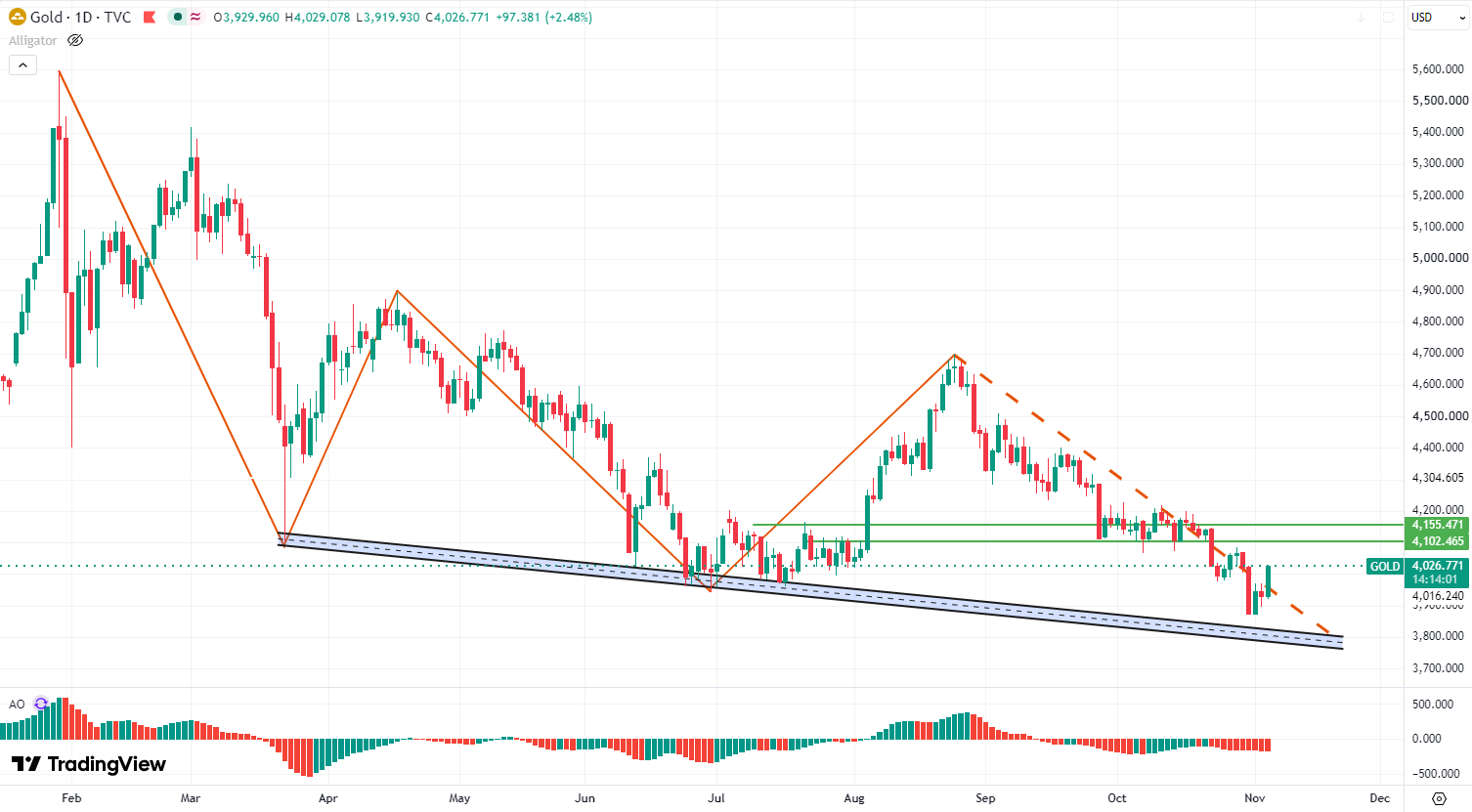
Gold's technical outlook has improved following its recovery above US$4,000.
Source: Tradingview
However, the metal remains below several important resistance levels, suggesting that the broader downtrend has not yet been conclusively reversed.
Following its late-October decline towards US$3,870, gold initially struggled to sustain a rebound above US$3,900.
Wednesday's sharp rally has changed the immediate technical picture.
The US$4,000 level, which previously acted as resistance, is now an important potential support area.
Bullish Scenario: Gold Holds Above US$4,000
If gold successfully establishes support above US$4,000, the latest recovery could extend towards US$4,050.
A decisive break above this area would bring US$4,100 into focus.
Beyond that, the US$4,100–4,150 resistance zone represents the next important upside target.
A sustained move above US$4,150 could improve the medium-term technical outlook.
However, a stronger confirmation of a broader bullish reversal would require gold to recover above US$4,200 and establish a pattern of higher highs and higher lows.
Until that occurs, the current rally may still be considered a recovery within a larger corrective trend.
Bearish Scenario: Gold Falls Back Below US$4,000
If XAU/USD fails to hold above US$4,000, the recent breakout could prove temporary.
A decline below this psychological level would bring US$3,950 into focus.
Further weakness could expose US$3,920, followed by the late-October low near US$3,870.
If gold breaks below US$3,870, the broader bearish trend could resume, potentially opening the way towards US$3,800.
The direction of the next sustained move will likely depend on changes in Treasury yields, the US dollar and expectations for Federal Reserve monetary policy.
How to Trade Gold Price Movements with CFDs in Australia
Gold contracts for difference (CFDs) allow traders to speculate on changes in gold prices without owning physical bullion.
Unlike purchasing gold bars or coins, CFDs provide exposure to price movements through a leveraged financial contract.
Traders can take long or short positions depending on their market expectations.
However, leverage magnifies both gains and losses, making risk management essential.
Trading a Potential Gold Breakout
Traders expecting further upside may monitor whether XAU/USD holds above US$4,000 and breaks through nearby resistance.
A move above US$4,050 could indicate improving short-term momentum, while US$4,100–4,150 remains a potential resistance region.
However, traders should be aware that rapid election-driven price movements can reverse unexpectedly.
Trading a Potential Gold Reversal
Traders expecting the rebound to fade may monitor whether gold loses momentum near resistance and falls back below US$4,000.
A sustained decline could increase attention on US$3,950 and US$3,920.
However, short positions can face significant losses if gold rises sharply in response to weaker economic data or further declines in Treasury yields.
Explore Gold CFD Trading with Mitrade Australia
Australian traders interested in following gold price movements can explore gold CFDs through Mitrade.
Mitrade provides access to financial market charts and trading tools that can help traders monitor XAU/USD price developments.

Trade XAU/USD with Tight Spreads
You might be interested in…
Disclaimer: The content presented above, whether from a third party or not, is considered as general advice only. CFD trading involves significant risk of loss. Past performance does not guarantee future results. This article serves informational purposes only and does not constitute financial advice. Consider your risk tolerance before trading.


