




Gold Price Forecast: Global Debt Risks Raise Questions About the Next Gold Rally

How to Start Trading Gold CFDs in Australia
Gold Price Today Australia: Global Debt Concerns Meet Rising Bond Yields
Gold prices remain sensitive to movements in US Treasury yields, the US dollar and expectations for central bank policy.
At the start of the week, oil prices declined as reports suggested Saudi Arabian crude exports were recovering, while bond markets continued to face pressure from expectations of further US rate hikes. Reuters reported that spot gold fell approximately 0.5% in the relevant Asian-market session.
The latest market environment presents a challenge for gold investors and CFD traders.
On one hand, rising government debt and fiscal uncertainty may strengthen demand for alternative stores of value. On the other hand, higher bond yields can increase the opportunity cost of holding gold and weigh on its short-term performance.
The key question for gold traders is whether global debt concerns will generate sustained demand for gold, or whether higher real yields and a stronger US dollar will continue to limit the upside.
For Australian traders, the main technical reference levels in this analysis are US$4,300 support, US$4,400–4,500 resistance and US$4,150 as a potential downside area.
Global Public Debt: Why It Matters for Gold
1. Rising Debt Can Influence Long-Term Gold Demand
Global government debt has become an important consideration for financial markets.
As public debt increases, governments may face greater borrowing costs and more difficult fiscal decisions, particularly when interest rates remain elevated.
Potential implications include:
Higher government interest expenses
Increased sensitivity to bond-market conditions
Pressure to reduce fiscal deficits
Greater uncertainty about long-term monetary and fiscal policy
Changes in investor demand for traditional reserve assets
Gold is often considered an alternative reserve asset because it does not represent a direct liability of a government or financial institution.
However, rising public debt does not automatically lead to higher gold prices. Gold's performance also depends on the level of real interest rates, the US dollar, inflation expectations and investor positioning.
Why Australian traders should care
Australian investors tracking gold prices should consider global macroeconomic developments, even when trading an instrument denominated in US dollars.
Changes in US bond yields and the dollar can affect XAU/USD, while AUD/USD movements may influence the Australian-dollar value of gold.
2. US Treasury Yields Remain a Critical Gold Market Driver
The 10-year US Treasury yield has been a major focus for markets amid concerns about inflation, government borrowing and further Federal Reserve tightening.
Recent reporting indicated that the 10-year yield had reached the 5% level during the previous week. On September 21, Reuters reported that US Treasury yields remained under pressure as markets considered the possibility of additional rate increases later in 2026.
Why does this matter for gold?
Gold does not pay interest or dividends. When yields on relatively low-risk government securities rise, the opportunity cost of holding gold may increase.
The effect is particularly important when real yields rise, because real yields account for inflation expectations.
These relationships are not mechanical. Gold may rise alongside yields if other forces, such as geopolitical risk or concerns about fiscal stability, dominate market sentiment.
3. Oil Prices Remain a Key Variable for Inflation Expectations
Oil prices have retreated from earlier highs as markets reassessed supply conditions in the Middle East.
Reuters reported on September 21 that Brent crude was around US$102.08 per barrel and US crude around US$98.53, with Saudi oil exports appearing to recover. However, analysts warned that supply could become tighter over the following weeks.
The direction of oil prices matters because energy costs can influence inflation and monetary-policy expectations.
If oil prices rise
Higher energy costs could increase inflation concerns and encourage markets to price in a more restrictive central bank policy.
This could place pressure on gold through higher yields.
If oil prices fall
Lower energy costs may reduce some inflation pressure and lessen expectations of additional rate increases.
This could support gold if yields and the dollar respond favourably.
However, a decline in oil prices caused by easing geopolitical tensions may also reduce immediate safe-haven demand. The effect on gold therefore depends on the underlying reason for the move.
Gold Price Forecast September 2026: Can Gold Move Higher?
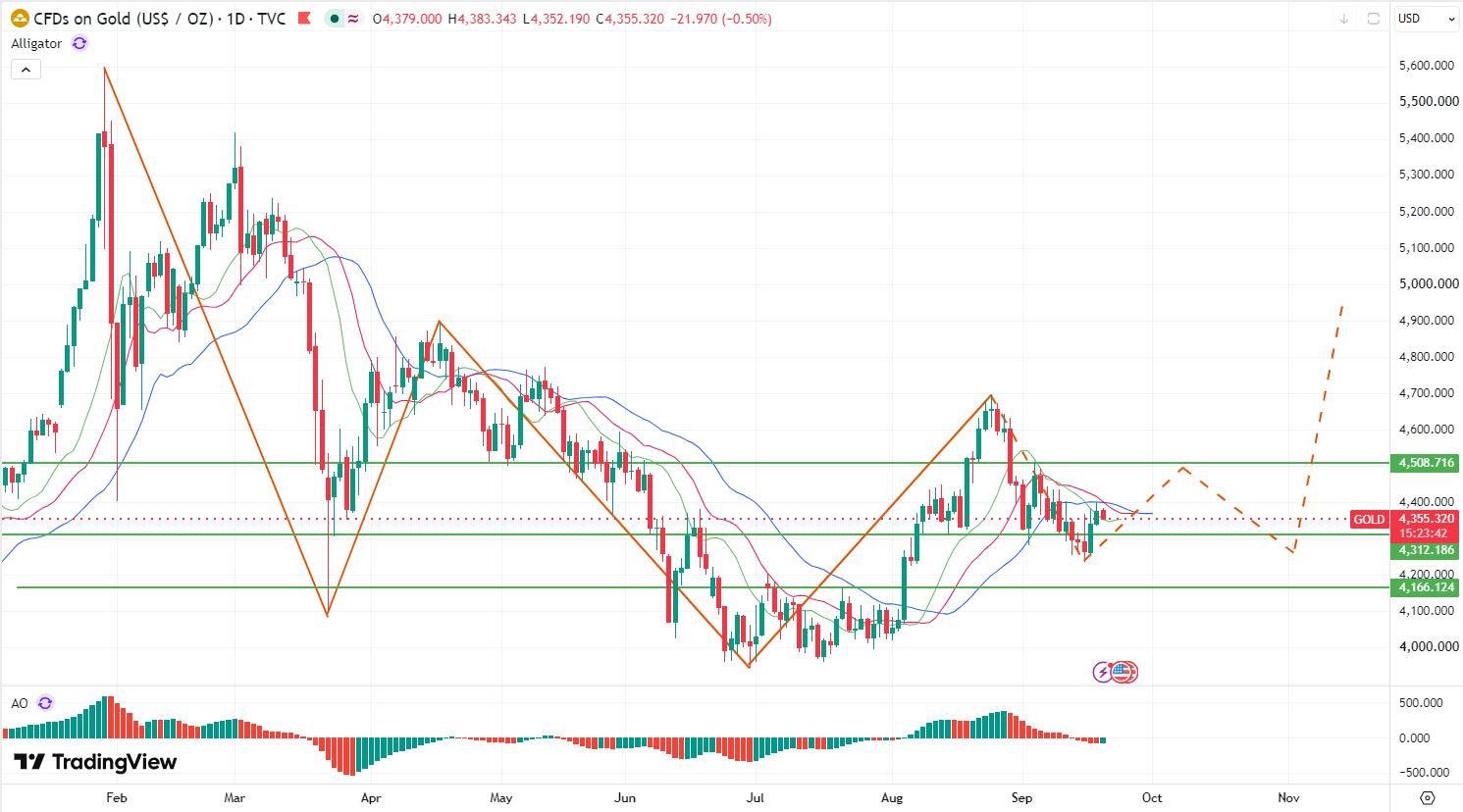
Source: Tradingview
Key gold price levels
| Reference Zone | Price (USD) |
|---|---|
| Higher recovery target RES | US$4,700 |
| Major resistance RES | US$4,600 |
| Key resistance RES | US$4,500 |
| Recovery level RES | US$4,400 |
| Key pivot PIVOT | US$4,300 |
| Secondary support SUP | US$4,250 |
| Major support SUP | US$4,200 |
| Potential downside zone SUP | US$4,150 |
Bullish technical interpretation
If gold holds above US$4,300 and breaks through US$4,400, buyers may attempt to extend the recovery towards US$4,500.
A sustained break above US$4,500 would provide stronger evidence of improving momentum.
Bearish technical interpretation
If gold repeatedly fails to overcome resistance and subsequently breaks below US$4,300, the market may retest lower support.
A decline towards US$4,200 or US$4,150 would represent a deeper correction relative to the reference range used in this analysis.
How to Trade Gold CFDs in Australia
Gold CFDs allow eligible traders to speculate on price movements without owning physical gold.
For Australian retail clients, ASIC's CFD product intervention rules limit gold CFD leverage to 20:1, equivalent to a 5% minimum margin requirement. Applicable conditions depend on the provider and client classification.
What to consider before trading
Traders should review the provider's current terms and ensure that the product is appropriate for their financial circumstances.
Trade Gold CFDs with Mitrade
Monitor XAU/USD movements and access gold CFD trading through Mitrade.

Trade XAU/USD with Tight Spreads
What to Watch in the Gold Market This Week
The coming trading sessions may be influenced by developments in several interconnected markets.
1. US Treasury yields
A continued rise in Treasury yields could weigh on gold, particularly if real yields increase.
A decline in yields could provide support, although the response will depend on the reason for the move.
2. The US dollar
Gold's performance is sensitive to dollar movements. A stronger dollar can create pressure on dollar-denominated bullion, while dollar weakness may provide support.
3. Oil prices
Oil prices remain important for inflation expectations. Changes in supply conditions and Middle East developments could affect the market's view of future interest rates.
4. Central bank communication
The Fed and other central banks' policy guidance may influence the market's expectations for future tightening or easing.
5. Geopolitical developments
Changes in the Middle East situation may affect oil supply expectations, risk sentiment and safe-haven demand.
Disclaimer: The content presented above, whether from a third party or not, is considered as general advice only. CFD trading involves significant risk of loss. Past performance does not guarantee future results. This article serves informational purposes only and does not constitute financial advice. Consider your risk tolerance before trading.


