




SanDisk Stock Surges 35%: Is SNDK Stock Still a Buy After the AI-Fueled Rally?
How to Trade SanDisk Stock in Australia
SanDisk stock has staged a powerful rebound in August, with shares gaining roughly 35% over the latest five-session stretch as investors reassessed the outlook for AI-driven storage demand. The rally accelerated after SanDisk’s August 13 Investor Day, where the company outlined ambitious long-term growth targets and highlighted growing demand for NAND flash memory from AI infrastructure and data centres.
The momentum continued into August 18. SNDK shares were trading around US$1,786.85, after gaining nearly 9% in the previous session, although the stock remains well below its June peak of around US$2,335.
The bigger question for investors now is whether the latest rally marks the beginning of another leg higher—or whether SanDisk stock has already priced in much of the AI storage opportunity.
In this article, we examine SanDisk stock price performance, the key drivers behind the recent SNDK rally, and whether SNDK stock is still a buy after its 35% surge. We also look at the risks investors should consider before taking a position.
SanDisk Stock Price: How Much Has SNDK Risen?
SanDisk Stock Price Today
SanDisk has been one of the strongest-performing memory and storage stocks recently. The rally has also pushed SanDisk's 2026 year-to-date gain above 600%, according to recent market reports, highlighting just how dramatically investor sentiment around the company has changed this year.
However, the recent surge should be viewed in context. SNDK previously reached a much higher level around US$2,335 on June 25, meaning the stock is still more than 20% below that peak despite its latest rebound.
The scale of the move is important because it changes the investment question. Rather than simply asking “Why is SanDisk stock rising?”, investors now need to consider whether the company's fundamentals can justify the higher valuation after such a rapid rally.
Why Is SanDisk Stock Rising?
Several catalysts are behind the latest SNDK rally, but three stand out: strong AI-driven storage demand, SanDisk's improved long-term financial outlook, and a shift toward longer-term customer contracts.
1. AI Is Driving Demand for NAND Storage
The biggest structural driver is the rapid expansion of AI infrastructure.
AI investment is often associated with GPUs and high-bandwidth memory, but data centres also require enormous amounts of storage to handle the growing volume of data generated by AI workloads. SanDisk is positioned directly in this part of the AI infrastructure chain through its NAND flash and enterprise storage products.
SanDisk's latest financial results show how quickly its data-centre business is expanding. In fiscal Q3 2026, data-centre revenue reached US$1.47 billion, up 233% quarter over quarter and 645% year over year. Overall revenue climbed 251% year over year to US$5.95 billion.
This shift is particularly important because it moves SanDisk's growth story beyond traditional consumer electronics and toward higher-value enterprise and AI applications.
2. SanDisk Raises Its Long-Term Growth Expectations
Another major catalyst came from SanDisk's Investor Day on August 13.
The company said it expects revenue to grow at a mid-to-high-teens annual rate between fiscal 2028 and 2030, supported by continued growth in storage demand and increasing production capacity. SanDisk also targeted gross margins of around 80% over that period.
The announcement immediately boosted investor confidence, with SNDK shares jumping more than 15% on August 13.
For investors, the significance goes beyond revenue growth. The targets suggest management believes the current NAND upcycle could produce higher and more durable profitability than previous memory cycles.
3. Long-Term Contracts Could Reduce NAND Cyclicality
SanDisk is also changing how it sells memory products.
The company has been signing multi-year New Business Model (NBM) agreements with customers, giving it greater visibility into future demand and pricing.
By August, approximately half of its 2027 production capacity and around two-thirds of its 2028 capacity had been secured through long-term customer commitments.
That could be significant because the NAND industry has historically been highly cyclical. When supply exceeds demand, memory prices can fall sharply and margins can deteriorate. Longer-term agreements could potentially reduce some of that volatility and make SanDisk's earnings profile more predictable.
4. The Broader AI Memory Rally Is Helping SNDK
SanDisk's rally is also part of a wider recovery across memory stocks.
On August 17, Micron, Western Digital and Seagatealso gained as investors became more confident about AI infrastructure spending and the outlook for memory demand.
At the same time, reports that US policymakers were encouraging Apple to avoid purchasing memory chips from certain Chinese suppliers provided another potential tailwind for US-based memory companies such as SanDisk and Micron.
Together, these factors have created a powerful narrative around US memory and storage stocks.
How to Trade SanDisk Stock in Australia
Australian investors can gain exposure to SanDisk in several ways, including buying US-listed shares or trading SNDK through a CFD platform.
Buy SanDisk Shares
Buying SNDK shares means taking direct ownership of the underlying stock. This approach may appeal to investors looking for longer-term exposure to SanDisk's AI storage growth.
However, purchasing US shares can involve brokerage costs, currency conversion between AUD and USD, and the need to fund the full position value.
Trade SanDisk CFDs
SanDisk CFDs provide an alternative for traders who want to speculate on SNDK's price movements without owning the underlying shares.
With CFDs, traders can potentially:
Go long if they expect SNDK to rise
Go short if they expect the stock to fall
Trade with leverage, subject to applicable limits and broker requirements
Manage positions using stop-loss and take-profit orders
For Australian traders, the key considerations when choosing a CFD provider include ASIC regulation, spreads, overnight financing, execution quality, platform availability and AUD funding options.
* CFDs are leveraged products and losses can exceed your initial margin depending on the product and circumstances. Investors should understand the risks before trading.
“Trade SanDisk Stock with an ASIC-regulated broker. Fast AUD funding via PayID. ”
SanDisk Stock Forecast 2026
Rather than relying on a single price target, investors should consider several possible scenarios for SNDK.
Wall Street remains broadly constructive. J.P. Morgan recently resumed coverage with an Overweight rating and a US$2,250 price target, while other bullish targets are even higher. However, these are analyst estimates rather than guaranteed future prices, and SNDK's unusually large recent gains mean volatility could remain elevated.
SanDisk Stock Technical Analysis
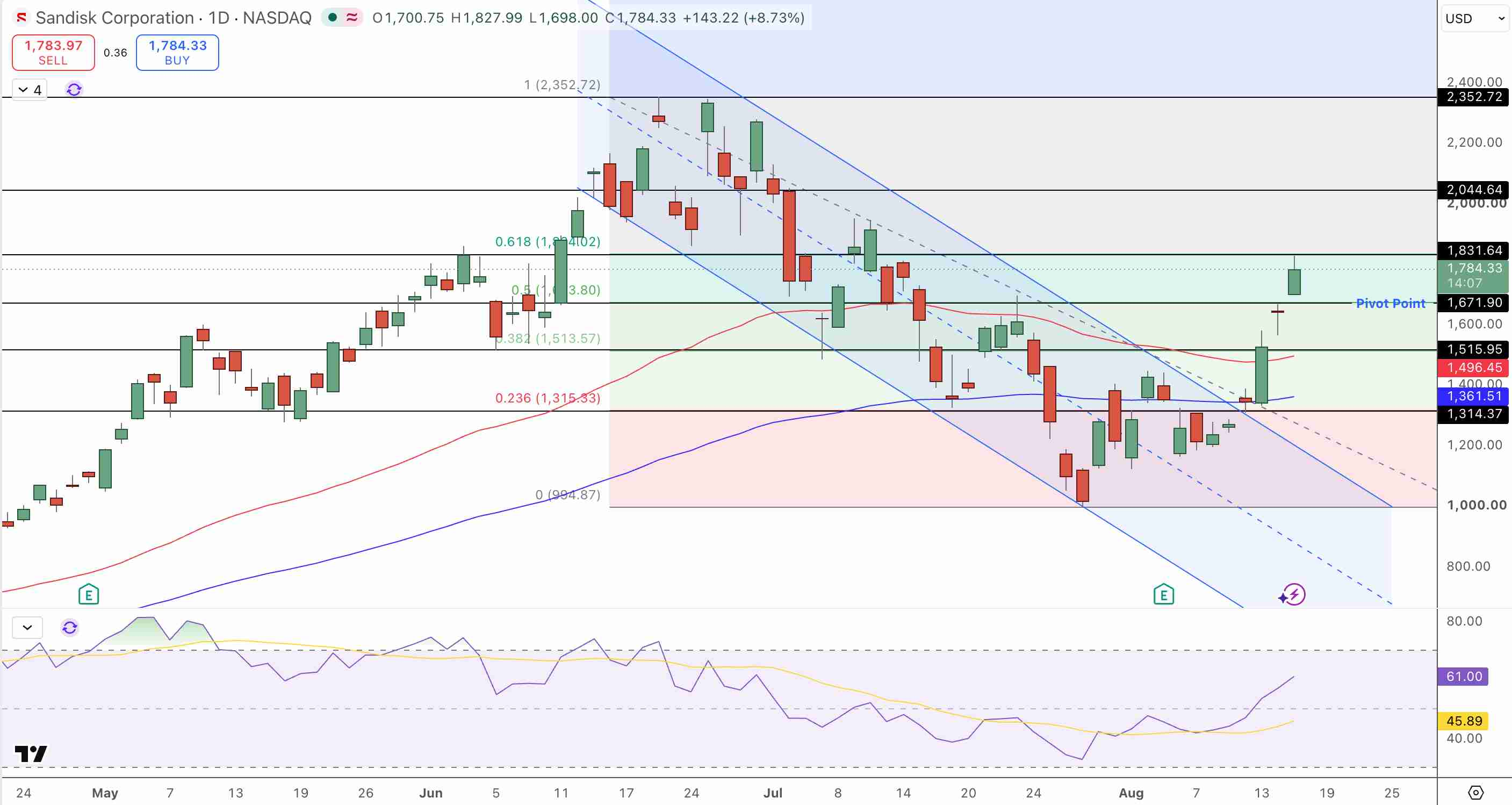
From a technical perspective, SNDK's latest rebound has significantly improved the chart.
The stock's August 17 move was particularly important because it pushed shares back above the 50-day moving average and marked a breakout from a roughly two-month downtrend base.
Source: Tradingview
Key SNDK Support and Resistance Levels
Based on the latest price action, traders can monitor the following areas:
Technical analysis should be treated as a framework rather than a prediction. After a 35% five-session rally, a pullback would not necessarily invalidate the bullish trend; instead, traders will be watching whether buyers defend previous breakout levels.
Can SNDK Break Above US$2,000?
A sustained move above US$1,830 would strengthen the bullish case and potentially bring US$1,900 and then US$2,000 into focus.
Conversely, a failure to hold the US$1,670–US$1,700 region could indicate that the latest breakout is losing momentum. Traders should therefore pay close attention to volume, moving averages and price reaction around previous resistance levels rather than focusing solely on the headline percentage gain.
SanDisk Stock vs Other AI Memory Stocks
SanDisk is not the only way to participate in the AI memory and storage boom. Micron, SK Hynix, Seagate and Western Digital all provide different forms of exposure to the growing demand for AI infrastructure.
SanDisk vs Micron
The closest comparison is probably SNDK vs MU.
SanDisk offers a more concentrated play on NAND and enterprise storage, while Micron has exposure across DRAM, HBM and NAND. That diversification can make Micron less dependent on a single memory category. Zacks recently noted that SNDK's forward P/E was higher than Micron's, while Micron's broader product portfolio gives it a valuation and diversification advantage.
On the other hand, SanDisk's more focused exposure can work in its favour if NAND pricing and enterprise SSD demand continue to outperform.
SanDisk vs SK Hynix
SK Hynix is more directly leveraged to the HBM boom that supports advanced AI accelerators, whereas SanDisk is primarily positioned around NAND flash and storage.
Therefore, investors looking for AI compute memory may prefer SK Hynix, while investors seeking a more direct AI storage/NAND theme may find SanDisk more attractive.
SanDisk vs Seagate and Western Digital
Seagate and Western Digital are more closely associated with mass storage and hard-disk drives, while SanDisk has a stronger NAND flash and SSD angle.
This distinction matters because AI data centres are increasing demand for both high-performance flash storage and high-capacity storage infrastructure.
Is SanDisk Stock a Buy in 2026?
The long-term fundamental picture for SanDisk has become increasingly attractive, particularly as AI transforms the economics of data-centre storage. However, the 35% short-term rally means the risk/reward profile is less straightforward for a new investor today.
For long-term investors, the key metrics to monitor are AI storage demand, NAND pricing, enterprise SSD growth, margins and long-term contract coverage.
For active traders, the more immediate question is whether SNDK can hold its recent breakout levels and continue toward US$1,900–US$2,000, or whether profit-taking triggers a deeper consolidation.
For Australian traders who want to speculate on either direction of SNDK, CFDs offer the flexibility to take long or short positions, but leverage also increases risk. A disciplined approach to position sizing and stop-loss management is particularly important after such a sharp rally.

 Enjoy simple and fast trading Flexible leverage options available Follow real-time trading strategies Demo account with $50,000 virtual funds

1. What is SanDisk stock?
SanDisk Corporation (NASDAQ: SNDK) is a US-based data storage company focused primarily on NAND flash memory, solid-state drives (SSDs) and enterprise storage solutions. Its stock has become increasingly associated with the AI infrastructure theme because data centres require significantly more storage as AI workloads expand.
2. Why is SanDisk stock rising?
SanDisk stock has recently surged on expectations of stronger AI-driven storage demand, tighter NAND supply and improving profitability. The company also raised its long-term growth outlook at its August 2026 Investor Day, forecasting mid-to-high-teens annual revenue growth for fiscal 2028–2030. Its multi-year customer contracts are another factor supporting investor confidence.
3. What is the SanDisk stock forecast for 2026?
There is no guaranteed SanDisk stock price forecast for 2026, but analyst expectations remain broadly bullish. Recent consensus data compiled by Investing.com shows an average 12-month price target of around US$2,217.77, with 18 of 22 analysts rating SNDK a Buy. Individual targets vary considerably, illustrating the high level of uncertainty surrounding the stock.
4. Does SanDisk benefit from AI?
Yes. AI data centres require large amounts of storage for training, inference and data management. SanDisk is positioned to benefit from rising demand for enterprise SSDs and NAND flash storage. The company has also highlighted high-bandwidth flash and AI inference as potential long-term growth opportunities.
5. Can SanDisk stock reach US$2,000?
A move toward US$2,000 is possible if AI storage demand remains strong, NAND pricing stays favourable and SanDisk continues delivering on its growth and margin targets. However, US$2,000 should be treated as a potential price level rather than a guaranteed target. Traders should monitor whether SNDK can sustain its recent breakout and maintain momentum above key technical support levels.
5. Can I trade SanDisk CFDs in Australia?
Yes. Some Australian CFD providers offer exposure to US stocks such as SanDisk. CFDs allow traders to potentially take either a long or short position without owning the underlying shares. However, CFDs are leveraged products, so losses can be amplified. Australian traders should check that their provider is appropriately regulated and understand the applicable fees, leverage and risk controls before trading.
Disclaimer: The content presented above, whether from a third party or not, is considered as general advice only. CFD trading involves significant risk of loss. Past performance does not guarantee future results. This article serves informational purposes only and does not constitute financial advice. Consider your risk tolerance before trading.


