


1 Brilliant ETF I'm Loading Up on if Inflation Continues Climbing
Key Points
The Schwab U.S. Dividend ETF (SCHD) prioritizes high-quality companies that generate lots of cash flow.
SCHD has averaged around a 3.1% dividend yield over the past decade.
SCHD has outperformed all major U.S. indexes so much this year.
- 10 stocks we like better than Schwab U.S. Dividend Equity ETF ›
June's inflation report showed a 0.4% decrease from May, but with oil prices rising amid continued conflicts in the Middle East, there's a very real chance it will reverse course in July. And even if it doesn't, it's almost guaranteed that it'll be up from last year (June was up 3.5% year over year).
Missed Nvidia in 2009? This Rare Signal Is Flashing Again. In 2009, a "Double Down" signal flashed for a little-known chipmaker called Nvidia. For the first time in years, that same "Total Conviction" signal is flashing for a company 1/100th the size of Nvidia. Continue »
In either case, inflation isn't going away, so it's important to ensure your money isn't losing purchasing power over time. Your average savings account won't pay enough in interest to keep up with inflation, but there are plenty of investments that typically will. One is the Schwab U.S. Dividend ETF (NYSEMKT: SCHD), which I eagerly load up on when inflation is climbing.
An attractive, healthy dividend
A dividend ETF is a great way to combat inflation because it provides guaranteed income with a chance for stock price appreciation. This isn't the case with cash or fixed-income investments, such as bonds.
Image source: Getty Images.
SCHD is a great go-to because it emphasizes high-quality, cash flow-heavy companies, so you don't have to worry about sustainability or yield traps. Its current yield is just over 3%, slightly below its average over the past decade.
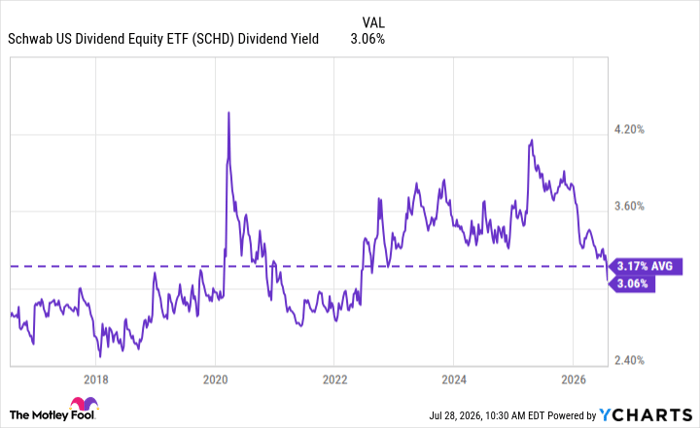
SCHD Dividend Yield data by YCharts
If we assume (emphasis on assume, because the stock market is unpredictable) that SCHD continues to average around a 3% yield, that's good enough to hedge against the 2% inflation the Federal Reserve targets to support economic growth and stability. Of course, inflation is often higher than that, but it's nice to know that some of your investments can help offset it.
SCHD rewards beyond just today's payout
Current yield aside (which is important), a key part of SCHD is that, to be included, a company must have at least 10 consecutive years of dividend increases. This is a bonus that also combats inflation.
The payout amount fluctuates because different companies pay dividends on different schedules, but over the past decade, SCHD's payout has increased by 210%.
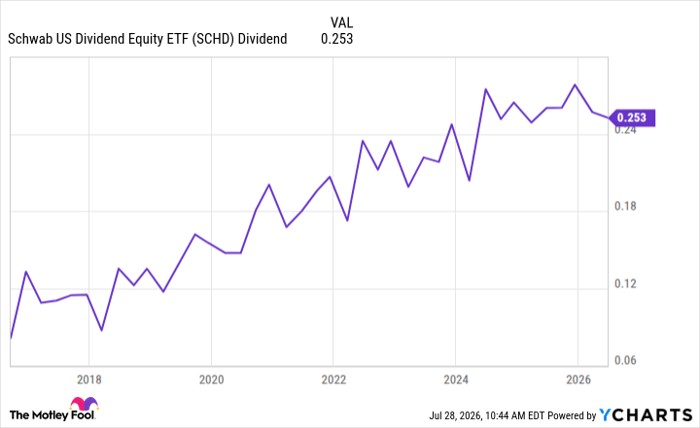
SCHD Dividend data by YCharts
The ability to maintain an attractive dividend that consistently increases over time makes SCHD one of the premier dividend ETFs on the market. You shouldn't invest expecting it to outperform the market year in and year out, but so far this year (as of July 28), it has outperformed the S&P 500 (SNPINDEX: ^GSPC), Nasdaq Composite (NASDAQINDEX: ^IXIC), Dow Jones Industrial Average (DJINDICES: ^DJI), and Russell 2000.
If you're looking to beat or at least offset inflation, you want an investment you don't have to second-guess, and SCHD checks that box. It's a staple in my portfolio and will likely be for quite some time.
Should you buy stock in Schwab U.S. Dividend Equity ETF right now?
Before you buy stock in Schwab U.S. Dividend Equity ETF, consider this:
The Motley Fool Stock Advisor analyst team just identified what they believe are the 10 best stocks for investors to buy now… and Schwab U.S. Dividend Equity ETF wasn’t one of them. The 10 stocks that made the cut could produce monster returns in the coming years.
Consider when Netflix made this list on December 17, 2004... if you invested $1,000 at the time of our recommendation, you’d have $390,394!* Or when Nvidia made this list on April 15, 2005... if you invested $1,000 at the time of our recommendation, you’d have $1,209,184!*
Now, it’s worth noting Stock Advisor’s total average return is 899% — a market-crushing outperformance compared to 206% for the S&P 500. Don't miss the latest top 10 list, available with Stock Advisor, and join an investing community built by individual investors for individual investors.
See the 10 stocks »
*Stock Advisor returns as of July 30, 2026.
Stefon Walters has no position in any of the stocks mentioned. The Motley Fool has no position in any of the stocks mentioned. The Motley Fool has a disclosure policy.
Recommended Articles


