


Why Is NVIDIA (NVDA) Falling? The $250B OpenAI Deal, Circular Financing Fears, and Asian Chip Rout
TradingKey - NVIDIA (NASDAQ: NVDA) stock settled at $196.51 on July 28 after tumbling 4.99%, wiping out around $250 billion of market capitalization in one day. On Tuesday, it is still heading lower towards a $194.13 chart support, while the semiconductor sector ETF is down an extra 2.4%. The selloff in NVIDIA stock was driven by two factors: First, The Wall Street Journal reported that NVIDIA is in discussions about guaranteeing up to $250 billion in funding for OpenAI’s data center project, reviving speculation of circular financing.
Second, Asian semiconductor stocks plummeted. Samsung’s stock fell 13.4% and SK Hynix sank 14.7%. NVIDIA’s credit default swap spreads widened to their biggest single-day gain on record. Analysts believe the concerns are overblown.
The $250 Billion OpenAI Guarantee - What It Is and Why It Spooked Markets
According to the WSJ report, NVIDIA is discussing a $250 billion financing backstop for an SB Energy data center in Piketon, Ohio, owned by SoftBank Group. OpenAI would be the main tenant in the facility. Another report mentioned an additional $350 billion in commitments for NVIDIA chip purchases in the same facility, possibly making the total amount above $500 billion, which would exceed NVIDIA’s market cap.
Alekandar Tomic, a professor at Boston College, characterized the deal as circular financing, which occurs when a company provides loans to a customer to purchase goods or services from itself. Critics have pointed out that this practice was a contributing factor to the dot-com bubble collapse.
The fundamental concern is that such a deal may alter how NVIDIA allocates its capital, since its ability to fund itself is now tied to OpenAI’s ability to pay for it. If OpenAI can’t generate enough revenue to pay for the equipment it has agreed to buy, NVIDIA will be exposed. However, analysts told Yahoo Finance that the fears were exaggerated. NVIDIA’s guidance for second-quarter revenue hasn’t changed and it’s receiving actual orders from customers.
Asian Chip Rout Added Momentum to the Selloff
NVIDIA stock’s 5% decline was also boosted by a massive overnight Asian chip selloff where South Korea’s benchmark KOSPI index sank 10.8%. South Korean chipmakers Samsung Electronics sank 13.4% and SK Hynix plummeted 14.7%, which were their steepest single-session losses in nearly two decades.
The reasons include news that Chinese firm CXMT had developed deep-ultraviolet lithography expertise to expand domestic production independently. SK Hynix American depositary receipts also fell below its initial public offering price in July.
This matters to NVIDIA because SK Hynix is one of the top two suppliers to NVIDIA of high-bandwidth memory (HBM), along with Micron. Competition among HBM vendors could affect the industry in the long run. In the short term, the selloff damaged investor sentiment and forced investors that have taken positions in AI infrastructure to trim their exposure to the entire sector.
The Other Developments - Texas, SSI, and Nokia 6G
In addition to the OpenAI assurance, Nvidia made three additional announcements this week that further contributed to the data dump. In one development, the Financial Times stated that Nvidia entered into lease agreements for up to $50 billion for the Hut 8’s Beacon Point campus in Texas. This will be a 1-gigawatt AI data center and Nvidia has a base contract for $19.6 billion over 15 years, according to the FT. Nvidia expects to lease out the computing power to neocloud service providers from the data center.
In another development, Nvidia announced a $5 billion strategic investment in Safe Superintelligence (SSI), founded by ex-OpenAI Chief Scientist Ilya Sutskever. SSI receives early access to the Vera Rubin GPU platform and increases the computing capacity by around ten times.
In yet another development, Nokia announced that it is testing Nvidia GPU-powered equipment for future 6G radio access networks, aiming for more than 100% higher spectral efficiency in 2028. It could also mark Nvidia’s first steps towards telecommunications infrastructure.
NVDA Technical Setup
On the 4-hour chart, NVDA has fallen below its rising trendline, and its 50-period EMA ($204.05) and 200-period EMA ($204.40). Both EMAs will now come together and act as resistance in the $204 to $205 area. RSI hovering near 36 is getting close to being oversold but without showing any sign of reversal. $194.13 is the nearest support.
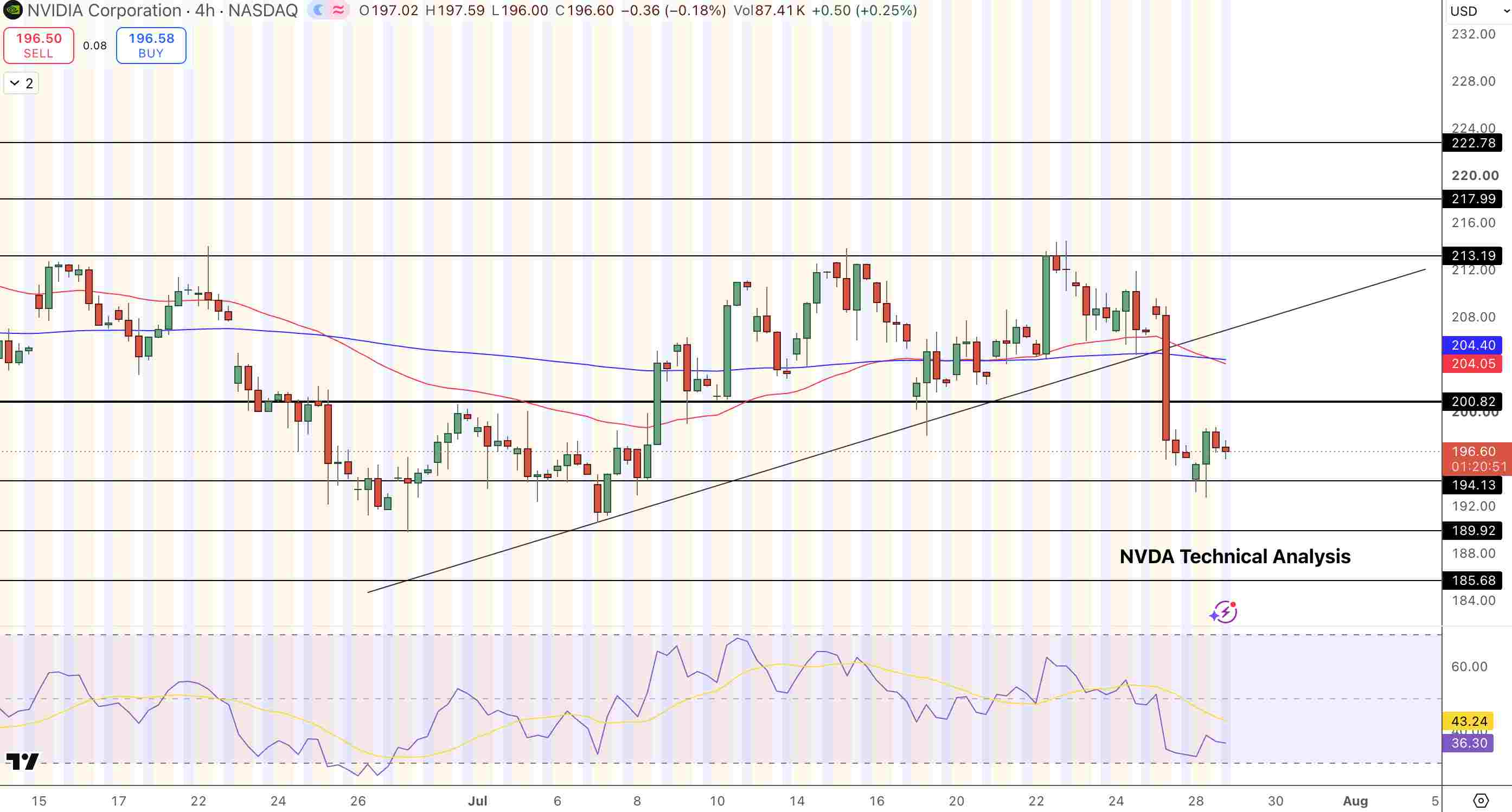
NVIDIA Price Chart - Source: Tradingview
Below it are $189.92 and $185.68. A recovery above $200.82 would be the first sign of bullishness, while a move above $204.40 would confirm the re-taking of the trendline and open up $213.19. Nvidia is expected to report Q2 earnings on August 25.
Key Levels
- Monday close: $196.51 (-4.99%). Market cap shed ~$250B in one day
- OpenAI deal: $250B guarantee to build SoftBank SB Energy facility in Piketon, Ohio. Could see $350B worth of chips purchased. Over $500B total
- Asian market sell-off: Samsung -13.4%, SK Hynix -14.7%, KOSPI -10.8%. CXMT DUV lithography issue
- CDS: Nvidia credit default swap spreads have the largest single-day increase on record
- Analyst consensus: Most analysts think the panic is overblown. 85% are rating the stock as Buy or Strong Buy. Average price target is ~$303
- Support: $194.13, $189.92, $185.68
- Resistance: $200.82, $204.05/$204.40 (EMA confluence), $213.19
- Earnings date: August 25. Q2 guided at $91B
Why Is Nvidia’s Credit Default Swap Spread a Red Flag?
A credit default swap is basically an insurance policy against debt default. The cost of such a swap rises as the perceived risk of the debt increases. Nvidia has traditionally had very little debt and enormous amounts of free cash flow, so a record single-day CDS spread increase for the company is noteworthy. It suggests that Nvidia’s risk profile could deteriorate if the OpenAI $250 billion guarantee is a real liability.
However, CDS markets are so thinly traded that they overreact to headlines. As a result, most equity analysts believe that the CDS move is a red herring.
What Is Circular Financing and Why Are People Talking About the Dot-Com Bubble Again?
Circular financing means that a company gives credit to its customers to purchase its own products. People are comparing Nvidia’s AI investments and guarantees to the dot-com bubble. During that period, equipment vendors would extend credit to telecommunication companies to buy the latest network gear, which artificially inflated revenues until the loans went bad.
The important thing to understand here is that Nvidia hardware generates real, measurable commercial value in the present day. Whether the dot-com analogy is accurate ultimately depends on how long it takes AI developers to realize enough commercial returns from their products to pay for the infrastructure debt they’ve taken on.
Bottom Line
NVIDIA dropped 5% on Monday after news of a $250B guarantee by OpenAI and selling pressure that collapsed Asian chip stocks. CDS spreads gained more than ever in a single day. The stock is down at $194.13 to under both EMAs at $204-$205 and a broken ascending trendline.
The circular financing issue is structural. Does the current arrangement have the potential to create incentives that can absorb losses if OpenAI’s revenues don’t keep up with its infrastructure debt?
Most equity analysts say those fears are overblown given the company’s fundamentals, which are still intact. They have $91 billion revenue guidance in Q2 and 85% Buy coverage.
To begin to recover, the stock needs to close above $200.82. The next support level below $189.92 is $185.68. August 25 earnings will provide financial confirmation or refutation of the circular financing thesis.
Recommended Articles


