


If I Could Only Buy and Hold 1 Stock Heading Into the Eye of a Stock Market Storm, This Would Be It
Key Points
Although most stocks ebb and flow with the broad market, there are exceptions.
These exceptions make sense, given the nature of the underlying companies’ businesses.
One particular ticker has already proven it’s capable of removing itself from the broad market’s flow when the tide turns bearish.
- 10 stocks we like better than Walmart ›
Every bull market eventually turns into a bear market. But for investors who make a point of only owning quality stocks, the right move is to ride out the storm with those same names, knowing they'll bounce back.
It wouldn't be wrong to also think a bit strategically when hints of a headwind start blowing, though, if only to dial back some of the adverse impact. And one name in particular is at the top of the list of tickers to own during these tough periods. That's mega-brick-and-mortar retailer Walmart (NASDAQ: WMT).
Missed Nvidia in 2009? This Rare Signal Is Flashing Again. In 2009, a "Double Down" signal flashed for a little-known chipmaker called Nvidia. For the first time in years, that same "Total Conviction" signal is flashing for a company 1/100th the size of Nvidia. Continue »

Image source: Getty Images.
Proven performance
Walmart is not necessarily immune to marketwide weakness. It can and does pull back when the market does.
However, Walmart shares are more likely than not to decouple from the broad market when things get bad, holding up when other stocks won't. That's what investors saw before, during, and shortly after the dot-com crash of 2000, anyway, as well as at the beginning of the subprime mortgage meltdown. Walmart shares remained volatile during these periods, but at least they sidestepped the brunt of the headwind.
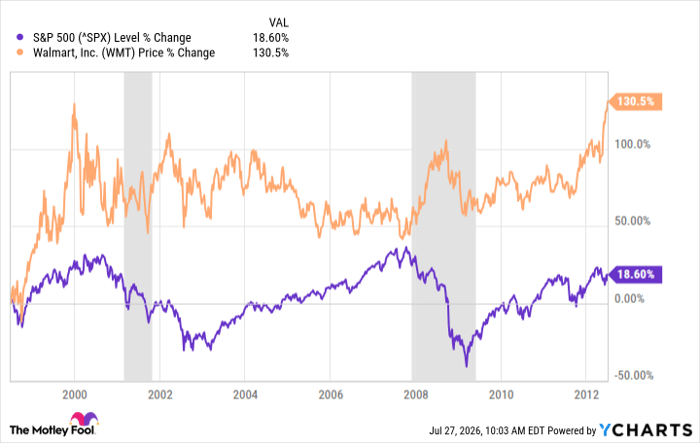
^SPX data by YCharts
Perhaps more important is what's not shown in the comparative chart. That's Walmart's cash dividend, which has continued to be paid during these bear markets. Its forward-looking dividend yield of just under 1% may not be thrilling, but that's based on a per-share payment that's now been raised for 53 consecutive years, with no end to the streak in sight.
Built for challenging economic environments
It's not tough to see why this ticker can push through prolonged market storms. It's the nature of the underlying company's business itself. More than half of Walmart's revenue reflects grocery sales, which consumers need regardless of the economic backdrop. It also doesn't hurt that the retailer is the low-price leader in most food categories, low prices made possible by its scale-based leverage with vendors and suppliers.
In this vein, Walmart has repeatedly touted that most of its market share gains over the course of the past four inflation-riddled years have come from affluent households (earning in excess of $100,000 per year) who are feeling just as much financial pressure these days as its core customers.
That being said, it doesn't hurt that about 90% of the U.S. population lives within 10 miles of one of its 5,215 domestic stores, which also offer low prices on nonfood consumer staples like clothing, cleaning supplies, medicines (prescriptions and OTC), hardware, baby goods, household items, and more. Sheer convenience counts for something, too.
Great for then, but also good in the meantime
No, it's not a guarantee that Walmart's shares will rally during the next marketwide storm, or even hold their ground. It's also worth mentioning that Walmart stock doesn't perform as well as most other stocks do at the beginning of new bull markets. Just make sure your expectations are fair and reasonable.
To the extent you're looking to mitigate your risk with a stock you can feel good about owning in any market environment, though, Walmart is a good one and arguably one of the best all-around ones.
Should you buy stock in Walmart right now?
Before you buy stock in Walmart, consider this:
The Motley Fool Stock Advisor analyst team just identified what they believe are the 10 best stocks for investors to buy now… and Walmart wasn’t one of them. The 10 stocks that made the cut could produce monster returns in the coming years.
Consider when Netflix made this list on December 17, 2004... if you invested $1,000 at the time of our recommendation, you’d have $377,990!* Or when Nvidia made this list on April 15, 2005... if you invested $1,000 at the time of our recommendation, you’d have $1,269,518!*
Now, it’s worth noting Stock Advisor’s total average return is 896% — a market-crushing outperformance compared to 206% for the S&P 500. Don't miss the latest top 10 list, available with Stock Advisor, and join an investing community built by individual investors for individual investors.
See the 10 stocks »
*Stock Advisor returns as of July 28, 2026.
James Brumley has no position in any of the stocks mentioned. The Motley Fool has positions in and recommends Walmart. The Motley Fool has a disclosure policy.
Recommended Articles


