


Volkswagen (VOWG) Q2 2026 Earnings: 5x P/E, 7% Yield, Triangle Breakdown
TradingKey - As the company releases Q2 2026 results today with the conference call scheduled for 9:00 AM GMT+2, Volkswagen (XETRA: VOWG) is trading at EUR 72.30, down from a previous close of EUR 73.30 on Thursday July 24. Over the past year, the stock is down 21.23%, and over the last month, 7.20%. In the last quarter, the company's earnings per share (EPS) came in at EUR 2.55 vs. the consensus of EUR 3.44; the earnings beat the estimate by -25.94%. Revenue at EUR 75.66 billion missed the consensus of EUR 78.26 billion. The symmetrical triangle on the 4H time frame has broken downwards. The stock is ranging from EUR 71.95 to EUR 74.35 today. The 52-week high and low are 110.20/71.00.
What Volkswagen Is Dealing With and Why the Valuation Looks the Way It Does
Volkswagen P/E is 5.97, and dividend yield is 7.21%. These metrics do not indicate a growth stock, but rather a company under pressure for which investors are demanding a steep discount to compensate for the risks involved. The reasons for these pressures are clear: Chinese domestic players, including BYD, are eating into VW's market share in China, which remains VW's most profitable market. Furthermore, European EV adoption has been slower than projected, leaving VW overextended in its EV strategy, and German labor costs remain high in comparison to the US and Asia, meaning margin improvements will take more time after a top-line recovery.
This week, a German state minister suggested that the EU should consider placing higher tariffs on cars produced in China, a scenario that would provide immediate support to VW in its core region of Europe. The automaker also reportedly is close to selling a portion of its Indian operations to JSW Group, a move that would add cash flow and a valuable local presence in the world's fastest-growing auto market.
VW is also beginning the production of a new compact electric SUV priced in the range of EUR 28,000, aiming to capture a significant portion of the mass market EV buyer segment that has been largely absent due to pricing barriers. The combination of these developments points to a company actively addressing its structural difficulties, which is what makes the company's Q2 report particularly notable, as it will be a good indication as to whether these measures are having any effect.
The Q1 Miss and What Q2 Consensus Expects
VW's Q1 2026 earnings were another disappointing result. EPS was EUR 2.55 vs. an EPS estimate of EUR 3.44, a beat of -25.94%. Revenue came in at EUR 75.66 billion, missing the EUR 78.26 billion consensus. The company's net income fell from EUR 3.15 billion in Q4 2025 to EUR 1.29 billion in Q1. According to the earnings call, Q1 EPS and revenue misses were due to continued pressures in China and higher costs associated with its EV ramp-up, alongside soft demand for cars in Europe.
TradingView consensus data indicates that analysts expect VW to report earnings of EUR 4.74 EPS in Q2, up from the EUR 2.55 reported in Q1. If the consensus for Q2 comes close to this estimate, then the results will represent a significant improvement. Failure to report EPS close to the consensus estimate, especially if the stock fails to show up again by the same magnitude as Q1, could see the stock trade down to its 52-week low of EUR 71.00.
At these levels, VW presents a classic value case. Trading at 5.97x earnings and yielding 7.21% on its EUR 75 billion quarterly revenue, the company's EUR 36.5 billion market cap implies an expectation that the company's performance will continue to deteriorate. Analysts rate the stock as a Strong Buy with five of them providing a EUR 125.20 average 12-month price target, suggesting 66.71% upside.
For the preferred shares, the EUR 106.79 consensus target suggests 46% upside. Also, the recent insider purchases have added some credibility to the case for higher prices. The idea is that this is a company for which a poor outcome is already priced in, and the outlook is more favorable with the introduction of EUR 28,000 EVs, the JV with the JSW Group, and potentially some tariff support from the EU.
VOWG Technical Setup
On the 4H chart, the VOWG stock has fallen below a symmetrical triangle and is currently trading below the 50 EMA which is at EUR 75.58, as well as below a descending trendline. The EUR 71.95 low today will act as critical support. RSI, at 39.9, remains below neutral but hasn't reached oversold levels, which means the stock will likely continue to fall in the event of another disappointing report in Q2.
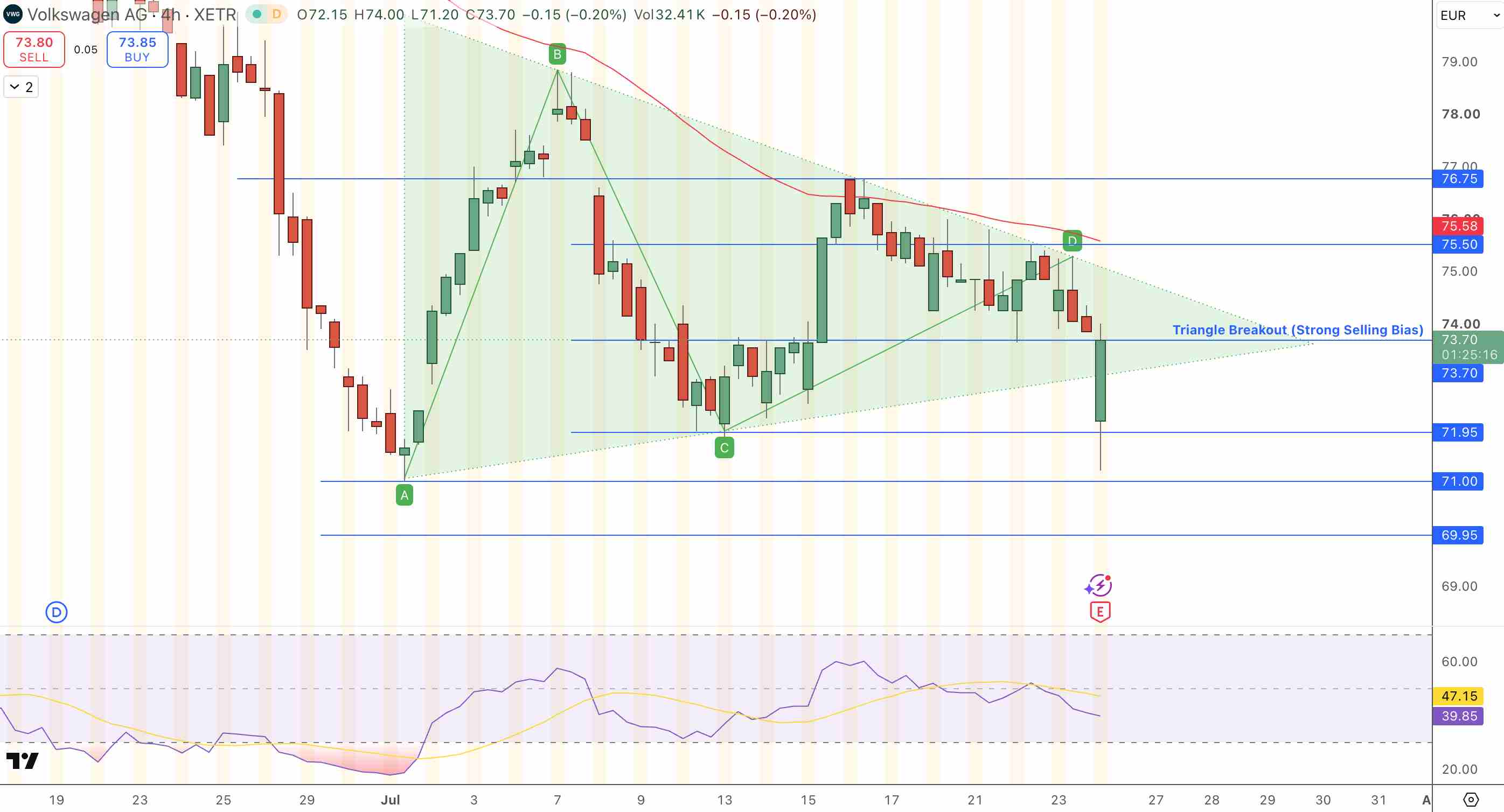
Volkswagen (VOWG) Price Chart - Source: Tradingview
Buyers need to get the stock back above the 73.70 level in order to begin looking for EUR 75.50 where the 50 EMA and the descending trendline come together. A close above EUR 75.50 should open the EUR 76.75 level. A failure in this support level would allow the EUR 71.00 and EUR 69.95 level to act as the new targets.
Key Levels
- Day: VWOW trading at EUR 72.30, with today's high and low of 74.35/71.95. Previous day close: 73.30
- Q1 misses: EPS at EUR 2.55 vs 3.44 consensus (beat of -25.94%). Revenue at EUR 75.66B vs 78.26B consensus
- Valuation: Price-to-earnings of 5.97x with a 7.21% dividend yield. Market capitalization of EUR 36.5B
- Analyst targets: A EUR 125.20 target price from 5 analysts, a buy rating, indicating 66.71% upside
- Resistance: EUR 73.70, EUR 75.50 (50 EMA plus a descending trendline), and EUR 76.75
- Support: EUR 71.95 (critical), EUR 71.00, and EUR 69.95
What Is Volkswagen's New Compact EV and Why Does the Price Point Matter?
Volkswagen today said it is launching an EV with an estimated cost of 28,000 Euro, which is in the range most European buyers look at. Most previous VW EVs, including the ID.4 and ID.3, were offered at a cost of 35,000 to 50,000 Euro. The low cost of 28,000 Euro puts VW directly in contention with BYD and some Chinese vehicles that are taking share of Europe on price.
The expectation is that if VW can build enough volume with a compact EV in the second half of 2026 and going into 2027, VW will have solved its single greatest product gap, which is low cost EVs for Europe.
Why Does VW Trade at 5.97x Earnings Despite Being the Second-Largest Automaker in Europe?
Low P/E ratios in autos are the result of peak P/E, or structural business model challenges, or both. Both apply to VW. China profits, a major chunk of group profit, are now reduced by China competition. EV costs come first, before EV revenue is generated at scale. German labor contracts reduce operating leverage.
A dividend yield of 7.21% is attractive, but is consistent with skepticism about enough earnings growth to justify a higher P/E. The 5 analysts that have it as a Strong Buy believe that the negatives are more than priced in at 72 and normalized earnings power is materially more than the current run-rate.
Bottom Line
Volkswagen reports Q2 earnings on today at very low multiples, 5.97x P/E, 7.21% dividend yield, with a 21% year decline. Q1 missed earnings by 26% and revenue by 3.4%. The 4H triangle was to the downside and RSI is 39.9, still not oversold. VW 71.95 support from today's low is critical. Hold that level and a Q2 better than Q1's miss can initiate a relief bounce toward 73.70 and 75.50. Two significant misses could test 71.00 and then 69.95. The 5 analysts rate it Strong Buy at an average target of 125. The market disagrees.
Recommended Articles


