


Lockheed Martin (LMT) Q2 2026: $230B Record Backlog, EPS Beat 10%, Guidance Raised
TradingKey - Lockheed Martin (NYSE: LMT) jumped more than 5% following its Q2 2026 earnings report, which exceeded forecasts on all major measures. Revenue hit $20.06 billion, reflecting 10.5% year-over-year growth and surpassing the $19.33 billion consensus by 3.8%. GAAP earnings per share came in at $7.94, beating the $7.20 forecast by 10.3%, while the company also generated free cash flow of $2.9 billion.
Lockheed subsequently increased its full-year revenue outlook to $80.75 billion (midpoint), a 2.5% increase from its prior guidance and 2% higher than Wall Street expectations. Backlog swelled to an all-time high of $230 billion, with the company citing the award of a $35 billion multiyear contract to produce THAAD interceptors as a major contributor.
At its current share price of $568.80, LMT shares have surpassed their long-term downward trend line, while the RSI stands at 77, technically overbought yet not yet signalling an impending correction.
Why Did the Company Beat Expectations in Q2?
Missiles and Fire Control posted the most robust results, with increased production rates contributing to a meaningful jump in operating income relative to last year. The year-ago quarter suffered from $1.6 billion in program losses along with $169 million in other charges, which weighed down 2025 results; that fact artificially enhances the year-over-year improvement in earnings.
On an organic basis, the business posted an operating margin of 12.4%, up 8.2% from the prior-year period, indicating the company's underlying profitability is actually expanding.
Company executives described moving their strategy towards becoming a "defense technology leader," and they are focused on matching weapons to targets while offering lower-cost, higher-quantity solutions for modern challenges, such as drones.
These statements are noteworthy because they reveal Lockheed Martin's strategic efforts to align itself with how contemporary conflicts have changed, where it is increasingly vital to field large quantities of inexpensive munitions and sophisticated guidance systems alongside more expensive assets, like F-35 fighter jets. The $65 billion in fresh orders secured and the $230 billion backlog illustrate the market demand for those solutions.
The $230 Billion Backlog and Why It Matters
With annual revenue of approximately $20 billion in recent quarters, the backlog equates to roughly 2.9 years of future work. That level of contract visibility is not typical of most defense industry participants. The milestone was reached thanks mostly to the aforementioned THAAD contract, a multiyear agreement to produce Terminal High-Altitude Area Defense missiles that can shoot down ballistic and cruise missiles. If we were to assume the full contract was priced at current revenue rates, the THAAD deal accounts for nearly 1.75 quarters of sales on a guaranteed basis. The backlog also grew as the company secured awards for radar and space systems.
Investors value backlogs because they give them a sense of when defense-related capital spending commitments are likely to mature into revenue and how secure those future revenues are against unexpected delays. Lockheed's primary customers are the Department of Defense and similar agencies in allied governments or countries purchasing US weapons systems on a foreign military sales basis.
These customers rarely cancel existing contracts. At the current moment, the defense spending budgets for the US and its NATO partners are rising. Therefore, with a $230 billion backlog and an elevated guidance estimate of $80.75 billion for this year, Lockheed has the most committed revenue pipeline in its history.
Guidance Raised - What $80.75 Billion Implies
Lockheed raised its full-year 2026 revenue guidance to a midpoint of $80.75 billion, from a previous estimate of $78.75 billion (2% above the consensus of approximately $79.2 billion). Management also announced the raise in the quarter that the company surpassed the market, so it is not simply shifting the second half into the second quarter; the company has raised both its current quarter estimate and its view into the future.
For the third quarter of this year, the company will pay its regular quarterly dividend of $3.45 per share, which it says it has enough free cash flow to fund and continue increasing.
In Q2 2026, Lockheed posted free cash flow of $2.9 billion, which compares to negative $150 million in the same period last year, another signal that management's claims about operational improvement are being backed up with cash generation.
LMT Technical Setup
LMT has broken a long-standing descending trend and crossed above key moving averages (50 EMA at $524.77, 200 EMA at $528.81). The stock is currently consolidating near resistance at $575.78 (at $568.80).
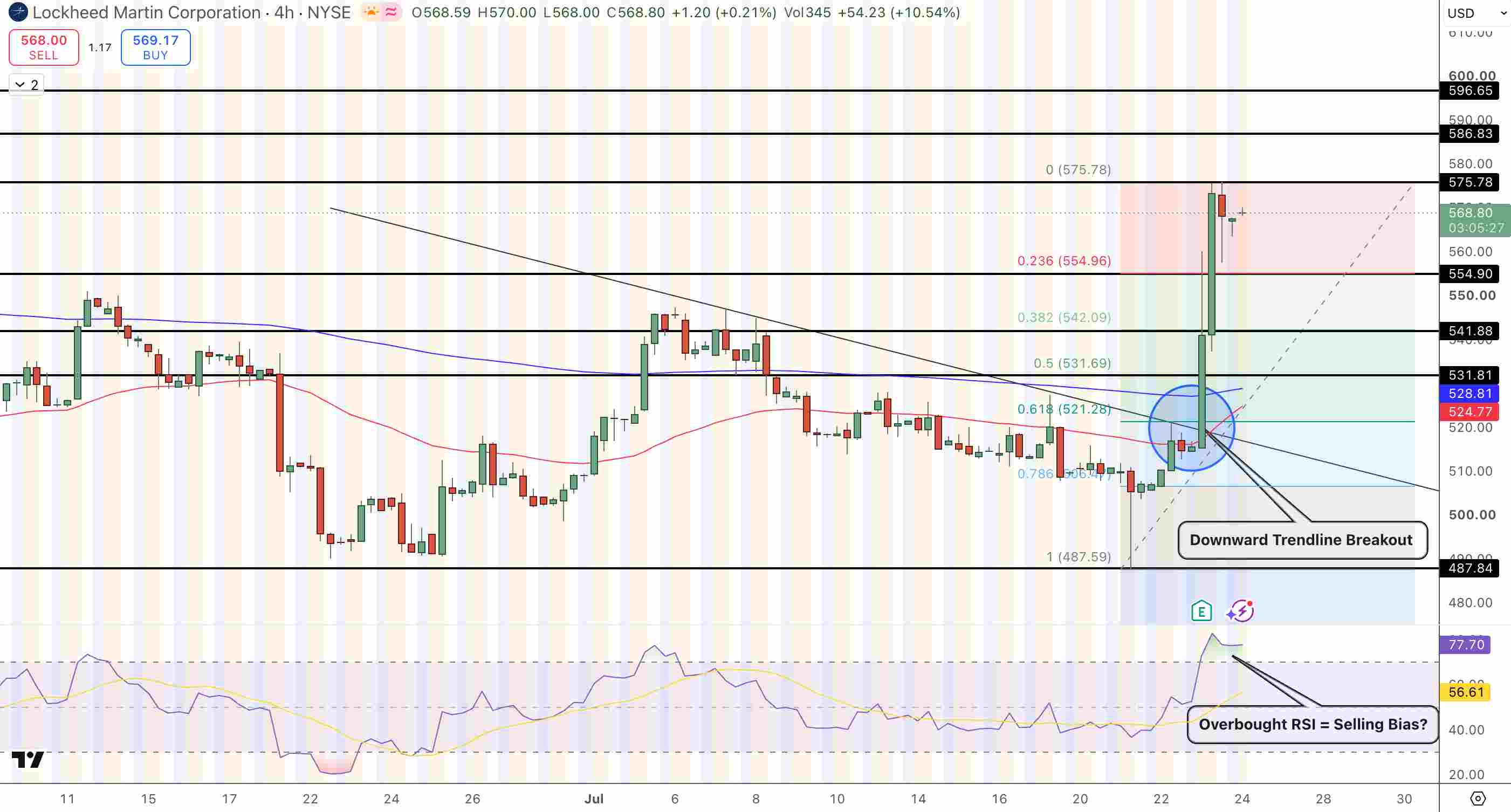
Lockheed Martin (LMT) Price Chart - Source: Tradingview
The RSI at 77 shows that the stock is overbought, usually resulting in a consolidation rather than an explosive breakout. If buying interest remains above $554.90, the next targets could be $575.78, $586.83, and $596.65.
A pullback to $554.90 or $541.88 should be viewed as a retest, not as the beginning of a reversal. The trend structure is bullish so far above the broken trendline.
Key Levels
- Q2 Revenue: $20.06B beat (vs $19.33B est, +10.5% YoY growth, 3.8% top-line beat)
- Q2 Earnings Per Share (EPS): $7.94 beat (vs $7.20 est, 10.3% beat, Free Cash Flow $2.9B, Op Margin 12.4%)
- Backlog: $230 billion record backlog with a $35B multiyear THAAD contract. Added $65B to backlog during Q2.
- FY2026 Guidance: Raised to $80.75B midpoint (from $78.75B, 2.5% upside)
- Resistance: $575.78 (near-term), $586.83, and $596.65
- Support: $554.90 (breakout retest), $541.88 (further support below)
What Is THAAD and Why Does the $35 Billion Contract Matter?
The Terminal High Altitude Area Defense (THAAD) is an American-made anti-ballistic missile defense system which works by attacking missiles in the terminal phase of their flight. The system has a history of US Army service, with deployments across South Korea, Saudi Arabia, and the United Arab Emirates, as well as additional countries.
The $35B multi-year THAAD contract Lockheed cites as a contributor to the $230B backlog is their largest single contract of the recent quarters, and the contract reflects the strong global demand for missile defense systems as the use of ballistic and hypersonic missiles in recent conflicts expands.
The THAAD interceptor missile systems are single-use systems that need to be manufactured, meaning this is a sustained production cycle instead of just a one-time purchase.
Is LMT's RSI at 77.7 a Reason to Avoid the Stock Now?
An RSI of 77.7 indicates strong bullish momentum over recent lows, with overbought conditions often followed by a consolidation or a pullback as traders take some profits. These scenarios do not usually mean the end of an established trend that is backed by sound fundamentals.
Given Lockheed’s fundamentals (specifically the record $230B backlog and its 10.3% EPS beat, raised guidance for the full-year, plus $2.9B in quarterly free cash flow), any pullback in the stock price from $568 to the $554-$541 support region would just be a test of the breakout. Investors that missed the move in LMT are often looking for that pullback to get involved.
Bottom Line
The latest earnings release confirms that Lockheed Martin has exceeded Q2 2026 earnings expectations, with EPS of $7.94, revenue of $20.06B, a FCF of $2.9B, and full-year guidance of $80.75B. With a backlog of $230B (including the $35B THAAD contract and $65B in new orders from the previous quarter), Lockheed provides one of the most predictable revenue streams you could find, and is an industry leader.
With an RSI at 77.7, the stock has moved too far and is likely to consolidate, though the first target will be to clear $575.78 resistance. Look to the $554.90 support for a buying opportunity and to watch for the $554.90 support to continue. The downward sloping trendline has been broken, and it looks to be supported by the fundamentals.
Recommended Articles


