


Tesla Q2 Revenue Rises but Profit Falls: Capital Expenditures Surge 142% YoY, Free Cash Flow Turns Negative, Shares Fall Over 3% After-Hours
TradingKey - On July 22, Eastern Time, Tesla ( TSLA) reported its second-quarter 2026 financial results, sending its share price down over 3% at one point. As of press time, it was still down 2.82% at $363.45.
During the period, Tesla's revenue increased by 26% year-on-year to $28.236 billion, far exceeding the market expectation of $25.71 billion. This was mainly driven by the stellar revenue performance of its automotive business. Tesla stated that automotive deliveries reached a record high in the second quarter, with continuous growth in new markets and solid performance in mature markets.
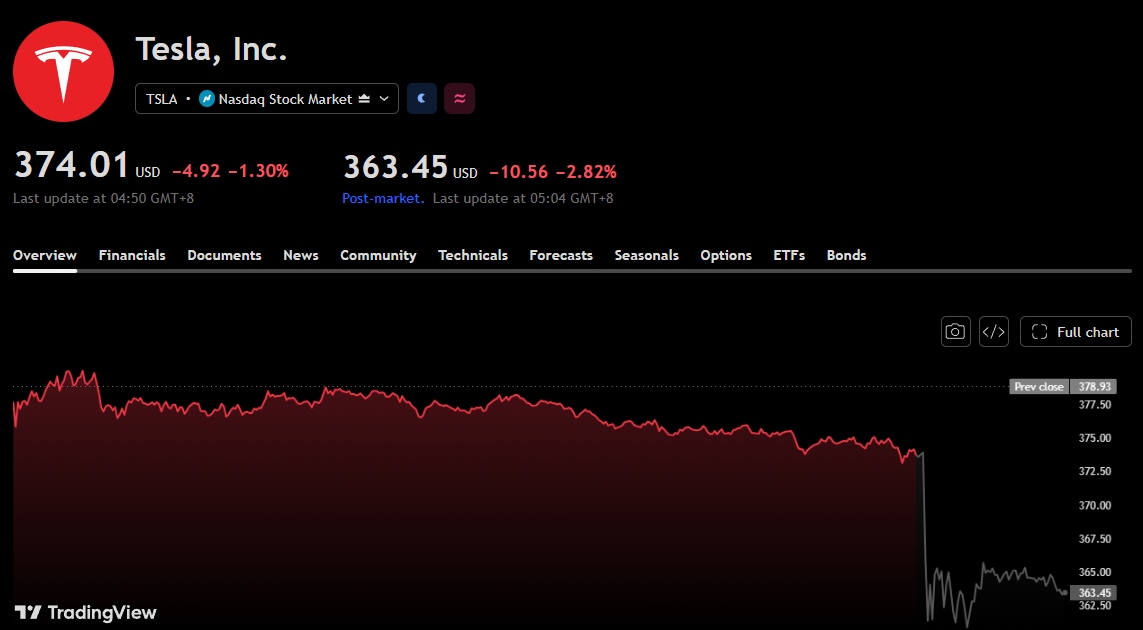
[Tesla Share Price, Source: TradingView]
Looking at the business segments, automotive revenue grew 23% year-on-year to $20.516 billion, of which automotive sales revenue was $20.006 billion; energy generation and storage revenue increased 13% year-on-year to $3.139 billion, with the energy storage business returning to growth. Services and other revenue increased 50% year-on-year to $4.581 billion.
On the profitability front, under GAAP, Tesla's net income for the second quarter was $1.114 billion, down 5% year-on-year; diluted earnings per share was $0.32, compared with $0.33 in the same period last year. Non-GAAP net income was $1.153 billion, down 17% year-on-year, translating to an adjusted EPS of $0.33, which missed the market expectation of $0.51.
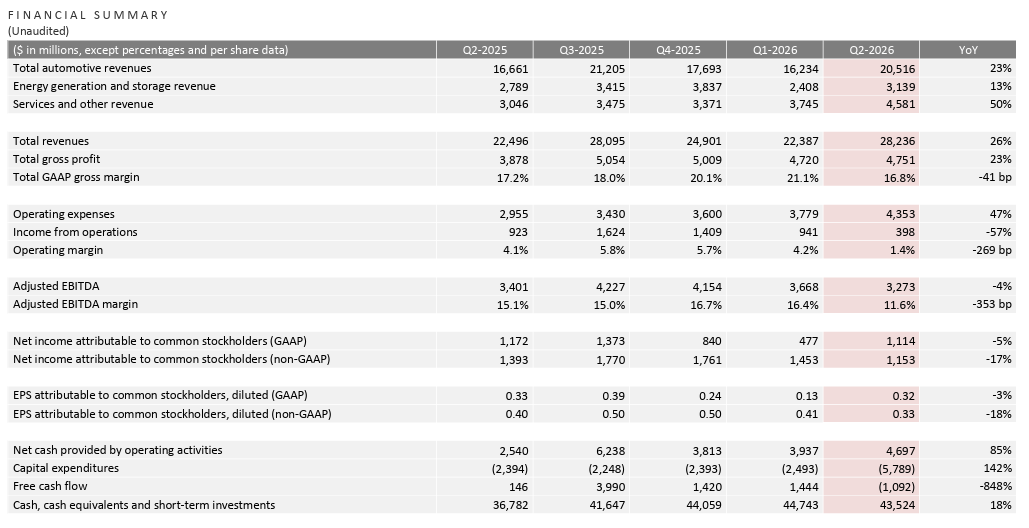
[Source: Tesla Q2 2026 Financial Report]
However, gross margin declined due to lower average selling prices of vehicles and reduced regulatory credit revenue. During the period, the GAAP gross margin was 16.8%, down 41 basis points year-on-year, missing the market expectation of 19.4%; operating income plummeted 57% year-on-year to $398 million, with the operating margin narrowing from 4.1% to 1.4%; adjusted EBITDA was $3.273 billion, down 4% year-on-year.
Notably, Tesla's free cash flow turned negative this quarter. The company's free cash flow was $146 million in the same period last year and $1.44 billion in the first quarter of 2026, while it recorded a net outflow of $1.1 billion this quarter.
The reason behind the revenue growth without profit increase is the surge in capital expenditures. Q2 capital expenditures reached $5.789 billion, up 141.81% year-on-year. In addition, operating expenses increased 47% year-on-year to $4.353 billion, of which R&D expenses were $2.371 billion (up 49% year-on-year) and SG&A expenses were $1.982 billion (up 45% year-on-year), primarily directed toward AI, Robotaxi, and new vehicle model projects.
In terms of business progress, Tesla's autonomous ride-hailing service (Robotaxi) has launched in seven major metropolitan areas in the US, with Austin, Dallas, Houston, Miami, Orlando, and Tampa in the unsupervised operational ramp-up phase, the San Francisco Bay Area operating with safety drivers, and Phoenix and Las Vegas under preparation.
For FSD, penetration in North America reached a record high, with over 55% of new vehicle deliveries including FSD subscriptions; following approval in the Netherlands, FSD has also been approved in Lithuania, Estonia, Denmark, and Belgium. As of July, FSD mileage driven by users in these countries has exceeded 50 million kilometers (31 million miles).
Tesla Semi is still on track to start production at the new Nevada factory within the year, and the Texas Megafactory is nearing completion; following the retirement of the Model S and Model X production lines, the Fremont factory has initiated construction of the production line for the humanoid robot Optimus, with production expected to begin within the year.
Recommended Articles


