


Prediction: Micron and Sandisk Stocks Will Both Plummet After July 30
Key Points
Micron and Sandisk have been huge beneficiaries of the artificial intelligence (AI) memory supercycle.
While demand for high-bandwidth memory, DRAM, and NAND remains strong, companies like Apple are exploring ways to reduce on-device memory requirements.
Micron and Sandisk cratered earlier this year after Alphabet announced a memory compression tool called TurboQuant.
- 10 stocks we like better than Micron Technology ›
The explosive growth of artificial intelligence (AI) has ignited a new supercycle in memory and storage chips. Training and running AI models demand enormous quantities of high-speed, low-latency memory to process massive data sets and parallel computations without bottlenecks.
Micron Technology (NASDAQ: MU) and Sandisk (NASDAQ: SNDK) have been prime beneficiaries of the AI memory boom thanks to their leadership in DRAM, NAND flash, and high-bandwidth memory (HMB). So far this year, Sandisk and Micron have surged 503% and 210%, respectively -- making them the top two performers in the Nasdaq-100.
Where to invest $1,000 right now? Our analyst team just revealed what they believe are the 10 best stocks to buy right now, when you join Stock Advisor. See the stocks »
While it may be tempting to follow the momentum, I think a harsh sell-off could be in store later this month. Read on to find out why.
Image source: The Motley Fool.
Why memory is becoming the bottleneck of AI workloads
AI systems cannot function efficiently without high-performance memory. Frontier models shuttle billions of parameters and contextual data between processors at blistering speed. Insufficient DRAM bandwidth or storage capacity quickly becomes a limiting factor regardless of how powerful the underlying GPU clusters are.
Micron specializes in DRAM and HBM for training and real-time inference. Sandisk focuses on high-density NAND flash and enterprise-grade solid-state drives (SSDs) -- the storage foundation for vast data sets and model weights that power AI at scale. Both companies have ridden powerful tailwinds as AI hyperscalers race to expand capacity -- creating a structural shortage that has supported robust pricing power and earnings expansion.
Apple is pushing for more efficiency on its devices
At the moment, there is no indication that Apple (NASDAQ: AAPL) will build its own memory fabs. Instead, the company continues to rely on external suppliers for its DRAM and NAND needs. However, recent reports suggest that Apple is exploring a collaboration with a company called PrismML, which specializes in memory compression.
The idea here is simple: Apple could use software optimizations to shrink AI models so they run more effectively on iPhones. By doing so, Apple can use memory quantization to slash memory cost requirements on select hardware while deploying the most demanding features on higher-end devices where component costs can be passed along to consumers in the form of price hikes.
Taking a trip down memory lane
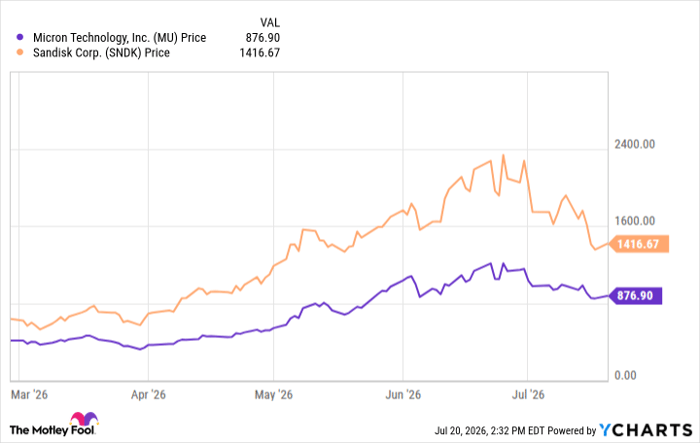
Back in April, Alphabet released a product called TurboQuant, which promised major reductions in memory usage for AI inference. As the chart below shows, this announcement triggered an immediate sell-off in Micron and Sandisk stocks on fears that memory demand would evaporate.
MU data by YCharts
Investors can see that the sell-off was swift, yet the declines were ultimately short-lived. Both stocks quickly recovered and went on to notch fresh all-time highs as AI adoption continued to scale with higher overall memory and storage usage.
I think a comparable pattern could play out after Apple reports earnings on July 30. Any commentary about on-device AI progress or even rumors of proprietary memory protocols could spark short-term selling pressure in Micron and Sandisk as investors worry about reduced memory demand or new competition.
With that said, history suggests such a move would be overdone. Even if Apple improves its on-device capabilities or partners with memory-efficient providers, the fundamental need for HBM across the broader AI infrastructure stack is not going to diminish overnight. In fact, any advancement that Apple makes ultimately underscores the enduring importance and scarcity of advanced memory in the AI era. For this reason, any post-earnings weakness in Micron or Sandisk could represent a compelling opportunity to buy the dip.
Should you buy stock in Micron Technology right now?
Before you buy stock in Micron Technology, consider this:
The Motley Fool Stock Advisor analyst team just identified what they believe are the 10 best stocks for investors to buy now… and Micron Technology wasn’t one of them. The 10 stocks that made the cut could produce monster returns in the coming years.
Consider when Netflix made this list on December 17, 2004... if you invested $1,000 at the time of our recommendation, you’d have $364,562!* Or when Nvidia made this list on April 15, 2005... if you invested $1,000 at the time of our recommendation, you’d have $1,247,668!*
Now, it’s worth noting Stock Advisor’s total average return is 894% — a market-crushing outperformance compared to 207% for the S&P 500. Don't miss the latest top 10 list, available with Stock Advisor, and join an investing community built by individual investors for individual investors.
See the 10 stocks »
*Stock Advisor returns as of July 22, 2026.
Adam Spatacco has positions in Alphabet. The Motley Fool has positions in and recommends Alphabet, Apple, and Micron Technology. The Motley Fool has a disclosure policy.
Recommended Articles


