


Memory Stocks Surge: SanDisk Soars 10% in a Single Day: Why Three Major Investment Banks Collectively Call to Buy After Slump?
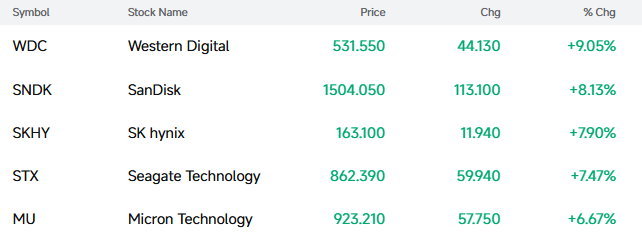
TradingKey - On Tuesday EST, memory stocks collectively surged in early trading. As of press time, Western Digital ( WDC) rose 9.05%, SanDisk ( SNDK) rose 8.13%, SK Hynix ( SKHY) rose 7.90%, Seagate Technology ( STX) rose 7.47%, Micron Technology ( MU) rose 6.67%. Among them, SanDisk once jumped over 10%, leading this round of the rebound.
The direct catalyst triggering the rally was a bullish report released by Morgan Stanley—the firm forecasts that memory prices will rise by at least 25% between Q2 and Q3 of 2026, and explicitly stated that it is "buying the dip" in the memory sector.
[Source: FutuBull]
Prior to this, memory stocks had just experienced a sell-off of "historic proportions." At this moment, three major investment banks have rarely aligned on the same side: this correction is not a collapse of fundamentals, but rather a clearing of crowded trades.
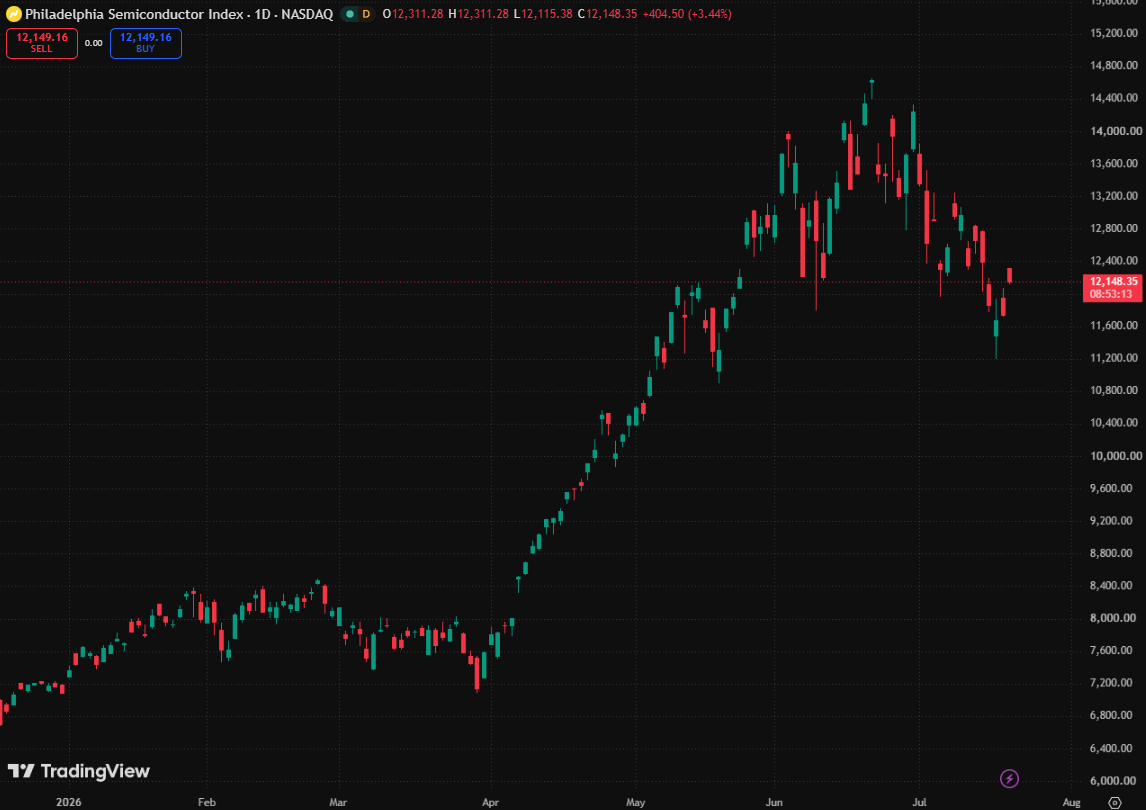
According to a JPMorgan Global Market Strategy report, the Philadelphia Semiconductor Index (SOX) has retraced about 20% from its late-June all-time high, entering a technical correction territory; the South Korean market, which is more sensitive to memory and AI hardware, suffered even heavier losses, with the Kospi Index (KOSPI) falling about 25% from its peak into bear market territory, where the expansion of leveraged ETFs amplified volatility.
UBS prime brokerage data shows that hedge funds have slashed their long positions in momentum and semiconductor stocks by about 5% of gross market value, marking one of the largest reductions on record, with net exposure to semiconductor and software stocks falling back to April levels.
[Source: TradingView]
Why Three Major Investment Banks Are Collectively Calling to Buy Now?
Morgan Stanley analyst Joseph Moore stated clearly that the recent pullback in U.S. memory stocks offers an attractive buying opportunity. The core rationale is the ongoing shortage of datacenter memory, and he forecasts that memory prices will rise by at least 25% from the second quarter to the third quarter of 2026.
Moore pointed out that this memory cycle is almost entirely driven by datacenter demand, with previous weakness in the consumer electronics, PC, and smartphone markets weighing on investor sentiment. However, the firm's channel checks reveal no signs of easing in supply constraints for the datacenter market. He further warned that the memory shortage could become even more severe in 2027 and 2028—with Morgan Stanley buying the dip in this sector.
J.P. Morgan strategist Mislav Matejka's team judges that the pullback in AI and momentum stocks has entered a more mature stage, suggesting that investors leverage summer volatility to buy the dip in semiconductors.
Three chains of evidence support this judgment: first, technical crowding has eased, with the SOX's RSI rapidly approaching oversold territory; second, inflation readings have begun to recede—U.S. Bureau of Labor Statistics data on July 14 showed that June CPI fell 0.4% month-on-month, with the seasonally adjusted annualized growth rate calculated on a three-month basis from April to June cooling to approximately 2.8%; third, in early Q2 earnings reports, the proportion of EPS and revenue beats for U.S. and European stocks has been higher than historical averages.
More crucially, a "gap" signal has emerged: the divergence between semiconductors' relative share price performance and relative earnings performance is widening—stock prices are falling faster than earnings expectations, while the earnings side has not significantly deteriorated. This is a classic hallmark of a "valuation reset" rather than "weakening fundamentals." The firm's technology team expects the tight supply-demand balance for DRAM and NAND to persist through 2028, with semiconductor industry revenue growth sustainable beyond 2026.
Michael Romano, Head of Hedge Fund Equity Derivatives Sales at UBS, noted in a client report that the violent sell-off in momentum stocks may be nearing its end. He expects the sell-off to bottom out by the end of July, or possibly even to have already bottomed, advising investors to gradually rebuild positions in AI and semiconductor stocks.
Last Friday's intraday price action provided supporting evidence: the UBS Momentum Index reversed sharply from a 3.5% decline to a 2.5% gain in just two hours. Romano wrote: "I think that once the tide turns, we could see a liquidity-driven surge." Positioning is currently shifting in a way that increasingly favors a rebound in momentum stocks, with SanDisk, Broadcom, Oracle, Datadog, and Microsoft all included in UBS's momentum stock basket.
However, he also emphasized the necessity of building positions in tranches: "De-risking momentum was, and remains, our high-conviction view; under these market conditions, building positions in phases is the prudent approach."
Overall, memory stocks completed a full cycle of "panic-clearing-reversal" in just one week. The consensus of the three major investment banks points to the same conclusion: this decline is a clearing of crowded trades, not an inflection point in memory fundamentals—the datacenter demand gap remains, the price-hike cycle will last at least through the third quarter, and the tight balance is projected to persist until 2028.
Recommended Articles


