


S&P Global Spun Off Its Mobility Business on July 1. Here's What the Leaner Ratings Giant Looks Like Now.
Key Points
Equity research outfit S&P Global recently shed an arm that doesn’t quite fit in with the rest of its business.
This division, though fiscally viable, was a drag on the overall organization’s bottom line.
Investors could start seeing the positive impact of this spinoff when Q2 results come in near month end.
- 10 stocks we like better than S&P Global ›
It's official. As of the beginning of this month, S&P Global (NYSE: SPGI) is a smaller but more focused company, having shed the least impactful of its businesses. That's S&P Global Mobility, now called Mobility Global (NYSE: MBGL). It is the arm that offers market intelligence to the automobile industry; it also owns and operates consumer-facing CarFax.
So how does this change things for investors? Fortunately, this is a very clean break, as S&P Global Mobility was already operating -- and being reported -- independently.
Missed Nvidia in 2009? This Rare Signal Is Flashing Again. In 2009, a "Double Down" signal flashed for a little-known chipmaker called Nvidia. For the first time in years, that same "Total Conviction" signal is flashing for a company 1/100th the size of Nvidia. Continue »
A simple before and after
First and foremost, yes, S&P Global is the company you may know better as Standard & Poor's, which licenses the S&P 500 index along with several other market barometers. That's not its biggest business, though. Its big breadwinners are market intelligence and ratings. Its ratings arm grades the quality of bonds and other fixed-income instruments, while its market intelligence division provides research on individual stocks and marketwide insights. If you've ever bought a stock or a bond in a brokerage account, you've almost certainly been exposed to one of its products.
So what does the company look like now, without mobility in the mix? As was noted, it's a clean break. The graphic below illustrates how much revenue and operating profit each of its businesses generated last year. Simply subtracting the mobility numbers from the mix below and then adding about 10% growth to the remaining figures will give you a pretty good idea of what to expect this year.
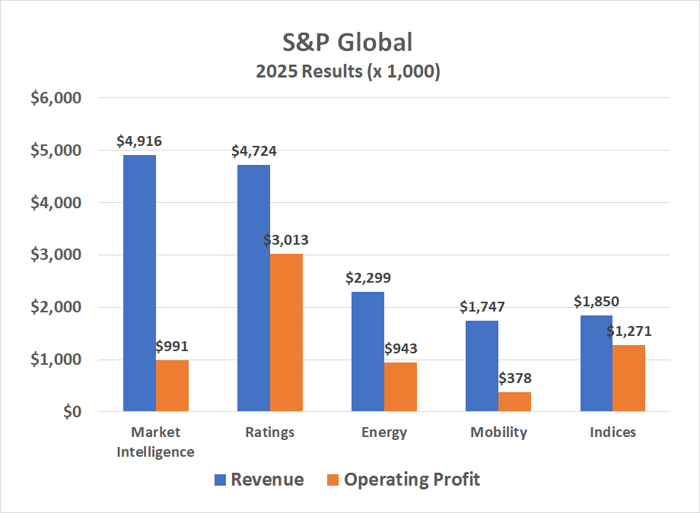
Data source: S&P Global 2025 report. Chart by author.
The energy arm is exactly what it sounds like -- a market data and strategic intelligence service aimed specifically at the oil and gas industry, although increasingly, all aspects of power production. While this may seem like as much of a misfit as mobility was, this data and the energy division's delivery platforms actually dovetail pretty nicely into everything else S&P Global does.
Looking ahead
On the surface, the change looks mathematically simple. There are some measurable upsides that aren't readily evident with just a quick review of the numbers, though.
One of these upsides is that, while it was the company's smallest business, mobility was also one of S&P Global's lowest-margin operations, with 2025 operating margins of less than 22% versus a companywide average of more than 40%. Without it, the organization will sport slightly higher profit margins.

Image source: Getty Images.
The other big upside is the aforementioned focus. Although the company managed it well enough, its mobility arm required resources and attention that could be better utilized in other ways. With this business no longer a strategic concern, management can focus on making the most of its core strengths.
Whatever the case, S&P Global's first quarterly earnings report without mobility is coming on July 28. We might get some more insights about the company's post-spinoff plans then, and we'll certainly get our first look at the new fiscal numbers without this division in tow.
In the meantime, this powerhouse dividend payer's 53-year streak of annual dividend growth remains intact, with no threats to it on the horizon.
Should you buy stock in S&P Global right now?
Before you buy stock in S&P Global, consider this:
The Motley Fool Stock Advisor analyst team just identified what they believe are the 10 best stocks for investors to buy now… and S&P Global wasn’t one of them. The 10 stocks that made the cut could produce monster returns in the coming years.
Consider when Netflix made this list on December 17, 2004... if you invested $1,000 at the time of our recommendation, you’d have $400,964!* Or when Nvidia made this list on April 15, 2005... if you invested $1,000 at the time of our recommendation, you’d have $1,272,955!*
Now, it’s worth noting Stock Advisor’s total average return is 930% — a market-crushing outperformance compared to 210% for the S&P 500. Don't miss the latest top 10 list, available with Stock Advisor, and join an investing community built by individual investors for individual investors.
See the 10 stocks »
*Stock Advisor returns as of July 17, 2026.
James Brumley has no position in any of the stocks mentioned. The Motley Fool has positions in and recommends Mobility Global and S&P Global. The Motley Fool has a disclosure policy.
Recommended Articles


