


Why IBM Earnings Tanked: AI Computing Hardware Is Squeezing Enterprise Software Budgets
TradingKey - On July 14, Eastern Time, IBM ( IBM) shares plummeted by over 25%, marking its largest single-day decline in nearly 60 years. This century-old tech giant, bearing the dual labels of AI and quantum computing, saw approximately $69 billion in market value wiped out in a single day. Behind this plunge, an ongoing structural shift is revealed: AI computing hardware is squeezing enterprise software budgets.
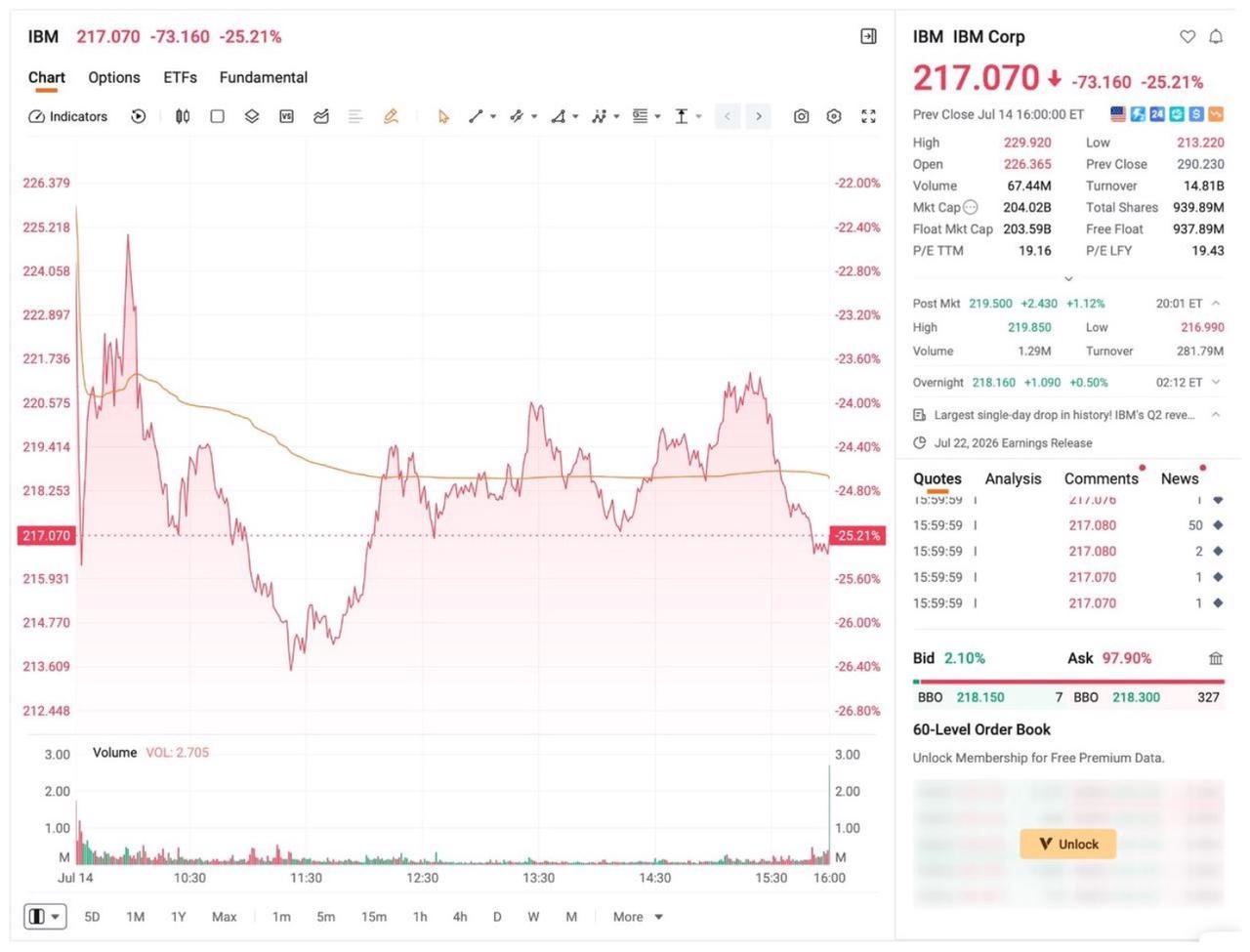
[Source: Futu]
What Kind of Company Is IBM?
Founded in 1911, IBM is a leading global provider of hybrid cloud, artificial intelligence, and enterprise services. After more than two decades of transformation, IBM has transitioned from being hardware-led to a hybrid cloud and AI company driven by software and consulting, with software and consulting services accounting for more than three-quarters of its total revenue.
Its core businesses include: Software (including Red Hat and the watsonx data and AI platform), Consulting (providing end-to-end services from strategy to operations), and Infrastructure (mainframes, storage, etc.).
Core Data of IBM’s Preliminary Second-Quarter Results
IBM's preliminary second-quarter revenue was $17.2 billion, far below Wall Street expectations of $17.9 billion. Adjusted earnings per share were $2.93, missing the expected $3.01. Software business growth was just 5%, significantly lagging expectations; the infrastructure business fell 7% year-over-year, whereas the market had only expected a slight decline.
IBM broke with tradition by proactively disclosing its financial results a week before the official release. Such a move usually means only one thing: the numbers are not pretty, and releasing the bad news ahead of time can prevent a more severe stampede during the official release.
IBM Chief Executive Officer Arvind Krishna said bluntly in a letter to investors: 'These conditions demand flawless execution from our team, and this quarter we missed. We failed to adapt and act quickly enough, and several large deals did not close when we expected, which accounted for the bulk of this performance shortfall.'
Following the announcement, panic quickly spread across the software sector. In pre-market trading on July 14, Workday ( WDAY ), ServiceNow ( NOW) each fell about 6%, Microsoft ( MSFT ), Salesforce ( CRM ), Intuit ( INTU) fell between 3% and 7% at the open.
How AI Hardware Spending Crowds Out Software Budgets
Understanding the key to this earnings shock lies in clarifying the mechanism by which AI computing hardware crowds out enterprise IT budgets.
Over the past several quarters, persistent shortages of memory chips have driven up prices of AI servers and storage devices across the board. The procurement logic for enterprises was simple: since prices would rise further next quarter, they might as well place orders now.
This panic buying culminated in the final weeks of June. IBM's customers suddenly shifted their quarterly capital expenditures on a massive scale toward purchasing servers, storage devices, and memory, directly crowding out the budget space originally reserved for IBM mainframes and supporting software. Krishna admitted: "We anticipated some supply chain impacts, but we failed to foresee the magnitude of the reprioritization of capital expenditures."
Enterprise IT budgets are split into CapEx (hardware) and OpEx (software subscriptions). This wave of AI infrastructure buildout has primarily crowded out CapEx. Meanwhile, IBM's transaction-processing software has long been viewed as "quasi-infrastructure," which customers are accustomed to purchasing under CapEx. Once CapEx was maxed out by storage and servers, IBM's orders were naturally pushed to the back.
This also explains why IBM was the first to suffer a plunge, rather than pure-play software companies like Salesforce or Workday. The latter's subscription fees are categorized under OpEx, making them much less directly impacted by the migration of CapEx budgets.
However, Bloomberg Intelligence analyst Anurag Rana pointed out: "Discretionary enterprise IT spending is deteriorating further, which is highly likely to become a common theme for most software companies in this earnings season."
IBM’s Internal Execution Failures
While changes in the external environment served as the trigger, it was IBM's own execution-level missteps that truly amplified the issue.
The most prominent issue is the sales performance of the z17 mainframe. When launched in April, IBM hailed it as the "strongest mainframe debut in history," but actual sales fell far short of expectations. The z17's companion transaction processing software was the primary drag—and transaction processing software is precisely the most profitable segment of IBM's software business.
Several large deals failed to close on schedule at the end of the quarter, accounting for the majority of the performance shortfall. The pipeline remains intact and no customers have been lost; the signings were merely pushed to the next quarter. However, when one quarter turns into two, the market's tolerance for "delays" is limited.
In addition, a recent spate of cybersecurity incidents across the industry has objectively distracted clients from their procurement. Corporate purchasing departments are juggling the pressure of AI infrastructure acquisition with urgent security and compliance matters, severely squeezing the negotiation resources left for IBM's large deals. The combination of internal misjudgments in timing and external environmental shocks ultimately culminated in this rare earnings warning.
Why Was the Market Reaction So Intense?
IBM's historical earnings disclosure schedule has been extremely regular, and it rarely flags performance prior to the official release. Announcing preliminary results a week early this time is a negative signal in itself; management needed the early release to cushion the blow of the official announcement. When a company known for stability takes unconventional actions, investors' first reaction is often risk-off selling.
Krishna's choice of words is also noteworthy. In his letter, he stated bluntly, "we had a miss," rather than using diplomatic euphemisms like "a challenging environment," directly admitting to execution failure. A CEO's willingness to take the blame often indicates that the severity of the issue goes beyond the scope of routine fluctuations.
Positioning structure also cannot be ignored: according to Bank of America's latest survey, cash allocations have fallen to 3.6%, and the Bull & Bear Indicator has touched an extremely bullish level of 9.4. Under this positioning structure, the market's buffer against negative news is extremely thin; once IBM's warning was released, the sell-off spread rapidly.
The deeper concern is that IBM has exposed not just a single company's problem, but a systemic signal: corporate IT spending structures are shifting, and the siphoning effect of AI infrastructure could impact the entire traditional software industry. Goldman Sachs ( GS) immediately proposed a 'software bear-case scenario' following IBM's warning, believing that the software and services sector will face a widespread sell-off.
Divergence in Institutional Views
Institut ions have not reac hed a "broadly bearish " consensus, but t he divergence is cl ear:
Institut ion | Nature of Judgment | Recommendat ion | Co re Logic |
Ci ti | Temporary pullback | Maintain Buy, target price of $375 | Delays in large deals are the main cause, and IBM's fundamentals remain unchanged |
BofA | Temporary pullback | Maintain Buy, target price $330 → $280 | Expected to lower full-year guidance, but this does not mean the long-term thesis is broken |
HSBC | Structural concerns | Hold → Underweight, target price of $191 | Compared to peers like SAP and Accenture, IBM's growth sustainability is weaker |
The focus of the divergence is whether this earnings miss is a short-term timing issue where software orders will return after the peak of hardware procurement, or an irreversible structural shift as corporate IT spending pivots toward AI infrastructure. Citi and BofA lean toward the former, while HSBC is closer to the latter.
IBM Business-Level Divergence
Not all of IBM's businesses are deteriorating. Against the backdrop of overall pressure on the software business, Red Hat's revenue growth instead accelerated to 11%, and the distributed infrastructure business grew 37% year-over-year, marking its best-ever performance. The recently acquired HashiCorp and Confluent also performed better than expected. First-half free cash flow was $4.8 billion, remaining within a healthy range.
Although the z17 figures were weak this quarter, the backlog still grew by 130% in comparison, with more than 85% of customers expanding or retaining capacity. No customers have been lost; the procurement timeline has simply been pushed back.
This means that the competitiveness of IBM's core products has not vanished in a single quarter. The orders are still there, the cash flow is still there, and high-growth business lines are still operating. The issue lies in the timing, not the structure.
Three Clues to Track Next
There are three clues to monitor to determine whether IBM is experiencing a temporary setback or a structural decline.
First, if Red Hat's growth falls below 8% or distributed infrastructure pulls back significantly, it would indicate that the issues extend beyond the scope of a budget squeeze; if it maintains double-digit growth, the core growth engine remains healthy.
Second, the magnitude of the full-year guidance revision provided by management during the earnings call on July 22. A downward revision within 5% would signal strong confidence in the return of orders; if it exceeds 10%, it suggests that IBM is seeing more negative factors that exceed expectations.
Third, the financial performance of software giants such as Microsoft and Amazon. The quarterly growth data of Microsoft Azure, Amazon AWS, and Google Cloud will directly answer whether this round of hardware budget squeeze is unique to IBM or a common pressure facing the entire industry. If two or more of these companies show a similar slowdown, it can largely be judged as an industry-level structural adjustment.
IBM will hold its earnings call after the market close on July 22, when it will release official results and discuss its full-year outlook. By then, the market will truly see whether IBM's orders have been temporarily pushed aside or are being squeezed out.
Recommended Articles


