


Should You Buy SpaceX Stock Below $135 Per Share? Here's What History Says.
Key Points
SpaceX has seen its stock fall back toward its IPO price of $135 per share.
History favors big tech IPOs over the long run.
But SpaceX is unlike any IPO in history.
- 10 stocks we like better than Space Exploration Technologies ›
After a hot start following its IPO, Space Exploration Technologies (NASDAQ: SPCX), better known as SpaceX, has seen its stock price come back down to Earth. The price is now approaching its IPO price of $135 per share.
Investors who couldn't get in on the IPO may be wondering whether to buy the stock if it dips below that number. Here's what history has to say.
Missed Nvidia in 2009? This Rare Signal Is Flashing Again. In 2009, a "Double Down" signal flashed for a little-known chipmaker called Nvidia. For the first time in years, that same "Total Conviction" signal is flashing for a company 1/100th the size of Nvidia. Continue »
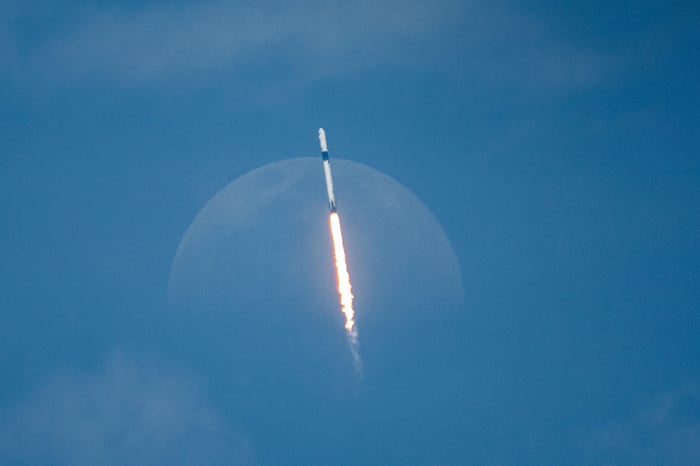
Image source: Getty Images.
How well do IPOs hold up over the long run?
Most IPO stocks see a pop on their first day of trading. Underwriters intentionally underprice offerings to ensure enough demand to fully allocate the stock offering and guarantee success for the company. Indeed, SpaceX closed its first day of trading about 19% above its IPO price, which is about average based on data dating back to 1960.
But most investors aren't interested in SpaceX's short-term outcomes. The company's value is based on its potential to disrupt multiple industries over the long run. The stock should appeal to investors who believe in CEO Elon Musk's ability to build more efficient reusable rockets, expand its satellite constellation, and reshape broadband internet access and artificial intelligence (AI). So, looking at how IPOs usually hold up after at least three years of trading can provide valuable insight.
For investors who buy just any new IPO as it comes to market, the long-term results aren't great. Even with a big first-day pop, the average IPO since 1980 (excluding the 1999-2000 dot-com bubble) produced worse returns than the overall market, according to data compiled by professor Jay Ritter. He found that all IPOs produce an average return of 44.2% from their IPO price over three years, but that trails the weighted-average market return by 1.6%.
But tech stocks specifically do significantly better. Tech IPOs produced average three-year returns of 73.3%, massively outperforming the market by 25.8%. And if you dig a little bit deeper, big tech stocks with sales exceeding $100 million (adjusted for inflation) perform even better. These companies have delivered an average three-year return of 82.5% and outperformed the market by 43.1%. Even if they're unprofitable, they still produce excess returns of 41.7% on average, according to Ritter's data.
In other words, history is on SpaceX's side as a large tech company making its public debut. Still, there are a few reasons to remain cautious about buying SpaceX, even at its IPO price.
The SpaceX IPO is a special case
SpaceX was the largest IPO in history, raising over $85 billion after underwriters exercised their option to buy additional shares. With a valuation of about $1.75 trillion, it's already a massive business. But that valuation puts its price-to-sales ratio above 90. And valuation still matters.
According to a University of Florida 2026 study of IPOs, since 1980, only 14 other IPOs have had over $100 million in sales and a price-to-sales ratio above 40. The average three-year return from their IPO price was just 3.1%, trailing the market average by 15.4%. While it's a small sample size, there's a clear correlation between IPO price-to-sales valuation and returns. The lower the valuation, the better the returns. SpaceX has one of the highest price-to-sales ratios in the market.
There's additional concern that SpaceX's stock price could be weighed down as lockup periods expire and early investors and employees can sell their shares. Interestingly, the same University of Florida study found that companies that float a smaller percentage of shares (SpaceX offered about 5% of the company's shares) end up outperforming companies that sell a larger portion of the equity at their IPO. That said, there's never been a company the size of SpaceX with so many shares locked up. That's a lot of capital for the market to absorb over the next six months or so.
The truth of the matter is that SpaceX is unlike any IPO we've ever seen. Using historical averages to project SpaceX's future stock price can only go so far. The actual results will depend on the same thing that applies to every stock in the market, whether old or new. Will the company perform better than the market expects? If it does, the stock price could outperform the market average. At its current valuation, the market is setting a very high bar for SpaceX to exceed.
Should you buy stock in Space Exploration Technologies right now?
Before you buy stock in Space Exploration Technologies, consider this:
The Motley Fool Stock Advisor analyst team just identified what they believe are the 10 best stocks for investors to buy now… and Space Exploration Technologies wasn’t one of them. The 10 stocks that made the cut could produce monster returns in the coming years.
Consider when Netflix made this list on December 17, 2004... if you invested $1,000 at the time of our recommendation, you’d have $397,351!* Or when Nvidia made this list on April 15, 2005... if you invested $1,000 at the time of our recommendation, you’d have $1,304,257!*
Now, it’s worth noting Stock Advisor’s total average return is 934% — a market-crushing outperformance compared to 210% for the S&P 500. Don't miss the latest top 10 list, available with Stock Advisor, and join an investing community built by individual investors for individual investors.
See the 10 stocks »
*Stock Advisor returns as of July 17, 2026.
Adam Levy has no position in any of the stocks mentioned. The Motley Fool has no position in any of the stocks mentioned. The Motley Fool has a disclosure policy.
Recommended Articles


