


Pfizer Has the Highest-Yielding Dividend in the S&P 500. Should Investors Be Worried?
Key Points
Pfizer's yield has fluctuated over the years due to its volatile share price.
Its recent earnings numbers suggest the dividend is safe, but there isn't a huge buffer.
- 10 stocks we like better than Pfizer ›
A high-yielding dividend may sound great for investors, but it can be a double-edged sword: when it's too high, investors start to worry about its safety. That's a big part of the reason why Pfizer (NYSE: PFE), whose 7.1% yield is well above the S&P 500 average of just 1.1%, isn't able to draw in investors; many are worried the dividend is due for a cut.
Not only is Pfizer's dividend far above average, but it is now also the highest yield in the entire S&P 500. Is this a warning sign for investors that the dividend may be cut in the near future, or could Pfizer prove to be an underrated income stock to buy right now?
Missed Nvidia in 2009? This Rare Signal Is Flashing Again. In 2009, a "Double Down" signal flashed for a little-known chipmaker called Nvidia. For the first time in years, that same "Total Conviction" signal is flashing for a company 1/100th the size of Nvidia. Continue »

Image source: Getty Images.
Pfizer's yield has been volatile in recent years
A high yield can be concerning, but that alone doesn't make it risky. Similarly, just because a yield is low doesn't mean it's sustainable, either. The yield can fluctuate significantly because it is tied to the share price. When a stock is rising, its yield falls because it costs more to secure the same level of dividend income. And when it falls, as has been the case with Pfizer's stock in recent years, the yield can rise significantly.
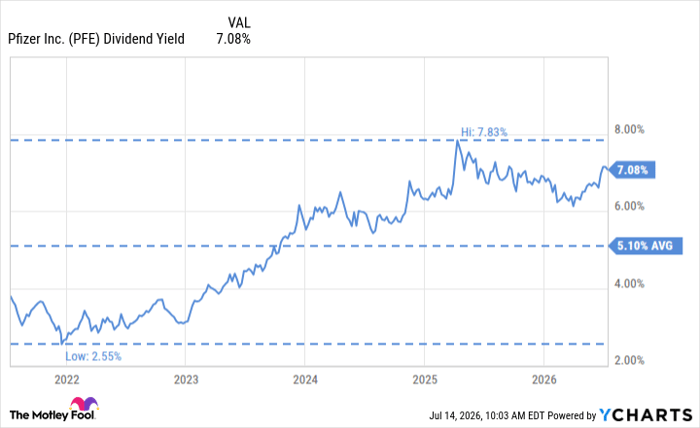
PFE Dividend Yield data by YCharts
If Pfizer posts strong earnings numbers in its upcoming quarterly results, issues promising guidance, or there's positive news around one of its drugs, its share price could take off, and just like that, the yield could come down.
There is, however, some risk with the dividend because Pfizer's earnings haven't been all that strong in recent quarters. During the first three months of the year, the company's diluted per-share profit was $0.47, not much higher than its quarterly dividend rate -- $0.43. There's not much of a buffer there, and investors may also be concerned about its long-term future, as the pharma company deals with patent cliffs and navigates a challenging course ahead, which could see its sales (and profits) drop in the future.
Is Pfizer's stock worth buying?
Pfizer's dividend may look shaky, but the good news is the company's earnings aren't in bad shape, and it's in the midst of restructuring and cutting costs, which should give it more breathing room in the future. It has also acquired companies that could unlock more growth opportunities down the road.
While this may not be the type of stock investors can simply buy and forget, Pfizer may be a good option for income investors willing to monitor it closely. As of now, the dividend still looks safe, and this could be an underrated option to consider, especially given its low valuation, as the stock trades at just eight times its estimated future earnings, based on analyst expectations.
Should you buy stock in Pfizer right now?
Before you buy stock in Pfizer, consider this:
The Motley Fool Stock Advisor analyst team just identified what they believe are the 10 best stocks for investors to buy now… and Pfizer wasn’t one of them. The 10 stocks that made the cut could produce monster returns in the coming years.
Consider when Netflix made this list on December 17, 2004... if you invested $1,000 at the time of our recommendation, you’d have $398,160!* Or when Nvidia made this list on April 15, 2005... if you invested $1,000 at the time of our recommendation, you’d have $1,249,202!*
Now, it’s worth noting Stock Advisor’s total average return is 918% — a market-crushing outperformance compared to 209% for the S&P 500. Don't miss the latest top 10 list, available with Stock Advisor, and join an investing community built by individual investors for individual investors.
See the 10 stocks »
*Stock Advisor returns as of July 14, 2026.
David Jagielski, CPA has no position in any of the stocks mentioned. The Motley Fool has positions in and recommends Pfizer. The Motley Fool has a disclosure policy.
Recommended Articles


