


Investors Wanted $7 Billion More of SK Hynix Than It Offered
Key Points
SK Hynix's U.S. debut attracted overwhelming institutional demand, with orders exceeding available shares by more than sevenfold.
Elite investors appear focused on SK Hynix's leadership in AI memory despite a sharp sell-off across memory-chip stocks.
Oversubscribed IPOs signal strong interest, but long-term returns will depend on execution, not opening-day enthusiasm.
- 10 stocks we like better than SK Hynix ›
When SK Hynix (NASDAQ: SKHY) brought its record-breaking share sale to Wall Street last week, the striking part wasn't just the $26.5 billion it raised -- it was how much more money was left standing at the door. A trio of marquee investment firms signaled they wanted to buy up to $7 billion of the stock, and the deal as a whole drew orders more than seven times the shares available.
For a memory-chip maker that most American investors couldn't easily buy until a few days ago, that is a stunning show of appetite.
Missed Nvidia in 2009? This Rare Signal Is Flashing Again. In 2009, a "Double Down" signal flashed for a little-known chipmaker called Nvidia. For the first time in years, that same "Total Conviction" signal is flashing for a company 1/100th the size of Nvidia. Continue »
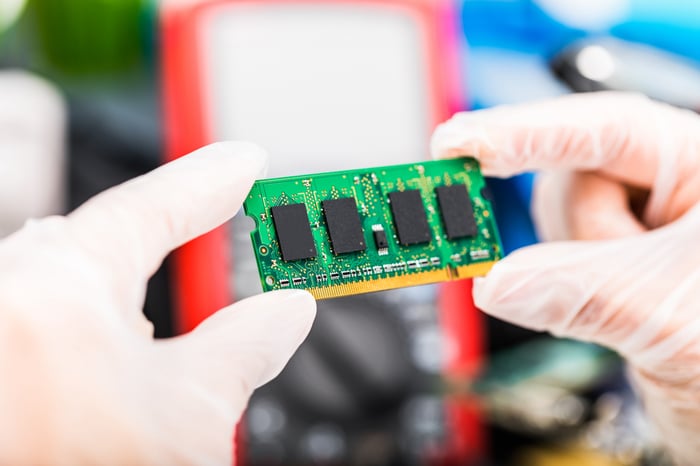
Image source: Getty Images.
SK Hynix saw a blowout order book
The numbers behind the demand tell the story. SK Hynix put 177.9 million American depositary receipts up for sale (each representing one-tenth of a share of the company's common stock). The order book swelled to roughly $171.5 billion during the bookbuilding process -- the stretch when banks gauge how much investors are willing to buy and at what price. That was seven times the available shares, which means the vast majority of would-be buyers walked away with far fewer shares than they asked for, or none at all.
The names in the book add weight to the enthusiasm. Alongside sovereign wealth funds, technology-focused funds, and global long-only managers, three heavyweight firms -- Coatue Management, Baillie Gifford, and Situational Awareness -- indicated plans to take up to $7 billion between them. When investors of that caliber elbow their way to the front of the line, it's usually because they see something they don't want to miss.
Why the appetite is so surprising
Here's what makes the frenzy genuinely interesting to me. It arrived in the middle of a rough patch for memory stocks. In the days just before the listing, shares of memory makers -- including SK Hynix's own Seoul-listed stock, along with peers like Micron Technology, had tumbled into a bear market, even as one rival posted a record quarter. So on one side, you had investors selling memory names on fears the boom is peaking, and on the other, you had institutions clamoring to pour billions into the sector's biggest player. Both things happened in the same week.
That tension is the real headline. It suggests the smart money isn't treating the recent sell-off as the end of the story, but as noise around a longer trend they still want exposure to. The draw is SK Hynix's grip on high-bandwidth memory, the specialized chips that sit beside artificial intelligence processors and feed them data fast enough to keep them busy. SK Hynix makes more of it than anyone and counts Nvidia among its customers. A clean, liquid way to own the leader in that niche simply didn't exist for U.S. investors before, so scarcity itself likely amplified the rush.
What heavy demand does -- and doesn't -- tell you
A word of caution, because oversubscription is easy to misread. Fierce demand for a new listing reflects excitement, not a guarantee of returns; plenty of hot debuts have cooled once the initial scramble faded. Memory remains a cyclical, boom-and-bust business. SK Hynix's shares have already run up sharply over the past year, and a crowded trade can unwind just as fast as it formed. The institutions buying here have long time horizons and deep pockets, which not every investor shares.
The overwhelming demand for SK Hynix is a real vote of confidence from some of the world's most sophisticated investors, and it says the appetite for AI memory exposure runs deeper than this month's sell-off would suggest. But I'd treat that as context, not a green light. If you're drawn to the story, the sensible path is to understand you're buying into a cyclical industry near a moment of high emotion, size any position accordingly, and let the company's results -- not the size of the order book -- guide the decision. That said, if you want to buy into a rival that is taking market share from the likes of Micron, you could be getting in on the ground floor of a life-changing investment.
Should you buy stock in SK Hynix right now?
Before you buy stock in SK Hynix, consider this:
The Motley Fool Stock Advisor analyst team just identified what they believe are the 10 best stocks for investors to buy now… and SK Hynix wasn’t one of them. The 10 stocks that made the cut could produce monster returns in the coming years.
Consider when Netflix made this list on December 17, 2004... if you invested $1,000 at the time of our recommendation, you’d have $395,679!* Or when Nvidia made this list on April 15, 2005... if you invested $1,000 at the time of our recommendation, you’d have $1,294,805!*
Now, it’s worth noting Stock Advisor’s total average return is 929% — a market-crushing outperformance compared to 211% for the S&P 500. Don't miss the latest top 10 list, available with Stock Advisor, and join an investing community built by individual investors for individual investors.
See the 10 stocks »
*Stock Advisor returns as of July 14, 2026.
Micah Zimmerman has no position in any of the stocks mentioned. The Motley Fool has positions in and recommends Micron Technology and Nvidia. The Motley Fool has a disclosure policy.
Recommended Articles


