


What Is the State Street SPDR Portfolio Developed World ex-US ETF, and Who Should Buy It?
Key Points
The State Street SPDR Portfolio Developed World ex-US ETF has delivered 19.2% annualized returns for the past three years.
Vanguard projects that developed market stocks (like the ones held by this ETF) might outperform U.S. stocks in the next 10 years.
- 10 stocks we like better than SPDR Index Shares Funds - State Street SPDR Portfolio Developed World ex-US ETF ›
International stocks are attracting investor attention. Recent Vanguard research forecasts that developed markets ex-U.S. equities could deliver annualized returns of 5.4% to 7.4% for the next 10 years, outperforming U.S. stocks.
Vanguard's researchers believe that the biggest long-term economic gains from the artificial intelligence (AI) boom might ultimately go to companies in international developed markets, such as Japan, Canada, and Western Europe. These companies might be best positioned to use AI to improve productivity without incurring the costs of building AI tools and data centers.
Missed Nvidia in 2009? This Rare Signal Is Flashing Again. In 2009, a "Double Down" signal flashed for a little-known chipmaker called Nvidia. For the first time in years, that same "Total Conviction" signal is flashing for a company 1/100th the size of Nvidia. Continue »
How can you buy developed market stocks outside the U.S.? One easy way to invest in these advanced economies is to buy the State Street SPDR Portfolio Developed World ex-US ETF (NYSEMKT: SPDW).
Let's look closer at this international ETF and see if it's a good choice for your investment portfolio.

Image source: Getty Images.
State Street SPDR Portfolio Developed World ex-US ETF (SPDW): 2,442 stocks, three years of 19.2% annualized returns
The State Street SPDR Portfolio Developed World ex-US ETF is a well-diversified international stock exchange-traded fund (ETF). The objective of this ETF is to offer broad exposure to international stocks in developed markets outside the U.S. It holds a portfolio of 2,442 global stocks from 25 countries. The fund has about $40 billion of assets under management and charges an ultra-low expense ratio of 0.03%. And it's provided a strong trailing-12-month dividend yield of 3.02%, which is better than some of the best dividend index funds.
For the past few years, this international ETF has had a strong run of performance. It's delivered average annual returns (by net asset value) of 19.2% for the past three years, and a 28.3% return in the past year. That's better than America's S&P 500 index.
What stocks are in the State Street SPDR Portfolio Developed World ex-US ETF?
This international ETF holds a broad range of stocks with a focus on developed markets. The top five countries represented in the fund are Japan (21.8% of the fund), the United Kingdom (11.2%), Canada (10.6%), South Korea (8.9%), and France (6.98%).
If you are concerned that the U.S. stock market has become too top-heavy with major tech stocks, this ETF might feel like a more diversified way to put your money to work throughout the global economy. The fund's top five sector holdings are:
- Financials: 24.2% of the fund
- Industrials: 17.9%
- Information technology: 15.06%
- Consumer discretionary: 8.3%
- Healthcare: 8.14%
As for specific stocks, the fund's top 10 holdings include:
- South Korean tech names like Samsung Electronics and SK Hynix
- Dutch semiconductor stock ASML Holding
- International pharmaceutical giants AstraZeneca, Roche, and Novartis
- Swiss consumer staples stock Nestlé
- Global financial services companies HSBC Holdings, Royal Bank of Canada, and Mitsubishi UFJ Financial Group
Why buy SPDW... or not
International stocks don't always beat American investments. Over the past 19 years since this fund was launched in April 2007, it has delivered average annual returns of 5.12%. That's about half of the U.S. stock market's long-term average of 10% per year. It's been outperformed by the S&P 500 index almost 4 to 1.
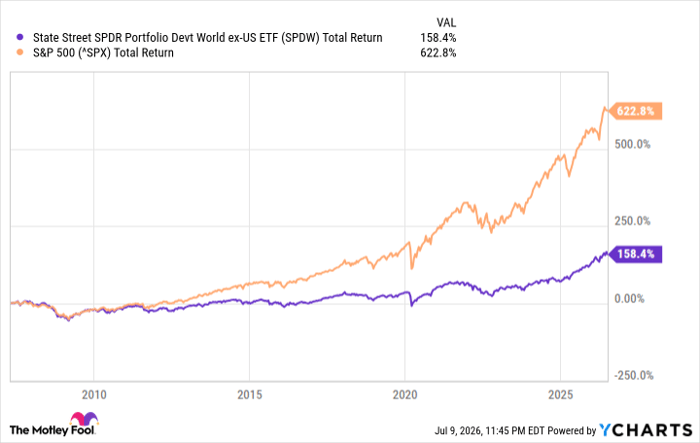
SPDW Total Return Level data by YCharts
But the future could be different than the past 19 years. If you believe that international stocks in developed markets are likely to keep growing, the State Street SPDR Portfolio Developed World ex-US ETF can give you an easy, low-cost way to buy a portfolio of more than 2,000 global stocks. This fund might be a good buy for long-term investors who want to diversify beyond the U.S. market.
Should you buy stock in SPDR Index Shares Funds - State Street SPDR Portfolio Developed World ex-US ETF right now?
Before you buy stock in SPDR Index Shares Funds - State Street SPDR Portfolio Developed World ex-US ETF, consider this:
The Motley Fool Stock Advisor analyst team just identified what they believe are the 10 best stocks for investors to buy now… and SPDR Index Shares Funds - State Street SPDR Portfolio Developed World ex-US ETF wasn’t one of them. The 10 stocks that made the cut could produce monster returns in the coming years.
Consider when Netflix made this list on December 17, 2004... if you invested $1,000 at the time of our recommendation, you’d have $395,679!* Or when Nvidia made this list on April 15, 2005... if you invested $1,000 at the time of our recommendation, you’d have $1,294,805!*
Now, it’s worth noting Stock Advisor’s total average return is 929% — a market-crushing outperformance compared to 211% for the S&P 500. Don't miss the latest top 10 list, available with Stock Advisor, and join an investing community built by individual investors for individual investors.
See the 10 stocks »
*Stock Advisor returns as of July 12, 2026.
HSBC Holdings is an advertising partner of Motley Fool Money. Ben Gran has no position in any of the stocks mentioned. The Motley Fool has positions in and recommends ASML and AstraZeneca Plc. The Motley Fool recommends HSBC Holdings, Nestlé, and Roche Holding AG. The Motley Fool has a disclosure policy.
Recommended Articles


