


Is the AI Data Center Boom Creating a Debt Bubble? Here's What Investors Need to Know.
Key Points
Bubbles go through stages: displacement, boom, euphoria, profit-taking, and panic.
Debt doesn't necessarily have to play a role in this process, but when it does, bubbles can become exaggerated.
When a debt-fueled bubble bursts, you get downturns like the dot-com crash at the turn of the century.
- 10 stocks we like better than Space Exploration Technologies ›
Artificial intelligence (AI) is a new and transformative technology. There has been a mad rush to build AI tools and infrastructure as companies like Space Exploration Technologies (NASDAQ: SPCX), Amazon (NASDAQ: AMZN), and Nvidia (NASDAQ: NVDA) spend heavily to stake out leadership positions. Not every company can become a winner, so much of the spending now underway may be in vain.
When the excitement around AI fades and investors demand results, the AI bubble will likely deflate. The downturn could be harsh if too much debt is taken on to cover wasted investment. And the cracks may already be showing.
Missed Nvidia in 2009? This Rare Signal Is Flashing Again. In 2009, a "Double Down" signal flashed for a little-known chipmaker called Nvidia. For the first time in years, that same "Total Conviction" signal is flashing for a company 1/100th the size of Nvidia. Continue »

Image source: Getty Images.
What's going on with Meta?
Meta (NASDAQ: META) just announced that it would lease out excess AI capacity that it has built. The stock rose on the news, as investors seemed to feel that the company had found a new way to profit from AI. However, a cynical view of the situation would be that Meta built more AI capacity than it needed and is now trying to salvage some value from that investment.
Notably, Meta has also held internal conversations about its AI investments not progressing the way the company had hoped, according to Reuters. And, to top it all off, the company recently raised $25 billion to fund its artificial intelligence spending, after raising $30 billion in late 2025. Pricing around the recent $25 billion capital raise suggested investors are more fearful than during the $30 billion capital raise, according to Bloomberg.
The problem is that Meta isn't the only company raising capital. After raising a massive $75 billion in an initial public offering (nearly $86 billion if you include the overallotment for the investment bankers), SpaceX raised another $25 billion via a bond sale. Some market watchers who spoke to CNBC warned that the bond sale, coupled with the equity raise, could lead to concentration risk in investor portfolios for those who went all in on the SpaceX IPO.
SpaceX is losing money right now, which isn't surprising for a start-up. However, part of the problem is the heavy spending taking place in the company's AI division.
More debt and some unique arrangements
These aren't the only technology giants that are spending heavily on AI. Or the only ones that are selling debt. For example, Amazon is reportedly raising $25 billion via a debt sale. Interestingly, people familiar with the deal say Amazon told the underwriters it wouldn't seek additional debt financing in 2026. It seems likely that this assurance was intended to address investor concerns that Amazon was issuing too much debt.
Nvidia just issued $25 billion in bonds. However, Nvidia has also been making other deals that raise questions, too. It has been offering revenue-sharing arrangements with AI companies, which help support near-term demand for Nvidia chips, but it offers only a cloudy outlook on the revenue front. Nvidia has also been investing in other AI companies, creating financial ties between the chipmaker and its customers. There's no clear view on whether the investments will work out, but the multi-billion-dollar deals could increase risk in ways that are hard for investors to see.
These deals aren't officially debt, but Nvidia is still increasing the risk for investors in the AI sector. If the revenue from such revenue-sharing deals isn't substantial, the spending needed to support them will have been wasted. And if Nvidia's investments don't work out, it could be forced to take big write-offs. No wonder investors are starting to get concerned about the AI spending spree that's taken shape. In fact, for those old enough to remember, this period is eerily similar to the dot-com bubble.
The pattern repeats itself over and over
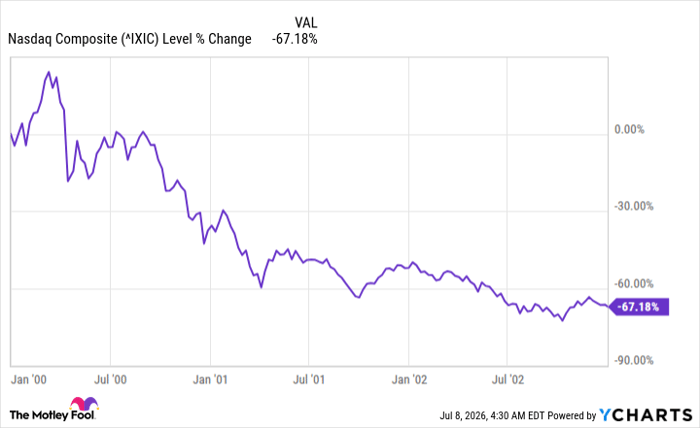
Is this a bubble? Most likely. But there's no telling when it will end. However, bubbles travel a fairly predictable path: displacement, boom, euphoria, profit-taking, and panic.
^IXIC data by YCharts
The displacement phase was the introduction of AI. The market is likely past the boom (the rapid increase in AI investment) and late in the euphoria phase, since AI has become such a big investment story. However, the rising concerns among investors that AI spending may have gotten ahead of itself, leading to periods of profit-taking, is a worry. And the ongoing debt-fueled spending increases the risk.
If profit-taking gains speed, it could tip into panic. At that point, investors will try to dump anything related to AI, from equity investments to debt investments. There's no way to know when that will happen, and the bubble could go on much further than anyone expects. But the timing of the bubble's end is getting closer, not further away. Let's just hope it deflates slowly and doesn't burst like the dot-com bubble, which took the Nasdaq down by nearly 80% before the selling finally subsided.
Should you buy stock in Space Exploration Technologies right now?
Before you buy stock in Space Exploration Technologies, consider this:
The Motley Fool Stock Advisor analyst team just identified what they believe are the 10 best stocks for investors to buy now… and Space Exploration Technologies wasn’t one of them. The 10 stocks that made the cut could produce monster returns in the coming years.
Consider when Netflix made this list on December 17, 2004... if you invested $1,000 at the time of our recommendation, you’d have $395,679!* Or when Nvidia made this list on April 15, 2005... if you invested $1,000 at the time of our recommendation, you’d have $1,294,805!*
Now, it’s worth noting Stock Advisor’s total average return is 929% — a market-crushing outperformance compared to 211% for the S&P 500. Don't miss the latest top 10 list, available with Stock Advisor, and join an investing community built by individual investors for individual investors.
See the 10 stocks »
*Stock Advisor returns as of July 11, 2026.
Reuben Gregg Brewer has no position in any of the stocks mentioned. The Motley Fool has positions in and recommends Amazon, Meta Platforms, and Nvidia. The Motley Fool has a disclosure policy.
Recommended Articles


