


The Risk Warren Buffett Considers Worse Than Holding Cash
Key Points
Warren Buffett says most investors' cash holdings are losing ground to inflation.
Yet, under his leadership, Berkshire Hathaway amassed a huge cash pile.
Adding some perspective and context to his advice will help investors better understand his thinking.
- 10 stocks we like better than Berkshire Hathaway ›
Warren Buffett has never been shy about voicing his opinion on idle cash. As he explained in an op-ed written for the New York Times during 2008's subprime mortgage meltdown, "Today people who hold cash equivalents feel comfortable. They shouldn't. They have opted for a terrible long-term asset, one that pays virtually nothing and is certain to depreciate in value." And he reiterated this stance not too long after that, saying, "The one thing I will tell you is the worst investment you can have is cash... cash is going to become worth less over time."
Except, the Oracle of Omaha wasn't taking his own advice when he stepped down as Berkshire Hathaway's (NYSE: BRKA)(NYSE: BRKB) CEO and chief stock-picker at the end of last year. By then, the company was sitting on a whopping $373.3 billion in uninvested cash -- roughly one-third of Berkshire Hathaway's total market cap. And under new CEO Greg Abel's leadership, this cash stash reached nearly $400 billion by the end of Q1. What gives?
Where to invest $1,000 right now? Our analyst team just revealed what they believe are the 10 best stocks to buy right now, when you join Stock Advisor. See the stocks »
Buffett's warning just needs context.
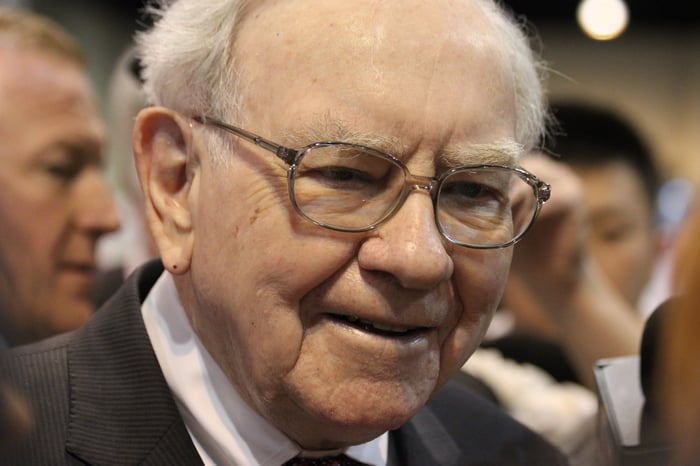
Image source: The Motley Fool.
The rest of the Berkshire cash pile story
You need to know two things about Berkshire's current cash hoard. First, most of it isn't actually cash. As of the end of March, the conglomerate held $339.3 billion in U.S. Treasury Bills, which are almost as liquid as cash but currently yield around 3.5%. That's not a huge annualized gain, but it is keeping pace with inflation. That's Buffett's primary concern.
Still, even high-yielding cash-like investments aren't the same as growth stocks and other income investments. Shouldn't Berkshire own more of these?
Maybe. But Buffett has addressed this too, and fairly recently. That's the second thing to know. In 2024's annual letter to shareholders, published in early 2025 (when Berkshire Hathaway's cash position first began really piling up), he noted, "Berkshire will never prefer ownership of cash-equivalent assets over the ownership of good businesses, whether controlled or only partially owned."
The word "good" is the key one here. Buffett -- and now Abel -- aren't seeing many quality prospects at a price they like that are unlikely to lose value; OxyChem and Taylor Morrison are recent rare exceptions.
And this leads us to the risk that Buffett considers worse than simply holding cash. As he said in a TV interview all the way back in 1985, "The first rule of an investment is 'don't lose.' And the second rule of an investment is 'don't forget the first rule.'"
If it's his very first rule, the risk of breaking it is clearly significant.
Not losing is at least as good as winning
That's not to suggest Berkshire never loses money on its picks. It does. Kraft Heinz comes to mind. So do the recent exits of Constellation Brands and Domino's Pizza. It happens. In the meantime, plenty of the conglomerate's holdings temporarily lose value.
Buffett has picked more winners than losers over the long run, though, and was smart enough to remain patient even when certain quality positions were struggling.
It's easier said than done, to be sure. Simply not suffering avoidable losses by buying ill-advised stocks, however, may be far more important than picking great ones, or even not just sitting on a bunch of cash.
Should you buy stock in Berkshire Hathaway right now?
Before you buy stock in Berkshire Hathaway, consider this:
The Motley Fool Stock Advisor analyst team just identified what they believe are the 10 best stocks for investors to buy now… and Berkshire Hathaway wasn’t one of them. The 10 stocks that made the cut could produce monster returns in the coming years.
Consider when Netflix made this list on December 17, 2004... if you invested $1,000 at the time of our recommendation, you’d have $409,970!* Or when Nvidia made this list on April 15, 2005... if you invested $1,000 at the time of our recommendation, you’d have $1,200,223!*
Now, it’s worth noting Stock Advisor’s total average return is 916% — a market-crushing outperformance compared to 210% for the S&P 500. Don't miss the latest top 10 list, available with Stock Advisor, and join an investing community built by individual investors for individual investors.
See the 10 stocks »
*Stock Advisor returns as of July 7, 2026.
James Brumley has no position in any of the stocks mentioned. The Motley Fool has positions in and recommends Berkshire Hathaway. The Motley Fool recommends Constellation Brands and Kraft Heinz. The Motley Fool has a disclosure policy.
Recommended Articles


