


SpaceX (SPCX) Price Forecast: In the Nasdaq-100 Now - What Happened to Palantir After Inclusion?
TradingKey - Space Exploration Technologies (NASDAQ: SPCX) officially became a Nasdaq-100 member on July 7, and the required purchases by QQQ and other Nasdaq-100 index-tracking funds have been finished. It is now trading at $158.77, or about 1% higher on the day, but it is still less than the $160.96 level that I mentioned in yesterday’s pre-inclusion analysis and much less than the $164.19 closing price after the announcement of the June 30 mobile partnership with Charter. It has an RSI (relative strength index) of 48.44, which is a neutral number, and is testing the bottom of the $149.92-$155.93 triple-bottom support level.
However, once the Nasdaq-100 inclusion is behind SPCX, there’s a shift in the discussion away from the index inclusion and more toward the stock. Palantir peaked in late December 2024 around its inclusion date, before dropping nearly 25% in the weeks following that. And Strategy, which peaked at an all-time high in November 2024, just one month before joining the index in December 2024, is down about 80% from its peak since joining. The next event that matters for the company will be the August 6 earnings release, which is also when the first expiration of lockups takes place.
The Historical Pattern: Why Nasdaq-100 Inclusion Is ‘Buy the Rumour, Sell the News’
Here are the facts on the historical impact of a stock’s inclusion in the Nasdaq-100. Truist equity strategist Sam Grelck analyzed the 30 largest IPOs over the last 15 years, noting that most (50%+) are trading below the IPO price by the end of the first week post-IPO and that 17 of the 30 were still in the red by six months. SpaceX is already trading below its $135 IPO price, though it recently came closer in its $158.77 price and its June 12 close. The most recent members of the Nasdaq-100 index show a similar trend.
Palantir peaked around its Dec. 23, 2024 inclusion date, and it subsequently fell by about 25% over the following weeks. Strategy reached an all-time high of nearly $543 in November 2024 before joining the index in December 2024.
That price is not yet reached for that firm, though it’s trading near $101. It’s a simple reason: Index funds must buy the new members in the Nasdaq-100 over a period of time, but then that buying activity stops once it’s done. After that, stock prices will move more or less on their own based on earnings, valuation and the investing public’s confidence in them.
And CoreWeave might represent a different kind of example to follow for the SPCX stock. CoreWeave, which was the best of the 30 largest IPOs over the last 15 years, still rose a total of 217% over a six-month span, even though it was down as much as 65% early in that period. SpaceX at $158.77 is still about 29.5% less than its peak price of $225.64, which means that it has already had a massive pullback or correction. There is still the matter of the $149.92-$155.93 triple-bottom support that is being held, with the support reinforced by an ascending trendline. If those lines are broken on the downside, investors will have to contend with a potential drop in price to the $135 IPO level before August 6 earnings, since there are no company-specific events of much import between now and then.
SPCX Technical Analysis
SPCX continues to hold support between $149.92 and $155.93 on RSI (48.44, neutral momentum). A close above $168.90 improves the outlook and targets $175.90, with a close below $149.90 breaking the setup.
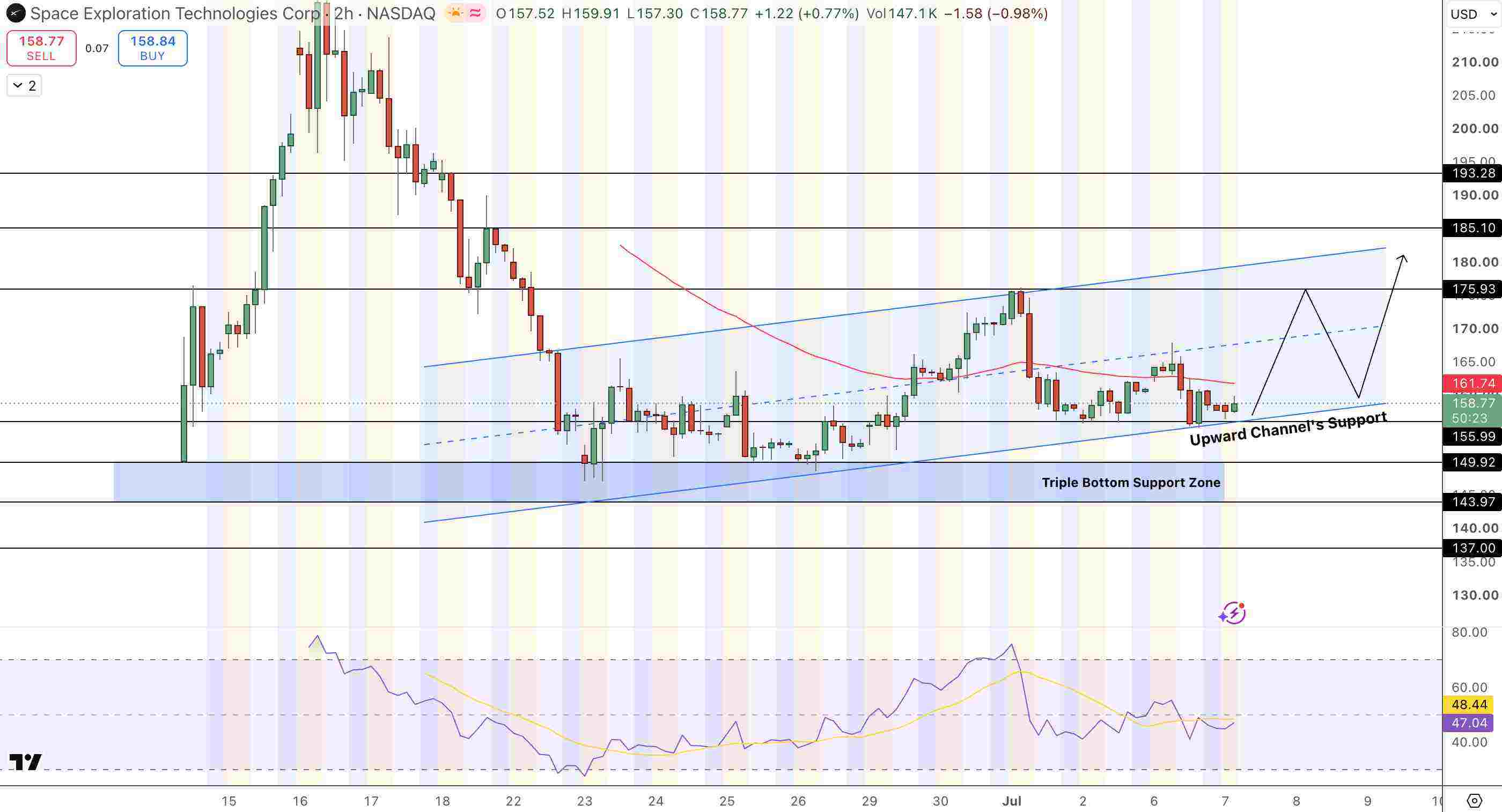
SpaceX (SPCX) Price Chart - Source: Tradingview
- Entry: Long above $168.90
- Target: $175.90
- Stop Loss: Close below $149.90
Key levels:
- Nasdaq-100 inclusion: Rebalancing completed on July 7
- xAI merger: Completed in February 2026, adding Grok and Colossus AI infrastructure
- Next catalyst: August 6 earnings and the first insider lockup expiration (20% of insider shares)
Did Nasdaq-100 Inclusion Move SpaceX Stock?
SPCX jumped about 1%, to $158.77 on July 7, when the SpaceX ticker made its way into the Nasdaq-100, but a lot of QQQ’s buying and that of other index-tracker funds had been done by the July 6 close and July 7 open, leaving the price little room to go. This has been the usual pattern, when inclusion is priced in ahead of time. For example, Palantir topped out right around its inclusion in December 2024, and then sold off 25% in the weeks after. Strategy hit its top right before inclusion.
What Did the xAI Merger Add to SpaceX?
The February 2026 merger added Grok, the Colossus AI data center platform (for major AI compute contracts, Anthropic and Google), and AI infrastructure management to existing Starlink and launch businesses. Colossus supports the company’s major AI compute contracts (Anthropic, Google). It was not just an aerospace launch company any longer, and this helps explain why the company is trading at a higher multiple than a traditional launch provider.
Why Is August 6 Important for SPCX?
August 6 is the first public earnings for SpaceX, plus the first lockup expiration. About 20% of the insiders can sell their stock then; another 10% can join the pool, if conditions tied to the IPO price for SpaceX is reached. Both the earnings report (revenues, margins, Starlink subscriber growth) and the increase of stock tradability and the resulting effect on supply-demand will be watched closely by the investors.
Bottom Line
SPCX has completed the Nasdaq-100 inclusion, and the stage now is for the fundamentals of the company. Support has held well at $149.92-$155.93, and with the February 2026 xAI merger, the business was augmented to include AI infrastructure in addition to Starlink and launch. The next big catalyst is the August 6 earnings report and first lockup expiration. Technically, if the stock trades above $168.90, that can open a run-up to $175.90; if it closes below $149.90, that spells trouble for this formation.
Recommended Articles


