


The Russell 2000 Just Did Something for the First Time Since 1991. Here's Why Investors Should Pay Attention.
Key Points
The Russell 2000 has now lagged the broader market for many years.
Small-cap stocks tend to perform well during periods of lower interest rates and economic expansion.
But a new dynamic appears to be in play.
- These 10 stocks could mint the next wave of millionaires ›
The small-cap Russell 2000 has long underperformed the broader market, as large tech and, more recently, artificial intelligence (AI) stocks have siphoned off investor flows.
That's why investors will likely be surprised to learn that the Russell 2000 significantly outperformed the broader market over the first six months of the year. In fact, the Russell 2000's 22% first-half gain is its best first-half performance since 1991.
Missed Nvidia in 2009? This Rare Signal Is Flashing Again. In 2009, a "Double Down" signal flashed for a little-known chipmaker called Nvidia. For the first time in years, that same "Total Conviction" signal is flashing for a company 1/100th the size of Nvidia. Continue »
Interestingly, this is not entirely a traditional Russell 2000 outperformance story. Like much of the market, the index has changed. Here's why investors should pay attention.

Image source: Getty Images.
AI is broadening
Historically, the Russell 2000 has been composed of companies with higher debt levels but greater growth potential than large caps. This gives the group exposure to interest rates, as lower rates mean lower interest payments on variable-rate debt.
Additionally, smaller companies tend to outperform when the economy is firing on all cylinders because consumers have more disposable income and businesses and enterprises invest more.
But this is not the story that has played out over the past decade. Large tech stocks have set a new bar, defying the law of large numbers and continuing to grow revenue, earnings, and free cash flow at a fast clip even as they get bigger.
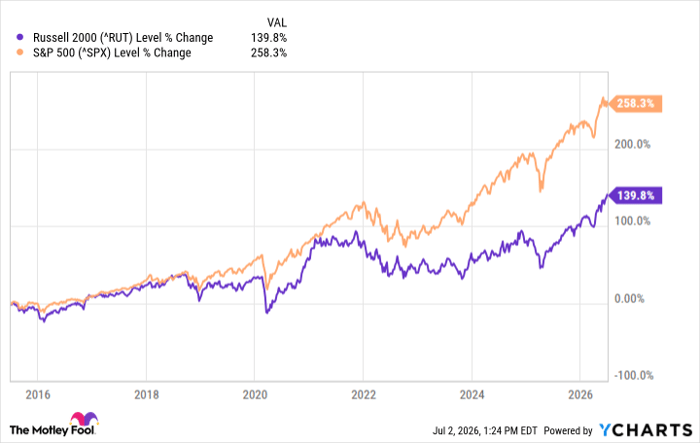
Data by YCharts.
Artificial intelligence seemed to exacerbate this trend, making groups like the "Magnificent Seven" no-brainer buys. But this year, investors have rotated into the Russell 2000 as the valuation gap has widened and the effects of AI have begun to ripple through the economy.
"I think a significant part of the small-cap story is tied to AI," Amy Zhang, a portfolio manager at Alger, said, according to CNBC. "The impact of AI investment trickles down from large-cap leaders to small-cap companies. The effect will be more amplified for small-cap companies, in terms of revenue and probability growth."
Over 30% of the top 50 strongest performers in the Russell 2000 are companies associated with semiconductors, per CNBC.
We've already seen this trend play out in large caps, where the AI trade has broadened, sending stocks in the AI supply chain soaring as chip clusters scale. Memory companies and those that make hardware connecting chips and data centers, and also help them communicate with one another, have soared.
This appears to be what's happening at the small-cap level, too. Ichor Holdings, a company that makes parts used in semiconductor manufacturing, has risen over 433% this year.
Of course, a cohort of investors has also rotated out of large-cap AI stocks due to concerns about valuations, a potential slowdown in investment, what returns on all this investment could look like, and broader concerns about the technology itself.
The Russell, which has long trailed the S&P 500, served as a good place to move money into.
Why investors should pay attention
Investors should understand that as AI broadens across the economy, it will be harder to avoid exposure to it, making more investors beholden to the AI cycle. Some investors may like this trend, while others will seek to avoid it.
That said, the index could have more room to run, given its struggles over the years relative to other indexes and the fact that small caps have historically outgrown large caps. The AI cycle has not slowed down despite significant investor concern, so if it continues, it could trigger a supercycle for the Russell 2000.
It's also quite possible that AI tools could increase productivity at smaller companies, boosting profits. It's still risky because higher interest rates, an economic downturn, or a slowing of AI investment would likely hit the Russell 2000 hard.
But if you are a long-term investor and want to be in the market, it's best to diversify as much as possible, even if that means diversifying within AI itself. The S&P 500 has become incredibly concentrated, so if you do have a lot of money invested in the broader market, shifting some to areas like the Russell 2000 is not a bad idea.
Where to invest $1,000 right now
When our analyst team has a stock tip, it can pay to listen. After all, Stock Advisor’s total average return is 918%* — a market-crushing outperformance compared to 208% for the S&P 500.
They just revealed what they believe are the 10 best stocks for investors to buy right now, available when you join Stock Advisor.
See the stocks »
*Stock Advisor returns as of July 6, 2026.
Bram Berkowitz has no position in any of the stocks mentioned. The Motley Fool has no position in any of the stocks mentioned. The Motley Fool has a disclosure policy.
Recommended Articles


