


Sandisk Stock Is Up More Than 6,000% Since Spinning Off From Western Digital. Is a Stock Split on the Horizon?
Key Points
Sandisk started trading as an independent company on the Nasdaq for around $38 per share.
Sandisk is the top-performing stock in the Nasdaq-100 so far in 2026.
Sandisk stock trades north of $2,000 per share, making it look expensive to everyday market participants.
- 10 stocks we like better than Sandisk ›
Following its spinoff from Western Digital last February, Sandisk (NASDAQ: SNDK) has delivered one of the most extreme stock performances in recent memory. Sandisk stock initially hit the Nasdaq at roughly $38 per share as an independent company. Yet over the last year and a half, shares have surged more than 6,000%.
This explosive rise has been fueled by strong demand for flash memory in artificial intelligence (AI) and data center applications. With Sandisk stock trading at more than $2,200 per share, smart investors are naturally wondering whether the company might soon pursue a stock split to manage the elevated share price.
Missed Nvidia in 2009? This Rare Signal Is Flashing Again. In 2009, a "Double Down" signal flashed for a little-known chipmaker called Nvidia. For the first time in years, that same "Total Conviction" signal is flashing for a company 1/100th the size of Nvidia. Continue »
Image source: The Motley Fool.
Looking at the mechanics of stock splits
A stock split occurs when a company increases the number of its outstanding shares while proportionally reducing the price per share, leaving the overall market capitalization unchanged. In a 2-for-1 split, each existing share is replaced by two new shares, and the price is cut in half.
Investors receive the additional shares automatically through their brokerage accounts on the effective date. The stock split process is purely mechanical and does not alter a company's underlying business model, earnings profile, or ownership structure.
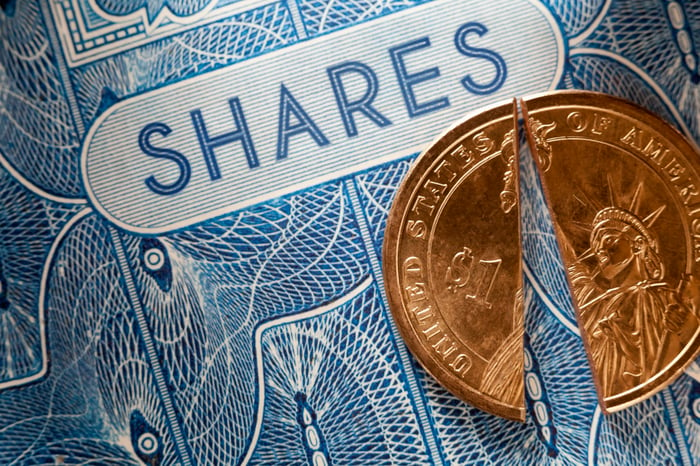
Image source: Getty Images.
Why do companies implement stock splits?
One of the biggest reasons a company pursues a stock split is to enhance accessibility and liquidity. A high share price like Sandisk's can psychologically deter retail investors, as they tend to feel uncomfortable purchasing shares costing thousands of dollars each. By lowering the per-share price in terms of absolute dollars, splits help broaden a company's investor base. In turn, this increases trading volume and improves the stock's visibility among smaller investors.
In addition, stock splits can signal management's confidence in the company's growth trajectory. In other words, announcing a split after a sharp, prolonged run-up can be interpreted as a positive sign that management expects the higher share count to be absorbed.
Is Sandisk a good stock split candidate?
At more than $2,000 per share, Sandisk's stock sits above the range most retail investors comfortably buy. A split would bring Sandisk's price into the low hundreds, which is a psychologically friendlier level that could draw additional buyers. Given the company's trajectory and its emerging role in AI infrastructure, rising participation from retail investors might help sustain Sandisk's momentum and reduce its reliance on a concentrated base of institutional portfolios.
Operationally, however, Sandisk won't gain anything meaningful from a stock split. A split doesn't change the company's manufacturing capacity, technology roadmap, customer contracts, or its cost structure.
Rather, it is a financial engineering exercise that brings modest administrative and legal expenses without improving competitive dynamics. The main benefit of stock splits revolves around behavioral finance and distribution: Making the stock appear more approachable expands the shareholder base and potentially supports a higher valuation multiple over the long term.
With the share price already having multiplied dramatically since its February 2025 listing, a split could be constructive for Sandisk, helping it maintain high trading engagement without incurring any material downside. Ultimately, whether a split makes sense will depend on management's priorities.
Yet when we look at other high-growth companies, they've all opted for stock splits when their stock prices went above a certain threshold. Amazon and Nvidia are prime examples of this.
But also keep also in mind that a stock split does not change Sandisk's valuation or growth trajectory; investors should consider building a position in the AI leader over a long-term horizon rather than waiting for a better entry price.
Should you buy stock in Sandisk right now?
Before you buy stock in Sandisk, consider this:
The Motley Fool Stock Advisor analyst team just identified what they believe are the 10 best stocks for investors to buy now… and Sandisk wasn’t one of them. The 10 stocks that made the cut could produce monster returns in the coming years.
Consider when Netflix made this list on December 17, 2004... if you invested $1,000 at the time of our recommendation, you’d have $418,761!* Or when Nvidia made this list on April 15, 2005... if you invested $1,000 at the time of our recommendation, you’d have $1,195,804!*
Now, it’s worth noting Stock Advisor’s total average return is 918% — a market-crushing outperformance compared to 208% for the S&P 500. Don't miss the latest top 10 list, available with Stock Advisor, and join an investing community built by individual investors for individual investors.
See the 10 stocks »
*Stock Advisor returns as of July 3, 2026.
Adam Spatacco has positions in Amazon and Nvidia. The Motley Fool has positions in and recommends Amazon, Nvidia, and Western Digital. The Motley Fool has a disclosure policy.
Recommended Articles


