


1 Major Warning Flag AMD and Intel Investors Can't Afford to Ignore
Key Points
Intel still has a long way to go before the foundry business is back.
AMD doesn't have the growth that Nvidia does.
- 10 stocks we like better than Intel ›
If you've invested in AMD (NASDAQ: AMD) or Intel (NASDAQ: INTC) over the past year, you're likely a very happy investor. Intel has risen about 480%, and AMD has risen around 280% over the past 12 months. Those are major gains, but not all stock gains are created equally.
Sometimes, stocks go up for odd or technical market reasons (think about some of the stocks driven by posters in the WallStreetBets subreddit or meme stocks). Other times, companies are growing rapidly, so the market values them differently. Or investors might be willing to pay more for a stock for a different reason.
Where to invest $1,000 right now? Our analyst team just revealed what they believe are the 10 best stocks to buy right now, when you join Stock Advisor. See the stocks »
A company growing sustainably is the best scenario for investors. Investors can get burned when a stock looks like it's doing well but the business behind it isn't living up to expectations.
I think that's exactly where AMD and Intel inventors find themselves now, and if they're not careful, all of the gains may be for nothing.

Image source: Getty Images.
AMD and Intel are turnaround plays
Both AMD and Intel were, and arguably still are, losing in their primary industries. Intel has two major businesses: its own chip line and a semiconductor business. On the chip side, Intel is still the industry standard, though AMD is pushing it as the top processor provider. However, this isn't a major growth area, and Intel's best chance to grow is through its foundry business.
The problem is Intel's foundry business lacks clients because most of them use Taiwan Semiconductor. That may be changing in the future, as U.S. President Donald Trump recently announced that Apple and Intel have a deal to make chips. We'll see if that pans out; it would be one of Intel's first major customer wins in a long time if it's true. Still, Intel has a long way to go before investors can truly claim that it's back.
AMD was never really down on its luck; its products were just inferior to those from Nvidia. But AMD has launched a few exciting new products that help it better compete against Nvidia.
Still, the problem is that Nvidia has such a large share of the AI infrastructure market that it's difficult for companies to switch from Nvidia to AMD products. This may shut AMD out of a lot of businesses and make it difficult to expand. Still, AMD has landed several major contracts with companies like OpenAI, so all hope is not lost. But when you compare AMD's growth rates to Nvidia's, they just don't match.
During each company's most recent quarter, AMD's data center division grew at a 57% pace. Nvidia grew at a 92% pace. That's a huge mismatch and shows that Nvidia is still the company to beat in its industry.
AMD and Intel have premium valuations
What concerns me are the stocks' prices compared to estimates for future earnings. The forward price-to-earnings ratio accounts for future growth in a stock's valuation. So, if a stock is overvalued from this perspective, that means its earnings must grow substantially in 2027 and beyond.
Given the industries and growth rates Intel and AMD are experiencing, I'd expect them to trade at around 25 to 30 times forward earnings estimates. However, both are valued far higher than that.
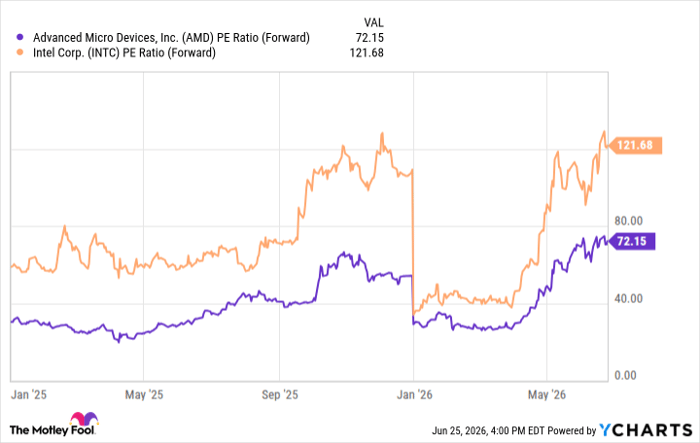
AMD PE Ratio (Forward) data by YCharts
For AMD to come to a reasonable level, it must nearly triple its earnings starting in 2027. For Intel, it has to deliver even greater earnings growth.
Considering the growth rates these two are putting up right now (AMD grew revenue at a 38% pace and Intel at a 7% clip), that's far too high a price for investors to pay. Investors would be far better off buying their primary competitors' stocks (like Nvidia or Taiwan Semiconductor), as these two are better-priced and still beating AMD and Intel. The market thinks they have already won.
Should you buy stock in Intel right now?
Before you buy stock in Intel, consider this:
The Motley Fool Stock Advisor analyst team just identified what they believe are the 10 best stocks for investors to buy now… and Intel wasn’t one of them. The 10 stocks that made the cut could produce monster returns in the coming years.
Consider when Netflix made this list on December 17, 2004... if you invested $1,000 at the time of our recommendation, you’d have $400,101!* Or when Nvidia made this list on April 15, 2005... if you invested $1,000 at the time of our recommendation, you’d have $1,212,683!*
Now, it’s worth noting Stock Advisor’s total average return is 911% — a market-crushing outperformance compared to 208% for the S&P 500. Don't miss the latest top 10 list, available with Stock Advisor, and join an investing community built by individual investors for individual investors.
See the 10 stocks »
*Stock Advisor returns as of July 2, 2026.
Keithen Drury has positions in Nvidia and Taiwan Semiconductor Manufacturing. The Motley Fool has positions in and recommends Advanced Micro Devices, Apple, Intel, Nvidia, and Taiwan Semiconductor Manufacturing. The Motley Fool has a disclosure policy.
Recommended Articles


