


Will SpaceX Soar After It Joins the Nasdaq-100? History Offers a Compellingly Clear Answer.
Key Points
SpaceX is the first to benefit from the new “fast track” rule, allowing certain companies to enter the Nasdaq-100 after 15 days of trading.
SpaceX completed its IPO last month.
- 10 stocks we like better than Space Exploration Technologies ›
Space Exploration Technologies (NASDAQ: SPCX) delivered one of history's biggest stock market events just recently: the largest initial public offering ever. SpaceX, raising $75 billion in the operation, then saw its shares rise nearly 20% from the $135 offer price on its first day of trading. And the exercise of an overallotment option brought the total of funds raised to more than $85 billion.
Since that time -- the IPO was on June 12 -- all eyes have been on SpaceX stock. Investors may be intrigued by the offer itself, but also by the company's leader, Elon Musk, and his ambitious projects. Now, a new milestone lies right around the corner. SpaceX is set to join the Nasdaq-100, an index including the largest non-financial companies on the Nasdaq, on July 7.
Where to invest $1,000 right now? Our analyst team just revealed what they believe are the 10 best stocks to buy right now, when you join Stock Advisor. See the stocks »
Will SpaceX soar after that time? History offers a compellingly clear answer.

Image source: Getty Images.
An interesting mix of businesses
First, let's consider why investors are so interested in SpaceX -- and this has to do with the company's interesting mix of growth businesses and its leadership. SpaceX is, as the name suggests, an expert in rocket launches. It aims to make launches cheaper and more efficient through its reusable technology -- and so far, it's made significant progress here. For example, NASA says that SpaceX's Falcon 9 back in 2010 reduced launch costs by a mind-boggling 85%. The goal now is to reduce costs by more than 99%, and a key step is just ahead: SpaceX aims to launch its fully reusable spacecraft, Starship, with payloads later this year.
SpaceX's second business is also closely linked to space: It's the satellite-based connectivity unit, Starlink, and is currently the company's biggest revenue driver. Last year, it brought in $11.4 billion on SpaceX's total of $18 billion. And Starlink membership, soaring from 2.3 million three years ago to more than 10 million today, offers us reason to be optimistic about growth.
Finally, SpaceX's third business is artificial intelligence (AI). Now, this might not seem space-related -- but it actually is. One of this unit's goals is to operate data centers in space, and the practical -- and cost-saving -- part of this is that SpaceX may use its own rockets to make this happen. And SpaceX also may use its rockets for the transport needs of Starlink.
Elon Musk at the helm
So SpaceX's businesses are diversified, yet they are complementary at the same time. And each may deliver a considerable amount of growth. Some investors also like the idea that Elon Musk is at the helm since he is known for being ambitious and innovative.
All of this is very positive, but it's also important to keep in mind that some of SpaceX's biggest goals involve technology that hasn't been fully developed or proven. And in order to develop that technology, SpaceX must invest billions of dollars. In fact, capital expenditures for its AI business last year reached $12 billion and helped push the company to a net loss. All of this represents risk. So even though SpaceX may be an exciting company, it's not the best investment for every investor, particularly at today's price.
At the current level, the stock trades at more than 100x sales, so it isn't cheap.
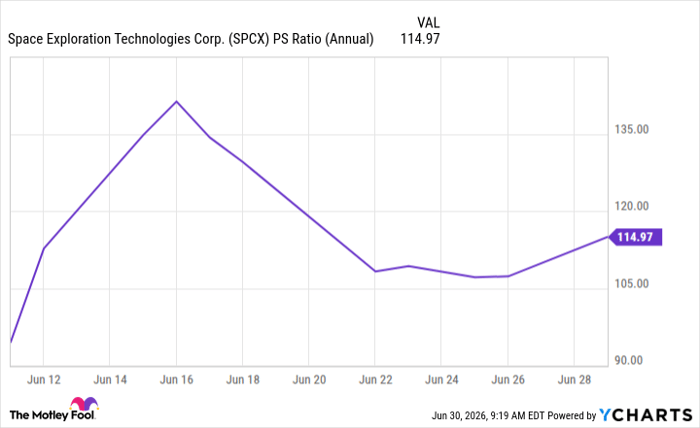
SPCX PS Ratio (Annual) data by YCharts
Entering the Nasdaq-100
Now, let's consider the upcoming Nasdaq-100 entry. This is due to the new "fast track" procedure that offers companies admission after only 15 trading days -- as long as they are among the 40 biggest in the index in terms of market value. SpaceX makes the cut and will join as of July 7. This means that funds tracking the Nasdaq-100 must add SpaceX shares, and this buying activity may lift the stock.
But this doesn't necessarily mean the stock will soar, as history shows us. A look at recent Nasdaq-100 additions -- added June 22 of this year -- didn't result in significant gains for those players.
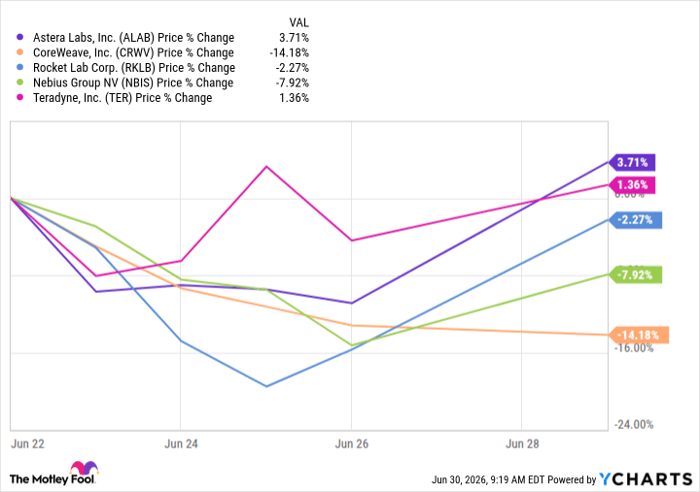
ALAB data by YCharts
A look back farther in time, to 2024, when Palantir Technologies, Strategy, and Axon Enterprise joined the Nasdaq-100, shows all three actually declined in the 10 days to follow.
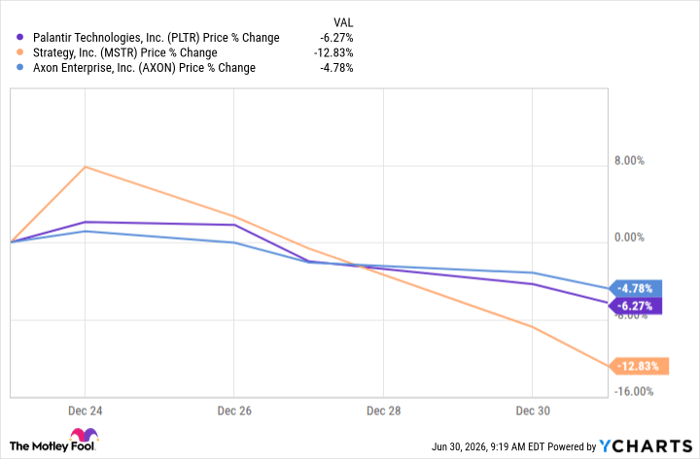
PLTR data by YCharts
So, while SpaceX could see a slight pop, as funds scoop up the shares, significant positive movement isn't guaranteed. What does this mean for you? In any case, short-term stock movements shouldn't be a concern. When investing, it's crucial to hold onto stocks for the long term, at least five years, to truly benefit from the company's growth. So, you shouldn't worry about buying SpaceX before a particular event, such as this Nasdaq-100 entry.
Instead, it's a better idea to take your time and consider the company's upcoming earnings reports before deciding whether to get in on this exciting but risky stock.
Should you buy stock in Space Exploration Technologies right now?
Before you buy stock in Space Exploration Technologies, consider this:
The Motley Fool Stock Advisor analyst team just identified what they believe are the 10 best stocks for investors to buy now… and Space Exploration Technologies wasn’t one of them. The 10 stocks that made the cut could produce monster returns in the coming years.
Consider when Netflix made this list on December 17, 2004... if you invested $1,000 at the time of our recommendation, you’d have $385,055!* Or when Nvidia made this list on April 15, 2005... if you invested $1,000 at the time of our recommendation, you’d have $1,228,089!*
Now, it’s worth noting Stock Advisor’s total average return is 902% — a market-crushing outperformance compared to 209% for the S&P 500. Don't miss the latest top 10 list, available with Stock Advisor, and join an investing community built by individual investors for individual investors.
See the 10 stocks »
*Stock Advisor returns as of July 2, 2026.
Adria Cimino has no position in any of the stocks mentioned. The Motley Fool has positions in and recommends Axon Enterprise, Palantir Technologies, Rocket Lab, and Teradyne. The Motley Fool recommends Astera Labs. The Motley Fool has a disclosure policy.
Recommended Articles


